The first CD opens
with Bax’s Folk-Tale for cello
and piano. At nearly ten minutes in
length, this is more than a miniature.
Peter J. Pirie finds it a little difficult
to pin down – he suggests that it is
"a piece with [a] legendary atmosphere,
somewhat Keltic (q.v.), somewhat Nordic
in the manner of Sibelius’s En Saga.’
This work was written in 1918 – towards
the conclusion of the Great War and
at a time when the composer’s ‘innocent’
views on Ireland had taken a considerable
knocking. It was the same year that
the composer left Elsita Sobrino for
Harriet Cohen. This is no bucolic folk-tale
– but a tragic and melancholy reflection
on Bax’s life and the world he found
himself in.
Rob Barnett is correct
in identifying the ‘tender almost fragile
lyricism’ of this work, however, like
the Sonatina this is a deeper
and more complex work than the title
would suggest. There is sadness about
this Folk-Tale that is almost
oppressive. Finally, on the score in
handwriting that is not Arnold Bax’s
is written Conte Populaire. This
is surely a totally inappropriate reading
of this work!
The Cello Sonata
is an amazing work. I guess that I must
be careful not to use too many superlatives
in the review of this disc; else readers
may think I have shares in the company!
However I am astounded that there are
only two recorded versions of what is,
even to the most jaded ear, a masterwork.
It must surely count as one of Bax’s
most important and characteristic works.
As a matter of interest, there are some
59 versions of the (great) Rachmaninov
Cello Sonata currently listed
on Arkiv.
Peter J. Pirie gives
a fine analysis of this work – so I
will just highlight a few points. Firstly
it is a long work – lasting more than
half an hour. And as a result of this
it does need a degree of application
and engagement by the listener. Yet
the time lies easily – for the work
is actually not a moment too long. The
balance of the part is perfect.
The opening of the
Sonata is like a conspectus of
Baxian fingerprints –"two bars
of arpeggio, like a harp preamble, a
group of dissonant chords in hammered
rhythm, feroce martellato, a
further quiet arpeggio culminating in
a soft deep bass chord, and the cello
entering dramatically…"
What impresses me most
of all, is the work’s sheer lyricism.
Bax delivers some of his most beguiling
tunes - I think especially of one of
the episodes in the final movement.
But at every turn there are gorgeous
themes. Sometimes they almost seem to
topple over one another. This applies
especially to the slow movement, the
‘poco lento’, but it is no less apparent
in the ‘epilogue’ section of the last
movement.
Since first hearing
these recordings some 35 years ago I
have been especially taken by the Sonatina.
So often the use of this word suggests
something ephemeral or perhaps designed
for neophytes. Yet most listeners would
never dream of putting the essays by
Ravel and Ireland into this category.
And neither should the Bax Sonatina
be ignored or deemed as somehow inferior
to the masterly and monumental Cello
Sonata.
The Sonatina is
just over quarter of an hour long, yet
manages to encompass a wide range of
material and a depth of emotion considerably
greater than the scale of the work would
suggest. Rob Barnett is right in suggesting
that this is a ‘gentle work’ however
I believe that there is a depth and
a yearning in the slow movement in particular,
and the other two movements in general
that is much less than gentle. Bax is
wearing his heart on his sleeve in more
than one passage in this work. Perhaps
Pirie is correct in describing the opening
movement as being ‘ardent’ and he notes
the "fiercely descending first
subject…" Yet the heart of this
work must be the ‘andante’. This is
written as a ‘three part song’ nevertheless
the balance of the parts is challenging.
The middle section is considerably erratic
and quite complex: there is almost a
feeling of disintegration. However the
opening ‘song’ is finally recovered
and is re-presented an octave lower
with a more elaborate accompaniment.
Of course there is more than a hint
of folksong about this movement…
The ‘rondo allegro’
is a charming piece. It more of a set
of variations than a formal rondo and
manages to sum up much that has gone
before in the previous movements. If
I was able to rename this work I guess
I would call it A Short Sonata
rather than risk consigning it to obscurity
with the word Sonatina.
Bax’s relatively late
Legend-Sonata for cello and piano
was written in 1943. I guess that when
I first heard this piece I imagined
it to be something along the lines of
The Tale the Pine Trees Knew
– an exploration of some Celtic derring-do.
However, this is a relaxed work in comparison
to much that Bax wrote in the first
thirty years of the twentieth century.
The composer may have had his own personal
reasons for describing this work as
a ‘Legend’ however this piece is totally
successful as purely absolute music.
Pirie suggests that this work is endued
with "a certain rich creative contentment".
The sleeve-notes give
a detailed outline of the form and progress
of this work that bears study. Interestingly,
Pirie compares the first main theme
to that of the first movement of Elgar’s
Cello Concerto – I am not so
sure. Although this first movement has
the appurtenances of ‘sonata’ form there
is, like so much of Bax’s music a feeling
of ‘phantasy’. This is a lovely opening
movement that ends quietly. The second
movement is a ‘lento espressivo’ which
does not really change the mood of what
has preceded it. Bax uses, as one of
the principal themes, what sounds like
a folk-tune that could easily have come
from the pen of Jack Moeran. This music
pervades the entire movement: the effect
is music of heart rending beauty. This
is surely one of the loveliest things
that Bax ever wrote. However this mood
of introspection is cast aside by the
‘rondo.’ This is a tune that is "built
up on a flick of semiquavers."
It is really a classically constructed
rondo that hardly deviates from the
textbook. However Bax does introduce
some rather interesting and sometimes
disturbing music. There is one gorgeous
episode that surely harks back to the
slow movement. The work ends with "a
flick of a diabolical tail".
Surely this is one
the composer’s great chamber works and
deserves to be better known by all Baxians
and English music enthusiasts.
The other two works on this two-CD collection
are by the English composer Gordon Jacob. Jacob has been almost
wholly sidelined in recent years, although a fair few of his works
are now beginning to see the light of day on CD. His Elegy
is a deeply sad and moving work. It was written in 1958 in memory
of the composer’s father, Stephen, who had died when Jacob
was only three years old. Geoff Ogram has pointed out to me, that
Richard Itter speaking on Radio 3, about the Lyrita Story, noted
that the original Jacob LP (RCS2) with the cello works and Piano
Sonata was the first to be issued by that company and that the
composer wrote the Elegy especially for the recording to "fill
a gap". Jacob dedicated this work to Florence Hooton. The
programme notes point out that this is a genuine ‘elegy’ rather
than a contrived piece with a ‘perfunctory title’. An elegy can
be defined as a poem of mourning, from the Greek 'elegos', or
perhaps as a reflection on the death of a loved one or even sorrow
generally. In music it is usually seen as being sad and sombre
in mood. Jacobs work fits all these criteria.
From the first note
to the last the mood of mourning is
largely unrelieved. Only very occasionally
is there any relief, any suggestion
of consolation. Yet the work does end
‘tranquillo’ and perhaps the soul is
finally given rest?
Any work for solo cello
is bound to be referential to those
masterpieces by J.S. Bach and for a
later generation to Kodály and
Britten. There are relatively few works
for this genre - apart from the two
mentioned - and one instinctively thinks
of William Walton’s Passacaglia
and Kodaly’s Sonata for solo
cello. So Gordon Jacob’s Divertimento
ought to fill a gap in the repertoire.
This is a ‘serious divertimento’ especially
the heart of the work which is a long
improvisation that certainly explores
considerable emotional depth. Yet the
other three movements are much more
in line with the popular idea of the
form. The opening ‘prelude’ gets the
work off to a flying start. But perhaps
the ‘minuet and trio’ comes closest
to JSB in spirit – but look out for
the pseudo-Spanish guitar effects. Perhaps
the work is summed up in the conclusion
by the skittish ‘rondino.’ This is perhaps
the most ‘modern’ part of the divertimento
– where Jacob pushes the boundaries.
There are some truly inspiring and interesting
‘noises’ in this movement. The player’s
technique is pushed to the limits.
I was brought up on
this particular version of the Bax (and
the Jacob!). But naturally the vinyl
has tended to remain on the shelf over
recent years. In fact I guess I had
not listened to Florence Hooton and
Wilfred Parry playing this work since
Bernard Gregor-Smith and Yolande Wrigley
issued their fine recording on ASV.
However I am delighted that I can have
this Lyrita disc back in my ‘active’
collection. Rob Barnett discusses Hooton
and her career as a pendant to his excellent
review on these pages: suffice to say
that in spite of the sound quality being
a little lacking, there is a magic about
these recordings – especially Bax’s
Sonatina and Sonata -
that will possibly never be repeated
in subsequent performances.
John France
see also review
by Rob Barnett
























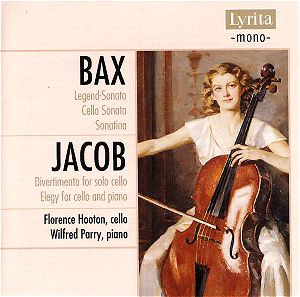
 Florence Hooton (cello); Wilfred Parry
(piano)
Florence Hooton (cello); Wilfred Parry
(piano) 
