If you’ve followed Sir Charles Mackerras’s releases of late, you’ll
be well aware that his recent Beethoven cycle on Hyperion with
this orchestra (apart from No.9) was greeted with pretty universal
acclaim. This new two disc set of Mozart’s four last symphonies
has also been very warmly welcomed from just about every quarter,
and it’s easy to hear why.
I have been a
fan of various performances from Mackerras’s previous Mozart
cycle on Telarc for many years (especially 40 and 41), and
in many ways he proves to be his own most serious competitor.
The basic approach to the music is remarkably similar, and
the playing of the Prague Chamber Orchestra is first rate.
However, there are a few things that jump out immediately
and raise the bar on the newer set. One is the recording,
which I always felt on Telarc to be a shade reverberant and
a touch too distant; this is borne out by A/B comparison with
the new, where the balance and acoustic are just about perfect
to my ears. The orchestral detail emerges with phenomenal
clarity, and it really does feel as if you have your favourite
seat in an excellent concert hall. Then there is the actual
playing, which is not necessarily better from the Scottish
Chamber Orchestra, just a bit more characterful in every department.
The strings are a touch less strident, having great unanimity
but a degree of warmth, and the all-important wind writing
is delivered with great aplomb and virtuosity.
As I say, Mackerras’s
speeds and phrasing are very similar to before, but he does
find certain details that can only come from years of experience
and living with great music. He still favours brisk speeds,
taut rhythms and a playing style which sits fairly comfortably
between ‘authentic’ and modern, especially with regard to
vibrato, of which he allows a judicious – and welcome – use.
One might take issue with some of the minuets, say, which
are sometimes (as in the ‘Jupiter’) so quick as to
miss a degree of underlying seriousness. But just as quickly,
if one compares this approach to more hard-line interpretations,
such as the recent René Jacobs/Freiburg Baroque (Harmonia
Mundi) or, even more extreme, Jos van Immerseel/ Anima Eterna
(Zig Zag), one realizes that Mackerras is spot-on, with none
of the almost absurd extremes indulged in by both those conductors
in places. The question of repeats is a tricky one, and Mackerras,
as before, opts for all repeats in all movements. Again, some
may question the need for this in every piece - especially
second half repeats - but it does seem right in the first
movements, especially the ‘Prague’, which runs to 18
minutes and suddenly appears to have a real Beethovenian grandeur.
I suppose this is where the brisk speeds help to keep any
negative feelings of ‘heavenly length’ at bay, because one
simply marvels all over again at Mozart’s invention and inspiration.
I think Mackerras
judges the introduction to Symphony 39 to perfection; it’s in
keeping with modern thinking in being fairly fast, but still sounds
magisterial, unlike Immerseel, who goes at such a breakneck pace
that any inherent stateliness is rather undermined. Once again
in this glorious work, one can hear Mackerras the ex-bassoonist
coaxing wonderful things from his players, as in the exquisite
overlapping lines of the andante (track 5, 6:40 onwards).
It all adds up to a performance sounds just right. The G minor
has an intensity and sweep that simply bowl you over, and Mackerras
seems to see the journey through these late works as a cumulative
one, leading inexorably to the famous ‘Jupiter’, with its
astonishing technical originality. His earlier recording of this
piece was good, but this is breathtaking; I’ve never heard the
counterpoint of that incredible finale so crystal clear, yet retaining
an almost improvisatory flair and abandon. This is playing that
makes you simply think of Mozart the magician, never of attention-grabbing
gestures.
It all adds up to
a great achievement, a set worthy to stand as a benchmark for
our time. Mozart scholar Neal Zaslaw’s liner-note and the superb
artwork and packaging, to say nothing of the mid-price, simply
seal the recommendation.
Tony Haywood






















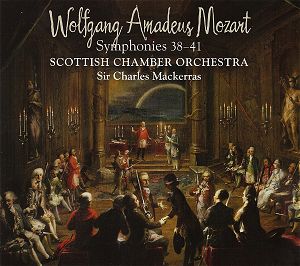

 Scottish Chamber
Orchestra/Sir Charles Mackerras
Scottish Chamber
Orchestra/Sir Charles Mackerras  [66:49 + 72:29]
