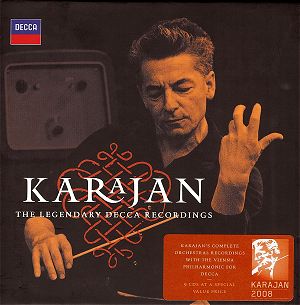
Issued to celebrate the conductor’s centenary this year,
this seems to be a straightforward repackaging of the 1995 compilation
“Karajan - The Great Decca Recordings”. Karajan’s association
with Decca was productive but brief, with all these recordings,
plus classic opera sets such as Aida, Otello or
Tosca, being set down under John Culshaw’s watchful eye
in the late 1950’s/early 1960s. At this stage Decca was at the
forefront of recording technology and the excellent quality of
the sound is much in evidence. Clarity coupled with richness of
sound, plus a believable concert-hall ambience, create a backdrop
for playing that for the most part is full of character and colour.
It’s
of necessity a slimmer volume than comparable offerings from
EMI or DG – at the height of his career (from between around
1965 and 1985) Karajan was to concentrate largely on recording
(and re-recording) much of this repertoire with the Berlin
Philharmonic for those rival labels. Towards the end of his
life, as relations with the BPO cooled, he was to work closer
with the Vienna Philharmonic again. This Decca set, therefore,
represents a snapshot of the younger Karajan at the height
of his powers, and a kind of half-way point between his Philharmonia
and Berlin periods.
The
two Haydn and Mozart symphonies are performed with a combination
of traditional Viennese suavity and power which I felt was
occasionally foreign to the music. Karajan emphasises the
grandeur in Haydn with unashamedly big-band readings. With
the Mozart, there is no shortage of drama in the G minor,
and the Jupiter is played in the grand style; but we
have moved on in our approach to these composers in the last
fifty years and these recordings, while interesting to hear,
present something of an anachronism.
Beethoven’s
Seventh and Dvořák’s Eighth are also given fine readings,
the Beethoven sounding ever so slightly disengaged, the Dvorak
relaxed and sunny. Karajan’s earlier Philharmonia Beethoven
Seven was more dynamic than this, but there’s a warmth to
the sound here coupled with a leanness that disappeared in
later, more sonically plush Berlin recordings. The Dvorak
is a memorable recording (Karajan included the work on a VPO
tour around the same time) in which the VPO woodwind is made
to sound authentically Bohemian; in any event it’s preferable
to his later Berlin EMI version.
Karajan’s
way with Brahms here encapsulates his contrasting approaches
to this composer’s works; the First Symphony attracted a rather
lukewarm press on its appearance mainly due to Karajan’s flexible
approach to tempi. To my mid it’s a fiery and exultant performance,
lacking the stodginess of some of his later Berlin recordings.
The final appearance of the chorale theme is indeed rather
slow but I’ve heard far worse and given the flexibility and
passion of the performance as a whole this is a relatively
small price to pay. The Third Symphony displays a more mellow
approach. Relaxed Viennese woodwind and strings create a Gemütlichkeit that is perhaps lacking the last degree of tension.
It’s a tricky work to bring off, and the transition from the
finale’s energetic first half to its more peaceful conclusion
is not entirely convincingly handled. By contrast the Tragic
Overture lacks nothing in fire and drive.
Karajan was always at his most persuasive in ballet scores, where the
drama and colour inherent in the music seemed to bring out
his most imaginative responses. The Tchaikovsky and Adam excerpts
are deservedly famous for the panache of the performances;
the same goes for Romeo and Juliet and Peer Gynt
where the orchestral colour is tempered by Nordic coolness.
Karajan’s justly famous performance of Strauss’s Zarathustra fully
encompasses the composer’s Nietzschean vision, both in the
purple passages and the more delicate moments. Here and in
the other Strauss works on the disc Karajan demonstrates how
fully attuned he remained to this composer throughout his
life. Till is suitably mischievous and pitiful by turns,
Juan ardent and dashing, Tod
und Verklärung suffused with the nobility this score needs
if it is to avoid becoming mawkish.
Karajan was also a master of the lighter Viennese repertoire; among his
earliest recordings with the VPO in 1946 were memorable versions
of Strauss waltzes and polkas and he included several of them
in the VPO’s World Tour about this time.
With the exception of a couple of ballet performances at the Staatsoper
Karajan does not appear to have performed The Planets
in concert, although he did make a second recording for DG
later in his career. His performance here is astounding in
its virtuosity and glamour and one can well understand the
sensation this disc created on its appearance. Compared with
Boult’s rather lame effort with the same orchestra on Westminster
Karajan’s performance is in a different league, although one
still senses that the VPO don’t have this music in their blood
as does Sargent’s contemporary BBC Symphony on EMI.
There
are no notes about the music, but a short introduction to
Karajan and his links with the VPO. Given that EMI have issued
their bumper Karajan collections at an average price of around
£1.00 per CD, this set’s retail price tag of over £45 seems
a bit steep.
Ewan McCormick

























 Vienna Philharmonic Orchestra/Herbert von Karajan
