This juxtaposition of Tallis and Byrd isn’t as much of a shotgun
wedding as it may first look. The Tallis English psalm tunes are
fairly spare in line but subtle rhythmic and harmonic variations
keep the attention. The Byrd Latin motets have a similarly firm
structure but the broader canvas allows for more variety and elaboration.
This CD begins with Tallis’s most familiar tune; the one Vaughan
Williams used for his Fantasia. Stile Antico accord it a zealous
approach of appreciable density and therefore inherent fire and
commanding progression. The surround sound brings clarity even
within All Hallows Gospel Oak’s very glowing acoustic. I compared
the Chapelle du Roi/Alistair Dixon recording made in 2000 (Signum
SIGCD 022). Slightly faster, 0:51 against 0:56, Dixon brings more
edge and drama but with less revealing of the harmonies than Stile
Antico whose greater elasticity accommodates the text more.
Byrd’s motet Vigilate
(tr. 2) is displayed by Stile Antico as a breathtaking tour
de force. There’s excitement and urgency in the opening command
‘Vigilate’, ‘Watch out’, a light opening start to the imitation
of cockcrow at ‘an gallicantu’ (1:07) which grows energetically
to a climax as it’s taken up by all parts. Then there’s enjoyment
from 2:08 of the sheer flourish of the fastest rhythms of the
motet at ‘repente’ to indicate suddenly. The picture of the
sleepers, ‘dormientes’ (2:30) slinks lightly.
Tallis’s ‘E’en like
the hunted hind’, gets from Stile Antico a smooth and comely
rippling line, a slight fade on ‘fainting’ (tr. 3 0:18), appropriately
firmer ‘to thee would fain aspire’ which becomes a springboard
for a more emphatic, open tone at ‘life and grace’ (0:38) and
climactic affirmation ‘It said e’en thus’. Byrd’s Ne irascaris
Domine (tr. 4) opens richly with Stile Antico’s lower voice
tone, the second tenor part sung by baritones. The cries for
help, ‘Ecce’ (1:50) begin firmly but respectfully, expand as
they cumulate in the parts and finally soften pleadingly. Stile
Antico find a hauntingly wan quality for ‘facta est deserta’
(5:07), ‘has become a wilderness’ and ‘Sion deserta’ is the
more expressive for its soft presentation. The soft call to
‘Jerusalem’ begins with a hopeful ascent but across this the
descending ‘desolata est’ is layered emotively from 7:20, a
facing up to reality.
Tallis’a ‘Let God
arise’ is presented with fuller tone for its declaration of
God’s majesty. An even firmer manner characterizes Byrd’s Exsurge
Domine (tr. 6) with the sopranos’ ‘quare obdormis?’ (0:23)
and the following melisma on ‘Domine’ here more reproof than
question but ‘et ne repellas me’ (0:47), ‘and don’t reject me’
is a soft-grained plea which becomes more confident as the motif
is repeated and cumulated in the parts. This technique is also
applied to the delineation of distress, ‘et tribulationes nostrae’,
the melismata here providing a multi-layered picture.
Tallis’s ‘Expend,
O Lord’ has a sober uprightness aiming for integrity. Byrd’s
Infelix ego (tr. 8) is a sustained exploration of guilt.
The first time all six parts operate, at ‘Ad quem confugiam?’
(1:28), ‘To whom shall I flee?’ you experience a shudder at
the alarmed outcry. At 3:21 all parts come together expressively
again at ‘quia ei graviter peccavi’ to acknowledge the extensiveness
of their transgression and similarly that the sinner has become
a stumbling-block at ‘quia ei scandalum fui’ (4:36), though
the rapid descending notes on ‘fui’ are smoothed over somewhat
at this measured tempo. The second part (5:31) is glowingly
affirmative in the repetitions of ‘imaginem suum’ (8:07), his
own image which God won’t reject, every appearance in every
part like that of a new face. The third part (9:12) is notable
for the moving quality of the sopranos floating over the penitential
texture, firstly at ‘tu solus refugiam meum’ (10:11), ‘you alone
my refuge’. In the closing section the wide range of the full
six-part texture at the close on ‘misericordiam tuam’ (15:04)
makes for a graphic expression of the vastness of the mercy
sought.
Tallis’s tune for
‘God grant with grace’ is still in hymnbooks today as the Tallis
canon, but the original here, nicely sustained, is airily contemplative
and ethereal. Byrd’s Laetentur coeli (tr. 10) begins
with pealing madrigalian flourishes which give way to more earnest
articulation at ‘quia Dominus noster veniat’ (0:52), ‘because
our Lord will come’ and a tender picture of mercy for the poor,
‘et pauperum suorum’ (1:08).
‘Man blest no doubt’
is in Stile Antico’s hands a strange but effective combination
of sobriety and serenity. In Byrd’s Quis est homo (tr.
12) Stile Antico revel in the vibrancy of rising entries at
‘vitam’, echoing between the parts and the assurance of falling
ones on ‘diligit dies’. The second part (2:07) is more gently
persuasive and with an aching beauty to the regret of its close.
I compared the 2006 recording by The Cardinall’s Musick/Andrew
Carwood (Hyperion
CDA67568). Carwood is pacier, taking 6:19 against Stile
Antico’s 7:13, with one voice to a part clarity and relative
objectivity, very fluent and ‘in the moment’. Stile Antico,
though rhythmically less crisp, articulate the text more expressively,
aided by more dynamic contrast, and bring more sense of the
overall span of the piece.
‘Come Holy Ghost’,
is chaste and finely balanced. For Byrd’s Mass Propers for Pentecost
Stile Antico add an extra soprano to luminous effect, notably
when all five parts enter at ‘replevit orbem terrarum’ in Spiritus
Domini (tr. 14 0:10) to depict the spirit filling the whole
earth. In total contrast Confirma hoc Deus is contemplative,
stately and adoring, crowned by two serene soprano parts. Factus
est repente (tr. 16) relishes a lively picture of mighty
wind, ‘spiritus vehementis’ (0:17), very dramatic.
‘Why brag’st in
malice’ by Tallis is straightforward in manner and lucid in
presentation. Byrd’s Tribulationes civitatem (tr. 18)
is similarly so but on an extended, dramatized level, ‘quas
passae sunt’ (0:56) a plain of repeated notes acknowledging
with the understanding of experience sorrows borne. The bold
motif of ‘ipsi montes’ (5:08), ‘even the mountains’ is vividly
contrasted with the flowing descents on ‘fugam’ (5:22), ‘flight’,
where a slightly quicker tempo would make the point more. But
the measured tempo is just right for the plea ‘Aperi oculos
tuos, Domine’ (8:04), ‘Open your eyes, Lord’, starting gently
but becoming more earnest with searing emphasis on ‘afflictionem
nostram’, ‘our affliction’, very concentrated yet human penitence.
‘O come in one to
praise the Lord’ is given forthright treatment with eager progression
and bloom. The same applies to Byrd’s Laudibus in sanctis
(tr. 20), its joy typified by the booming bass entry at ‘Laude
Dei’ (1:26) enthusiastically repeated by the other parts. The
closing Hallelujah chorus is a shimmeringly articulated peal
before the parts take turns in blazing the motif ‘tempus in
omne’ across the texture.
This CD is a knockout.
Sensitive expression of the texts is paramount. With two to
three voices to a part there’s an appreciable sense of shaping
which comes from Stile Antico creating the interpretation as
an ensemble without conductor. You won’t find a better demonstration
of just how beautiful and yet also powerful these pieces are.
Michael Greenhalgh
























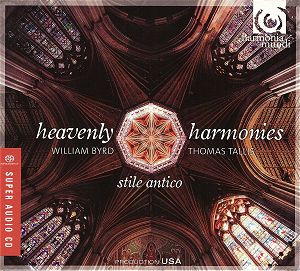

 Stile Antico
 [78:51]
