Philip Glass started
work on Another Look at Harmony
in 1975. He wrote much of it whilst
working on his opera Einstein on
the Beach. The work represents
Glass’s attempts to come to grips
with the use of chromatic harmony
in the context of his existing style
which essentially conformed to the
tenets of Californian minimalism.
In Another Look at Harmony Glass
started to go beyond his existing
style, where harmony was the product
of the accidental impact of interacting
melodic lines.
Glass’s style had
evolved as a reaction to the complexity
of post-war music. The basic style
involves the repetition and reiteration
of small units, with a strong emphasis
on rhythm and melody. From Another
Look at Harmony Glass would also
start including cyclic harmonic sequences
as well. But, whereas in traditional
classical music harmony was at the
fundament of any piece, Glass would
use his cycles of re-iterated harmony
to support and point out the rhythmical
structures.
A term which was
often associated with early Minimalism
was Process Music; this is music which
arises from a process or attempts
to make a process audible. In early
minimal pieces this is reflected in
the slow harmonic progressions; Another
Look at Harmony is an interesting
attempt to take this further and make
changing harmonic sequences a part
of the Glass style.
Another Look at
Harmony parts 1 and 2 found their
way directly into Einstein on the
Beach. Another Look at Harmony
part 3 is for voice, clarinet
and piano. Another Look at Harmony
part 4 was commissioned by the
Holland Festival of 1977.
As with much of the
repertoire associated with Californian
minimalism, Another Look at Harmony
was written for a small ensemble,
an electronic organ and an intimate,
rather dry acoustic. Much of this
repertoire is indelibly associated
with amplification and close-miking.
The resulting sounds are deliberately
non-natural. We are used to hearing
works performed by vocal ensembles,
usually one to a part, where necessary
amplified to suit the piece in mind.
The result gives a uniformity of attack
and control which create a very specific
performance style.
Another Look at
Harmony part 3 has been recorded
by the Western Wind Ensemble. The
ensemble number just eight singers
and the recording rather conforms
to the style described above.
But if you visit
Philip Glass’s web site, the work
is described as being for chorus and
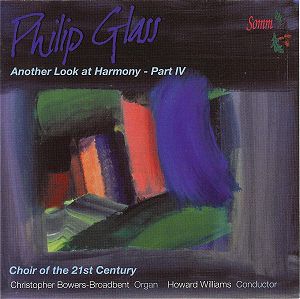
organ. Howard Williams and the Choir
of the 21st century have
taken this literally and performed
Another Look at Harmony part
3 in a style which can only be described
as English Cathedral. The work was
recorded in June 2007 following live
performances. In order to make the
performance viable, the choir was
split into two and performed in relays
with Christopher Bowers-Broadbent
taking the organ part.
This is what we hear
on this recording, rather than any
sort of recording trickery. In his
programme note Williams says that
he wanted to re-create the effect
of his live performances.
The results are,
in many ways, a triumph. The choir
and organist have taken a piece which
owes its existence to the idea of
structured, almost computer-controlled
repetition and given it a whole new
life in a live acoustic. What we lose
is the clarity and control which a
small group of closely recorded singers
can deliver. With multiple voices
on each line we lose the cleanness
and clarity of attack and unanimity
of purpose. What we gain is a feeling
of live acoustic, of a real living
performance. The choir give the piece
vitality and vividness, but we have
to accept that the singers sound as
if they were tiring at times and the
sopranos’ tone gets a little hard.
I have nothing but
praise for Bowers-Broadbent’s reading.
It is not virtuoso or bravura in a
showy way, but displays a remarkable
feat of endurance as he plays the
extensive organ part in a neat, controlled
and understated way.
This is not necessarily
the definitive recording. It is a
fascinating and brave attempt to make
one of Glass’s early pieces available
in a new format. The results give
a striking new sound to Glass’s familiar
world.
Robert Hugill
























 Christopher Bowers Broadbent (organ)
