|
EXPLORE
Musicweb - CLICK
------------------
Message Board
Announcements
Twitter @MusicWebINt
------------------
RECORDING
OF THE MONTH
Shostakovich Symphony 8
RCO, Nelsons
RECORDING
OF THE MONTH

HALLÉ WALKURE
4+1CDs £22 post free
RECORDING
OF THE MONTH

Complete Orchestral Works

EMI Complete Ferrier

Storyteller

Mahler
Symphony 7
Bamberger Symphoniker
Jonathan Nott
................
RECORDING OF THE MONTH

Simone Young
RECORDING OF THE MONTH
Italia Nicola Benedetti

Only complete set
on the Market
35CDs £67

RECORDING
OF THE MONTH
Momentous!
BARGAIN
OF THE MONTH

Italian Cello Concertos
and Sonatas
3CDS £10.95

Brahms Symphonies Zinman
£26.85
RECORDING
OF THE MONTH
Beethoven Symphonies
Thielmann


Magic Moments of Opera
10 Operas Arthaus £95

Brilliant Classics 40CDs

Brilliant Classics 60CDs

9 Symphonies Chailly
£31.90

9
Symphonies C Davis
£18.70
BARGAIN
OF THE MONTH
Absolutely marvellous!
£5.99 post free

Bruch VC1 Gluzman
Quite the finest performance of the Bruch concerto
I have ever heard.

The best opera DVD of the year so far [ST]

Mahler Song Cycles
Katarina Karnéus
Available
again
The Raga Guide
4CDs + 196 page book
£33 post-free world-wide
15,000 copies sold
Editorial
Board
Classical Editor
Rob Barnett
Seen & Heard
Editor Emeritus
Bill Kenny
Editor in Chief
Stan Metzger
MusicWeb Webmaster
Len Mullenger
Assistant Webmaster
David Barker
|
 |
 |
|
alternatively
AmazonUK
AmazonUS
|
John
BULL (1563-1626)
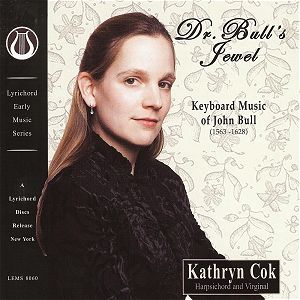
Dr. Bull’s Jewell
Doctor
Bull’s Goodnight [2.57] Chromatic Pavan (Queen Elizabeth’s) [6.04]
Chromatic Galliard (Queen Elizabeth’s) [3.40] The King’s Hint [3.28]
Walsingham [17.34] Bonny Peg of Ramsey [1.27] Fantastic Pavan [5.37]
Galliard to the Fantastic Pavan [2.12] My Self [2.20] In Nomine
[7.22] My Jewel [2.22] The Quadran Pavan [2.16] Galliard to the
Quadran Pavan [7.00]
Kathryn
Cok (harpsichord)
rec. Laurentiuskerk, Minjnsheerenland, Holland, November
2006. DDD
LYRICHORD LEMS-8060 [68.56]  |
|
|
Who was this rather mysterious and almost mesmerizing
figure Dr. John Bull? Not much is known about him but from
an early age he must have been a superb keyboard player.
He is found as a young man as organist at Hereford Cathedral
and three years later at the Chapel Royal. He later works
directly for Queen Elizabeth and then for Charles I. Rather
oddly he ends his days in Antwerp as organist of the cathedral.
Some say he left England because of an adulterous affair.
It has even suggested that he might have been a spy and
had to leave after a diplomatic incident. His music is
often highly intellectual and some of the most challenging
of the period. To gain a picture of his character you could
do no worse than listen to ‘Doctor Bull’s Myselfe’ which
is a lively and happy ‘Gigge’. The version played here,
is incidentally a much longer and more ‘flashy’ version
than the one in the FitzWilliam Virginal Book, where forty-two
of his works are preserved. However there are other pieces
here drawn from other collections.
As Kathryn Cok herself says in minuscule print
in the booklet notes, three forms are represented here.
There are the lighter dances and short descriptive pieces
like ‘Dr. Bull’s Myself’. Then there are the Pavans and
Galliards. These were complex and never meant to be danced
to. The Pavans are normally the longest and certainly the
slowest, being in three sections with varied repeats. The
only exception here is the Quadran Pavan which clocks in
at a quarter of the length of the much varied Galliard.
Finally there are the In Nomines and other variation
sets like ‘Walsingham’. These are highly involved and decorated.
They comprise several variants, in the case of the In Nomines
on a famous polyphonic fragment found in Taverner’s Mass ‘Gloria
Tibi Trinitas’ and in ‘Walsingham’ on a popular melody
of the late Elizabethan period.
As the disc is entitled Dr. Bull’s Jewell that
is where I started and I immediately hit a snag. Several
of Bull’s compositions appear in the FitzWilliam Virginal
probably compiled by one Francis Treggian whilst an inmate
in the Fleet Prison. So I tracked down my copy. The CD
book rather puzzlingly told me that the piece would last
for 7:22 yet it consists of only three pages. In addition
Kathryn Cok never plays the repeats which were standard
in keyboard music of his period after about every eight
bars. The work is typical in that it is structured as an
eight bar theme followed by variation. Bull’s Jewell falls
into three sections (like a Pavan or Galliard) each with
its varied repeat. However, either due to bad editing or
quirky performance the final repeat has vanished. Incidentally
it lasts for just over two minutes.
Next I listened to the vast ‘Walsingham’, a work
considered so important that it opens the entire FitzWilliam
Collection of 247 pieces. It consists of thirty sections
each one marked to be repeated; the final length of the
work does not warrant thinking about. In Variation 18 Miss
Cok sounds as puzzled by the rhythm as it appears on the
page. Several variations tend to start with one rhythmic
idea and glide into another unrelated one, as this one
does. Indeed no. 20 begins with a three-against-two rhythm
for two bars and then continues in ordinary compound time.
Neither does the piece as a whole build to a virtuoso climax.
Compare this with the better known ‘The King’s Hunt’. In
this latter piece the left hand has some difficult manoeuvres
and stretches to imitate a riding rhythm. Similarly tricky
passages can be found in Walsingham, for example in variations
12 and 16.
The Chromatic Pavan and Galliard - curiously not
in the FitzWilliam VB - is not chromatic as we know it
but has several passages which use the sharp and flat keys
quite extensively. This creates a somewhat ‘out-of-tune’ effect
because the instrument here was - and obviously is - tuned
to the mean-tone system; Cok has made herself responsible
for her own tuning. In this method of tuning everything
is based on the fifth or fourth. In simple keys of say
two sharps or flats all is well but the more ‘black’ notes
you introduce the more the tuning becomes a problem. Hence
the title ‘Chromatic’ as Bull uses all ‘black notes’ but
never uses a chromatic scale.
There are two instruments used for this recording,
both illustrated in the booklet. One is a double-manual
harpsichord made by Titus Crijen of Amsterdam of 1638 and
the other a 17th Century Virginal made by Willem
Kroesbergen of Utrecht also after Ruckers. Although it
is not clearly indicated which piece is played by which
keyboard, Cok explains in her notes that “I have chosen
to use the rich, resonant sound of the harpsichord for
the more serious and densely polyphonic pieces and the
crisp, light sound of the virginal for the secular settings
and variation sets”. A little, and somewhat untypical piece
like ‘Bonny Peg of Ramsey’ is therefore heard on the virginal
and the ‘In Nomine’ is played on the harpsichord. They
are both fine instruments and closely but realistically
recorded.
All in all this is a very fine disc. It offers
a wise and fascinating choice of pieces, nicely recorded,
thoughtfully annotated - except as mentioned above - and
beautifully prepared, researched and played. And this is
music by a figure who can be seen to be in the first rank
of early English composers.
Gary Higginson
|
|
Advertising
Rates
Visitor
stats
MusicWeb
International
has over 40,000 Classical CD reviews on offer
Discs
received
Having a problem
Donating?

Gerard
Hoffnung Concerts &
The
Bricklayer Story
New
Releases

New
Releases


MusicWeb
sells the Polish
catalogue CDAccord
£10.50 post free W-W

MusicWeb sells the
Arcodiva catalogue
£12.00 post free W-W

£11.75
post-free world-
wide
MusicWeb
can now offer
you discs from the following catalogues:
Prices include postage
Musicweb
Special
Offers
Monthly
Best Buys
Google
Ads - for information about privacy matters, click here.
Amazon Musicweb International is a participant in the Amazon
EU Associates Programme, an affiliate advertising programme designed to provide
a means for sites to earn advertising fees by advertising and linking to Amazon.co.uk
and Amazon.com
|