Boccherini seems to be a composer about whom opinions strongly
diverge. Either you love him or you hate him. There are musicians,
in particular cellists, who adore him and play his music frequently;
others detest him and avoid his compositions at all cost. That
difference of opinion isn't a phenomenon of our time. In the booklet
notes for this set Laura Alvini quotes several composers and theorists
of the 18th and 19th century. Their opinions on Boccherini are
just as different as those in our time. Grétry, for instance,
wrote that Boccherini's music is alternately "gloomy, tender,
rending, gracious and even excessively gay". Only a couple
of decades later the German composer Louis Spohr gave a completely
different verdict: "this is not music". Today it is
mainly Boccherini's string quintets and some of his cello concertos
which are paid attention. From this perspective the set of discs
to be reviewed here presents music one wouldn't expect from the
composer who in his time was celebrated as one of the world's
greatest cellists.
One
of the cities where Boccherini performed in this capacity
was Paris, although only one performance is documented. He
arrived during a tour of Europe which was planned to end in
London in 1767. In fact it ended in Madrid instead. At about
that time two collections of music by Boccherini were published
in Paris. It was here that he composed the six sonatas for
pianoforte and violin opus 5. The set was dedicated to an
amateur keyboard player, Anne Louise Boyvin d'Hardancourt
Brillon de Jouy. She was an excellent musician, as the English
journalist Charles Burney testifies: "she is one of the
greatest lady-players on the harpsichord in Europe. This lady
(...) plays the most difficult pieces with great precision,
taste and feeling (...). She likewise composes, and she was
so obliging as to play several of her own pieces both on the
harpsichord and pianoforte accompanied with the violin by
M. Pagin, who is reckoned in France the best scholar of Tartini
ever made." This remark about her performing on the pianoforte
is interesting. At the time Boccherini wrote his six sonatas
opus 5, the pianoforte was still a relatively new instrument,
but Ms Brillon inspired him to write the keyboard part specifically
for the new instrument, including dynamic markings. When the
sonatas were published in 1769 the reference to the pianoforte
was replaced by "harpsichord" and many dynamic markings
were removed. This reflected the fact that the harpsichord
was still the dominant keyboard instrument. The publisher
simply had to adapt the sonatas for commercial reasons.
According
to Franco Angeleri in Boccherini's sonatas the violin is no
longer subordinate to the keyboard, "but is instead completely
integrated with the fortepiano into a single musical fabric,
thus giving rise to an evolutionary process which will culminate
in Beethoven's conception of the sonata for violin and piano".
This seems to me a little exaggerated: the keyboard takes
a clear lead in the proceedings, is the most busy of the two
and is often the most virtuosic. Four of the six sonatas are
in three movements, mostly fast - slow - fast, whereas the
two remaining sonatas are in two movements. Some movements
are quite dramatic, like the allegro assai from the Sonata
No. 4 and the allegro molto from the 5th Sonata. One of the
features of Boccherini's music is that some thematic material
returns time and again in several compositions. With the exception
of the allegro assai from the 4th Sonata already referred
to, that is not the case here, probably because these sonatas
are early works and the composer’s trademarks had not as yet
been fully developed.
Although
the six sonatas for keyboard with violin and cello date from
more than ten years later they are connected to the opus 5.
The title pages of 18th century prints contain the words "Second
Livre" (second book), which - as there are no previous
trios of this kind by Boccherini - can only refer to the sonatas
opus 5. The collection's title is "Six Sonates en trio
pour le Clavecin ou Pianoforte avec accompagnement de violon
et basse" showing that in these trios the keyboard again
has the main part. Even so it has to be noted that the cello
isn't simply playing the bass line of the keyboard but regularly
follows its own path. It is a shame that in this recording
the balance between the instruments is sometimes less than
ideal as the cello part isn't always clearly audible. The
structure of these sonatas is somewhat different from that
of the sonatas opus 5. Only two of the six sonatas are in
three movements and both begin with a movement in a moderate
tempo - poco andante and moderato respectively - and end with
a menuet, one of which is a 'minuetto militare'. The other
four sonatas are in two movements, which was quite usual at
the time in chamber music of a diverting nature.
The
authenticity of these trios has been questioned. For example,
in Gérard's catalogue of Boccherini's works they are labelled
'spurious'. But Laura Alvini is convinced these works are
indeed written by Boccherini. Her reasoning seems pretty convincing.
If one listens to these trios there is no reason why they
are hardly played in comparison to the trios for this scoring
by Haydn or Mozart. Laura Alvini underlines the modernity
of Boccherini's trios in regard to the relatively independent
role of the cello, which is "ahead of its time".
Both
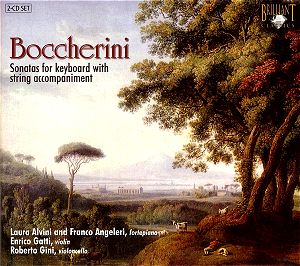
collections get very fine performances on these discs. The
dramatic, the more lyrical and the diverting aspects of these
works come out well. Both Franco Angeleri and Laura Alvini
display the colours of the fortepiano and fully exploit its
dynamic possibilities. Unfortunately the instruments used
here are not specified in the booklet. In both recordings
Enrico Gatti plays the violin and he does so with great expression,
as does Roberto Gini who plays the cello part in the trios.
Boccherini
once said: "I know well that music is made to speak to the
heart of man, and this is what I try to do if I can; Music without
feelings and Passions is meaningless". The works presented
here are definitely not without "feelings and Passions",
and therefore the musicians have done both Boccherini and modern
audiences a great favour by presenting them in such splendid interpretations.
Johan van Veen
























 Galimathias Musicum:
