Editorial Board
MusicWeb International
Founding Editor Rob Barnett Editor in Chief
John Quinn Contributing Editor Ralph Moore Webmaster
David Barker Postmaster
Jonathan Woolf MusicWeb Founder Len Mullenger
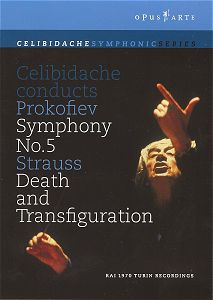
Sergei PROKOFIEV (1891-1953)
Symphony No.5 in B flat major op.100 (1944) [42:35] Richard STRAUSS (1864-1949) Tod und Verklärung op.24 (1889) [27:55] Orchestra
Sinfonica di Torino della RAI/Sergiu Celibidache
rec. 1970, Turin, live. OPUS ARTE
OA0979D [77:00]
Opus Arte limit themselves, as elsewhere in this series,
to stating that these are “RAI 1970 Turin Recordings”. They were
in fact recorded at the same concert, on 30 April 1970. I think
the Prokofiev must actually have been the last item since
the public start unceremoniously putting on their coats as
soon as the music is over. The concert began with Cherubini’s “Water
Carrier” Overture, presumably not televised.
Since the 1969 Bruckner 9 I recently reviewed, the television team
has advanced considerably in expertise. Attention is still
concentrated on the conductor, but when they home onto an
orchestral player or section, they actually choose one that
is doing something important. There are even a few imaginative
touches, such as a close-up of Celibidache superimposed on
a full-screen image of the tam-tam. As often happens with
restored black-and-white films, the contrasts seem to have
been scrubbed excessively clean, while the image itself,
though firm, lacks detail. I found this rather tiring on
the eyes. The sound is fair but congested and it is a pity
that the stereo tape from RAI sound archive could not have
been substituted.
A recent commentator (not on MusicWeb) remarked, apropos
a DVD of Boult, that to modern eyes the conductor seemed
almost comically
detached from the proceedings. He should enjoy the second
movement of the Prokofiev. Celibidache sets aside here his
usual manner of beating time simply and clearly – as he did
in the first movement. His face clouds with anger as the
movement starts. Thereafter he acts out the music with grimaces
and puppet-like gestures, sometimes passing the baton to
his left hand to free his right arm for elegant pirouettes.
He even allows an occasional ghoulish grin to crease his
Dracula-like countenance. The trouble is, Boult, by whatever
means, usually fired up the orchestra. This time it is the
Turin band which appears almost comically detached from the
proceedings, just blandly getting on with the job.
In fact, this is, from the beginning, a relatively low-key
performance by Celibidache’s standards, with the sort of ropy horns at
the beginning which the orchestra usually reserved for lesser
podium luminaries. Better is the third movement where Celidibache
is in his element drawing the long, cool lines. He is visibly
dissatisfied with the balance near the beginning of it, urgently
gesturing certain players to give more, damping down others.
Rather fascinating to watch. The finale gets up a fair head
of steam. I must say that as I write I am playing my off-the-air
tape of the performance, where the stereo recording gives
it considerably greater impact. Celibidache students might
like to know that his tempi are not at all eccentric here:
at 11:38, 8:39, 13:00, 09:18 there are no remarkable differences
compared with a “normal” reading such as that given by Paul
Kletzki in Rome in 1961, with timings of 11:47, 08:02, 11:55,
09:28.
The Strauss is a totally different experience. This is absolutely
enthralling performance. The opening is pure magic, the faster
sections have galvanic force. The final section is long-drawn,
distilling all the spiritual intensity for which Celibidache
was famous. No posturing on the podium this time, either,
just straightforward, very eloquent time-beating and a left
hand that seems able to draw every desired nuance from the
orchestra. Noticeably, this performance draws an ovation
while applause for the Prokofiev is no more than polite.
Most Turiners preferred to stay away – the hall is no more
than half-full – but those that went evidently knew the difference
between a great performance and a fairly good one.
This one, by the way, is more of a Celibidache special – his 27:55
is more than four minutes longer than Ormandy’s “normal” timing
of 23:44.
Christopher Howell
Please support our advertisers below by clicking on the logos for further information.

























 Orchestra
Sinfonica di Torino della RAI/Sergiu Celibidache
Orchestra
Sinfonica di Torino della RAI/Sergiu Celibidache  [77:00]