This
is an official release in which “RAI’s historic black and white
master is faithfully restored … with digitally re-mastered 2-track
mono”. We are not told the exact date but I presume – I haven’t
made a detailed check – that it is the performance from 2 May
1969 which RAI re-broadcast from time to time and which I have
on tape. In which case a stereo recording exists too.
The
sound image is pretty clear. Posterity will probably thank the
cameramen for being content, in the main, to concentrate on
images of the legendary conductor. When they do shift their
attention elsewhere the results are less happy. A shot of the
leading cellist, for example, who continues to hog the scene
until long after the melodic interest has been taken up by the
violins.
Still,
we have a rare opportunity to study Celibidache’s conducting
technique in action. Almost more than any other conductor I’ve
seen, his baton beats time unfailingly and with exemplary clarity.
It might appear “text-book” or even “academic” conducting were
it not for the eloquence with which his stick moves. His left
hand does not cue in the instruments – after all those rehearsals
they ought to know when to come in – but is continually adjusting
points of balance and dynamics, beckoning an instrument forward
here, damping one down there. His lank, almost Frankenstein-like
face suggests extraordinary inner concentration. His mouth is
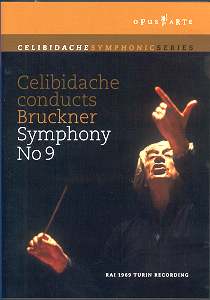
firmly closed the whole time – the photograph you see on the
cover with his mouth apparently exhorting the orchestra is not
a still from this particular film – and the only facial expression
is a slight raising of his eyebrows. You are left in no doubt
that every detail of the performance has been controlled by
the conductor.
When
the performance ends, however, his first concern is to acknowledge
the orchestra, not the public. They refuse his invitation to
stand up, at which he remains for long with his back to the
audience, applauding the orchestra. When he finally gets them
on their feet he steps of the podium and shakes a few hands
before turning towards the public with – at last – a wisp of
a smile.
So
much for the visual aspect. What of the performance? The presence
of one of the RAI orchestras does not usually bring added value
to historical resuscitations in which they take part, but that
is to reckon without Celibidache. Suffice to say that the other
evening I was watching a DVD of Karl Böhm conducting the Vienna
Philharmonic late in life, and anyone who didn’t know would
have taken the latter orchestra to have been the more provincial
of the two. There are some patches of raw brass intonation in
the scherzo but on the whole the Turin band acquits itself with
honour.
At
this stage in his career Celibidache’s tempi had not become
so extreme as they did later. At 23:17, 11:03, 22:18 his timings
are not particularly unusual. Indeed, the Turin public were
to hear slower tempi in all three movements from Ferdinand Leitner
in 1987: 24:05, 11:12, 24:08. Maybe they expected – or feared
– something even longer drawn-out from Giulini in 1996 but in
the event they got 23:18, 09:53, 22:32.
As
Giulini’s faster scherzo – and Misha Donat’s accompanying essay
– suggests, it is this movement, beaten in three by Celibidache,
which might cause some surprise. Furtwängler and Karajan established
a tradition for an “exciting” reading of this scherzo, but slower,
menacing interpretations are not unknown. As we see, Leitner
adopted such a view, and I remember back in my days at Edinburgh
University that Alexander Gibson – whose Bruckner could often
be awfully fast – surprised us all with a performance along
these lines. He also beat it in three. Carl Schuricht was something
else again. Only a tad faster, he relaxed during parts of the
trio to evoke visions of old-world Vienna that I find hard to
get out of my head.
Overall,
this performance impresses by its inexorable growth. From the
first note to the last we are caught up in Celibidache’s spiritual
vision of the work, ranging seamlessly from far-off mystery
to terrifying power. Reclusive legends sometimes gain momentum
from their very silence. This DVD would of itself prove that
Celibidache was as great as has been claimed. It is to be hoped
that the RAI archives will yield further treasures, as well
as the companion issue of the “Symphonie Fantastique” which
was recently reviewed
by Christopher Fifield. I don’t know how extensively his concerts
were filmed but I remember seeing a Mendelssohn “Italian” as
the first in a series of rebroadcasts, so at least a little
more exists.
More
generally, I hope that the RAI’s sound archive recordings of
Celibidache might be investigated more fully. The concentration
of DG and EMI on his later performances was the easy option,
given that the recordings were more recent and the orchestras
better. But Celibidache could get remarkably good results from
the RAI orchestras and the original tapes can produce far better
quality than might be imagined from the bootleg transfers that
used to circulate on LP. Most importantly, Celibidache’s Italian
years were those of his first artistic maturity, untainted by
the lapses into self-caricature which sometimes disfigured his
later interpretations.
Not
for the first time, I find Misha Donat spoiling a basically
good essay by his habit of relying on faulty memory for things
he could very well look up. It is all very well to say, late
at night in a pub, that “To the best of my knowledge Celibidache
set foot in a studio on only two occasions: once, in 1953, to
record the Brahms Violin Concerto with Ida Haendel for HMV;
and again more than a quarter-century later, for his own composition
Der Taschengarten in Stuttgart”. When you are writing
an essay which readers may suppose to be authoritative, a brief
attempt to improve your knowledge will do no harm. After a spot
of Googling – which Donat could have done himself – I find that
Celibidache’s Decca sessions, with the LPO in Kingsway Hall,
were:
Tchaikovsky: Symphony no. 5 (5.7.1948 + 9.6.1948)
Mozart: Symphony no. 25 (4.9.1948 + 29.12.1948)
Tchaikovsky: Nutcracker Suite (28.12.1948 + 2.7.1949)
They
have occasionally been reissued.
Christopher
Howell













 Orchestra Sinfonica
di Torino della RAI/Sergiu Celibidache
Orchestra Sinfonica
di Torino della RAI/Sergiu Celibidache [62:00]