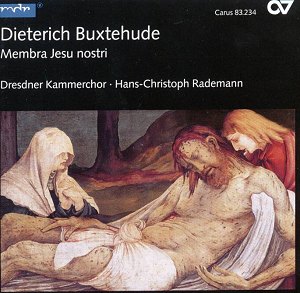
The tradition of
verse meditations on the crucified body of Christ – like that
of visual representations - goes back many centuries. An anonymous
English poet, of the late thirteenth or early fourteenth century,
explained that meditation on the crucifixion was good for the
Christian since it brought tears to the eyes and sweetness to
the heart, since it prompted both grief and love. Poems on the
body of Christ abound. One of the most famous – written in Latin
by the thirteenth century Cistercian monk Arnulf of Louvain
(c.1200-1250) a Cistercian monk underlies Buxtehude’s cycle
of seven cantatas, Membra Jesu nosri patientis sanctissima
to give it its full title. The poems have sometimes been
attributed to St. Bernard of Clervaux, a fellow Cistercian but,
though they have much in common with St. Bernard’s spiritual
language, the evidence suggests that they are Arnulf’s work).
Buxtehude’s cycle
was composed in 1680 and dedicated to Gustaf Düben, organist
of the German church in Stockholm and conductor of the Swedish
court orchestra, and a good friend of the composer. The autograph
manuscript of the work survives in a collection of some 105
works by Buxtehude, assembled by Düben’s son and now preserved
in the university of Uppsala.
Buxtehude has devised
(at least one assumes that he was responsible for the choice
of text as well as for the writing of the music) a cycle of
seven short cantatas, each addressed to a different part of
the body of Christ – in order, these are the feet, the knees,
the hands, the side, the breast, the heart and the face. Musically
the cantatas move through a cycle of keys – C minor, E flat
major, G minor, D minor, A minor, E minor and back to C minor.
Seven, it should be remembered was one of the biblical numbers
of perfection. In each of the cantatas, Buxtehude sets three
verses chosen from Arnulf’s poem, usually referred to as the
Rhythmica oratio. Each is prefaced by an instrumental
sonata, some of them (such as the sonata in tremulo which
prefaces the very first sonata) wonderfully apposite to the
text which follows. Each cantata also carries a kind of Biblical
epigraph – from Nahum, Isaiah, Zaechaeriah, the Song of Songs,
the first epistle of Peter, the Song of Songs (again) and the
Psalms. The whole is beautifully made, words and music wonderfully
well-suited one to another. It is one of the masterpieces of
Lutheran music before Bach (and will stand comparison with all
but the greatest of Bach).
This new performance
brings dignity and assurance to the work. All of the soloists
sing with conviction and in a thoroughly appropriate idiom.
The work is conducted with evident understanding and clarity
of purpose. Choir and instrumental ensemble give not the slightest
cause for complaint. There is, therefore, much to admire and
nothing deserving of real complaint. And yet, in ways that are
hard to pin down, it falls just short of rivalling some
of the very best performances the work has received on CD (and
it is a work which seems to me to have been very fortunate in
its recordings). Versions by such as that by Konrad Junghänel
with Cantus Cölln (Harmonia Mundi HMC 901912), Masaaki Suzuki
with the Bach Collegium of Japan (BIS CD 871), René Jacobs with
Concerto Vocale (Harmonia Mundi HMC 901333 and Harry Christopher
with The Sixteen (Linn CKD 141) have a spiritual and/or intensity
which this new recording doesn’t quite match. Since the much
more Italianate version conducted by Diego Fasolis on Naxos
(8.553787) also appeals to me, it may be that I am failing to
respond adequately to the greater restraint of this recording.
And that relative restraint may be more suited to Buxtehude’s
own aesthetic canon. I don’t wish, therefore, to do anything
other than recommend the version by Hans-Christoph Rademann
as a fine interpretation but one which hasn’t quite won me over.
At least not yet – I suspect this may be the kind of recording
whose subtle qualities grown on one over a period of time.
The two cantatas which
complete the CD – both of which are apparently being recorded
here for the first time – are minor works, but very well worth
hearing and they get accomplished and intelligent performances.
Glyn Pursglove
see also Review
by Jonathan Woolf
























 for details
 Christina Kaiser,
Astrid Werner, Anja Zügner (soprano); Alexander Schneider (alto);
Tobias Hunger (tenor); Matthias Lutze, Marek Rzepka (bass); Daniel
Deuter, Margaret Baumgartl (violin); Juliane Laake, Benjamin Dreßler,
Katharina Schlegel, Renate Pank (viola da gamba); Matthias Müller
(viola da gamba; violone); Michaela Hasselt (organ); Michael Dücker
(theorbo); Dresdener Kammerchor/Hans-Christoph Rademann
Christina Kaiser,
Astrid Werner, Anja Zügner (soprano); Alexander Schneider (alto);
Tobias Hunger (tenor); Matthias Lutze, Marek Rzepka (bass); Daniel
Deuter, Margaret Baumgartl (violin); Juliane Laake, Benjamin Dreßler,
Katharina Schlegel, Renate Pank (viola da gamba); Matthias Müller
(viola da gamba; violone); Michaela Hasselt (organ); Michael Dücker
(theorbo); Dresdener Kammerchor/Hans-Christoph Rademann