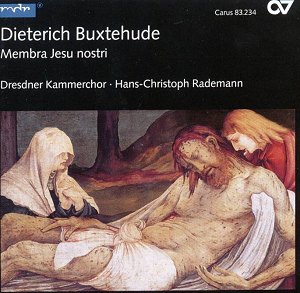
Membra Jesu nostri
(The Limbs of our Jesus) is a series
of seven compact cantatas based on the
Latin text Rhytmica Oratio. Once
ascribed to St. Bernard of Clairvaux
it’s now thought to be by the Cistercian
abbot Arnulf von Löwen who lived
in the first half of the thirteenth
century. Buxtehude is thought to have
come across a 1633 printing of the text
and to have written the score around
1680 whilst he was active in Lübeck.
It can’t however be assumed with any
certainty that it was ever performed
there. The cyclical nature of it suggests
a Passion setting.
The text concerns the
membrum of Christ, seven body
parts – feet, knees, hands, side, chest,
heart and face. Each cantata is introduced
by an instrumental sonata and this is
followed by the biblical motto in the
form of a tutti passage – with the exception
of the fifth and sixth where it’s written
for a smaller ensemble. The succeeding
arias are based on Arnulf’s texts and
then we have a reprise of the motto
– except for the final cantata which
ends in an Amen. The instrumental accompanying
group consists of two violins, violone
and basso continuo – though in the sixth
we have a five part gamba consort. Vocally
the cantatas are written in five parts
– two sopranos, alto, tenor, and bass
– or in three parts in the case of Nos.
5 and 6.
The textures of these
cantatas are very finely realised in
this premiere recording. The opening
sonatas are brief, sometimes terse,
but always expressive. That of the second,
Ad genua, opens with tremulo
for instance, varying the colours and
rhythms expertly. The solo and choral
contributions are of a generally high
order. Fulsome warmth for instance is
a feature of the Tutti of the second.
Nor do the forces overlook the contrasting
powers of expression that lie in the
most textually laden of the passages
– listen to the beautiful solo soprano
line contrasting with the declamatory
power of the Quid sunt section
in the Ad manus cantata. Similarly
the voci of cantata No.5, Ad
pectus thins to almost nothing in
increasing desolation. The most moving
of the instrumental sonatas is the Sixth,
Ad cor. It’s almost twice as
long as any of the others and evinces
an intensity that is notably well conveyed
by the Dresden forces under Rademann.
Great care is also
taken over the weight of single and
choral entries; in the voci of
Ad cor for example the voices
have great purity and plangency, By
the final cantata, Ad faciem,
the writing has become increasingly
affirmative and confident ending with
a complex and vibrant Amen.
There are two further
cantatas. The brief War Gott nicht
mit uns diese Zeit is set to a text
by Martin Luther. But the longer Walts
Gott, mein Werk ich lasse will be
better remembered as a very well known
Protestant hymn. It’s also the better
work, more extensive, a touch more florid
and also more intense.
Recorded live in the
Lukaskirche this is yet another in Carus’s
important catalogue of disc premieres.
Diligently, impressively and with consistent
success this company is building up
a portfolio of very fine discs. The
recording is excellent and the booklet
contains texts and documentary material.
First class all round.
Jonathan Woolf
























 for details
 Dresden Kammerchor/Hans Rademann