Where have I come across
a Russian conductor with the WDR Symphony
Orchestra, Cologne, in Shostakovich?
Of course, the highly-praised Rudolf
Barshai set of the symphonies, available
complete on Brilliant Classics and in
part on single discs from Regis. Semyon
Bychkov’s own recordings with this orchestra
have been appearing at intervals: Nos.
4 ,7 (Leningrad), 8 and 11 are
advertised in the booklet for the present
CD. 4, 11 and the present CD are hybrid
SACD recordings, though packaged in
a normal square-cornered case, rather
than the round-cornered cases usual
for SACDs.
The WDR Symphonie-Orchester
of Cologne comes over on those Barshai
recordings very creditably, especially
when one considers that the recordings
were made live. If anything, now that
Semyon Bychkov has been their director
for over twelve years, they are a match
for the very best, Karajan’s well-drilled
Berlin Philharmonic in their two recordings
of this symphony not excepted.
Here on Musicweb Gwyn
Parry Jones welcomed Bychkov’s recording
of the Leningrad on AV0020, as
did Colin
Clarke, albeit with several important
reservations. At least CC agreed that
Bychkov had the makings of a fine Shostakovich
interpreter, but I tend to align myself
more with GPJ’s more positive view.
The only thing which now seems odd about
GPJ’s review is his statement that Avie/Bychkov
recordings were ‘streaming forth’. The
stream seems to have slowed down; at
this rate Bychkov’s Shostakovich cycle
will take as long to complete as Ashkenazy’s.
In my recent review
of the complete box set of Ashkenazy’s
recordings I compared his version of
No.10 with Neeme Järvi’s. My allegiance
to Järvi (CHAN8630, with Ballet
Suite No.4) remained unshaken, but
I thought the Ashkenazy one of the best
of an uneven cycle. In some respects
that may be due to the fact that I now
consider the Tenth to be Shostakovich’s
masterpiece: the Fifth may be the more
overtly appealing but the Tenth was
the first in which Shostakovich was
truly free to express himself.
I liked the way in
which both Järvi and Ashkenazy
bring out the Mahlerian elements in
the long first movement: it isn’t just
the length that reminds me of Mahler,
there are definite hints of the Resurrection
Symphony, even an echo of Mahler’s
setting of Der Mensch liegt in grösster
Not. (Mankind lies in the greatest
need.) Bychkov has already established
his Mahlerian credentials with his version
of that composer’s Third Symphony which
Colin
Clarke thought had much to recommend
it, though not his first choice. Tony
Duggan recommended Bychkov’s Mahler
3 highly in his comparative review:
‘triumphantly top of the pile’ among
digital recordings. All three conductors
take this movement at a leisurely enough
pace to let it make its point: Järvi
takes 22:59, Bychkov and Ashkenazy,
by an incredible coincidence, both weigh
in at 23:10. (The metaphor is deliberate:
this is a weighty movement). Remember
that Shostakovich began and completed
this symphony in the year of Stalin’s
death, his first symphony for eight
years. Thus 1953 marked a rebirth for
Russia in general and for creative artists
like Shostakovich in particular – hence,
perhaps, the echoes of Mahler’s Resurrection
Symphony. Ironically, Prokofiev,
who had suffered from proscription almost
as much as Shostakovich, did not live
to see that rebirth; he died the very
same day as Stalin.
In the first movement
it is as if the ice has not yet begun
to thaw; mankind, at least in Russia,
is still suffering (in grösster
Not, in grösstem Pein, ‘in
the greatest need, in the greatest torment’,
to quote Mahler again). Stalin had dominated
Russia and the Soviet bloc for so long
and so completely that people wondered
what would happen next; as I well remember,
the fear at first was that something
terrible would ensue. Rightly, as I
believe, all three interpretations reinforce
this weighty view of the opening movement,
though on repeated hearing I now feel
that Ashkenazy lets the tension drop
a degree too much in places; both Bychkov
and Järvi maintain the tension
much better. All three are well played
and well recorded, making honours about
even here: perhaps Bychkov’s ice seems
by a small margin the thickest and most
impenetrable.
In the second movement,
Allegro, Bychkov is a tad slower
than Järvi and Ashkenazy but all
three conductors convey the energy of
this movement well. The energetic opening
comes over very well, with Bychkov,
his players and the engineers resisting
the temptation to emphasise the insistent
percussion at the expense of the turbulent
strings. Volkov’s possibly spurious
Memoirs indicate that this second
movement is a musical portrait of Stalin;
to my ears it sounds much more like
the turmoil which followed his death,
when the Soviet officials did not know
what to do, not even daring to announce
the death for some time.
In the Allegretto
third movement Bychkov strikes a balance
between Ashkenazy’s very slightly rushed
tempo and Järvi’s rather deliberate
one. All three have problems with the
points where the dance rhythm sinks
beneath the surface – perhaps the fault
lies with Shostakovich here for allowing
the listener’s attention to wander,
or perhaps Shostakovich was still hinting
at the uncertainty of the times.
The finale seems
to mirror the whole symphony as it moves
from the Andante opening to the
Allegro section. Notoriously
cryptic about his music, Shostakovich
merely said of the Tenth that it marked
the return to human feelings. At the
beginning the freeze is still potentially
menacing and the feelings are still
in check; by the end even Shostakovich
himself, present in the music since
the third movement, and now more openly,
in the form of his D-S-C-H motif (D-E
flat-C-B in German notation) has joined
in the dance, though rather hesitantly
and stumblingly. There is general agreement
about this movement, with Ashkenazy
and Järvi coming in a few seconds
on either side of Bychkov’s timing.
The playing throughout
the finale and, indeed, throughout
the symphony, is excellent. Forget any
ideas that this is a mere provincial
radio orchestra. The wide-ranging Avie
recording helps, of course, though it
is equally true that the better the
sound quality, the more potential there
is for flaws to be revealed. Ashkenazy’s
version was made with the RPO at a time
when they were not at their best and
Järvi’s Scottish National Orchestra
are not usually reckoned one of the
world’s greatest. Both, however, play
very well: if the WDR players have the
edge on them, it is not by much.
Couplings may well
be decisive. Ashkenazy is currently
available only in a box set; if the
individual CDs were to be made available
separately, his coupling is the Chamber
Symphony. I much prefer this work
in its original String Quartet form
but it is a generous coupling and it
comes first on the CD. Järvi’s
coupling, the Fourth Ballet Suite,
is a rather inconsequential piece and
it is most inappropriately placed –
who wants to hear this work hard on
the heels of the symphony? Of course,
it can be programmed to play first,
but that is a nuisance.
Bychkov seems to have
a penchant for coupling mainstream symphonies
with the works of contemporary German
composers: his Avie recording of Mahler’s
Third Symphony is coupled with York
Höller’s Der ewige Tag.
There is a school of thought that recommends
interspersing concert performances of
mainstream music with the odd contemporary
piece. I’m not sure that I endorse it,
especially on CD: faced with two equally
good versions of the same symphony,
I’m sure that most people would choose
the one with music by the same, or a
similar, composer as a filler.
Detlev Glanert’s Theatrum
bestiarum was premièred at
the 2005 Proms in this mixed-menu fashion,
in a programme which began with Lyadov
and ended with Stravinsky’s Fairy’s
Kiss: I’m not sure how the presence
of the Glanert and Oliver Knussen’s
Whitman settings affected attendance
that night. This music is several degrees
more avant-garde than Shostakovich,
even though the work is dedicated to
him and the composer, in an interview
printed in the booklet, draws comparisons
between himself and Shostakovich. For
someone who was born in Hamburg and
grew up in West Germany to compare his
own regime with that of Stalinist Russia
seems rather to stretch the point. When
I read the interview, I thought at first
that Glanert must have been brought
up in East Germany. The music seems
to me to have more affinity with Stravinsky
– shades of the Rite of Spring
in Part 3 – than with Shostakovich;
Glanert’s perceived problems with the
establishment would, therefore, have
more in common with the commotion which
Stravinsky caused than with the mortal
danger in which Shostakovich potentially
stood.
Carnival of the
Animals it definitely ain’t, and
I can’t imagine that it is likely to
be hailed as a masterpiece in time to
come. I know that contemporaries said
that about Beethoven’s Late Quartets
– I can even see why they said it –
and maybe I shall be proved wrong at
some future date: to me it seems to
make a great deal of noise to no real
purpose.
Theatrum bestiarum
receives a vivid recording, with its
extreme dynamic range well captured.
The same is true of the CD as a whole:
the opening of the Shostakovich arises
naturally, as if by some natural development.
If the effect is marginally less magical
than in Ashkenazy’s version, where the
music seems to emerge from near-inaudibility,
the difference is marginal. All three
recordings, Chandos, Decca and the new
Avie, are what the old pre-Penguin Stereo
Record Guide would have marked with
a D for ‘demonstration-quality’.
The sound throughout
is truthful, wide-ranging and well-focused,
equally at home on both of my systems:
it was neither too bright on the one
nor too bass-heavy on the other. I didn’t
note any of the problems to which GPJ
refers in his review of the Leningrad
– the artificial sheen and the moments
of congestion. The climaxes are handled
very cleanly and no part of the orchestra
is emphasised at the expense of another.
Even in stereo the sound-stage has a
convincing degree of depth, which SACD
can only serve to enhance.
The notes in the booklet
are informative, though the English
translation is rather stilted. Nowadays
German sleeve-note writers can be relied
on to offer more idiomatic English than
the old DG sleeve-note which exhorted
readers to use ‘special clothes to clean
this record’, but it still helps to
have a native speaker make the translation.
"Other than that of his much revered
Gustav Mahler, Dmitri Shostakovich did
not openly display his emotions ..."
would have made much better sense if
it had been rendered "Unlike his
much revered Gustav Mahler ..."
I note that Bychkov
is becoming something of a pluralist,
having just released an impressive Hänssler
Profil CD of Rachmaninov’s The Bells
and Symphonic Dances: my fellow
Musicweb reviewer Terry
Barfoot thought that this CD eclipsed
Neeme Järvi’s version of The
Bells. I have a feeling that, with
a little more acquaintance, his Shostakovich
10 will also replace Järvi as my
preferred version.
Bychkov’s version of
Shostakovich’s problematic Eleventh
Symphony (AV2062) is now the version
of choice on many lists. This version
of the Tenth, a much more central work
in Shostakovich’s output, certainly
ranks very high in my estimation. Give
me a little longer to come to terms
with the Glanert Theatrum bestiarum
coupling, the only real obstacle to
my nominating this as the best Tenth
on the market. If you don’t like the
coupling, you can always ignore it –
which is what I tend to do with the
Ballet Suite on the Järvi
version, anyway. In any case, both Karajan
versions are devoid of coupling and
even some full-price versions, for example
the recent Günther Herbig on Berlin
Classics, are offered alone.
Whichever version you
choose, don’t be tempted to economise
with this symphony: if you must go for
less than full price, let it be Rostropovich
on mid-price Warner Elatus 2564 61568-3,
highly recommended on Musicweb by Michael
Cookson, or one of the mid-price
Karajan versions on DG. None of the
Naxos Shostakovich symphonies is really
recommendable, but the Rahbari version
of the Tenth has received unwarranted
praise in some quarters. Andrew Litton’s
bargain-price twofer of Symphonies 6
and 10 (Delos DE3283) is as highly regarded
in some quarters as his version of No.10
is regarded as too superficial by others.
I don’t think this set has been reviewed
on Musicweb, but I note that Colin
Anderson found Litton’s account
of the Fifth Symphony unexceptional
but too circumspect and Gwyn
Parry Jones also thought it uncompetitive.
Adrian
Smith, on the other hand, recommended
Litton’s version of No.8 very highly.
Brian Wilson
























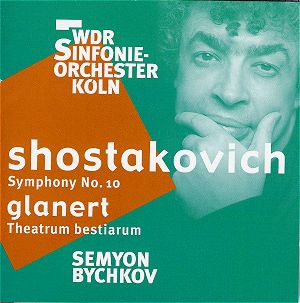
 WDR
Symphonie-Orchester Köln/Semyon Bychkov
WDR
Symphonie-Orchester Köln/Semyon Bychkov
 AVIE
AV2137 SACD [75:06]
AVIE
AV2137 SACD [75:06]