Editorial Board
MusicWeb International
Founding Editor Rob Barnett Editor in Chief
John Quinn Contributing Editor Ralph Moore Webmaster
David Barker Postmaster
Jonathan Woolf MusicWeb Founder Len Mullenger
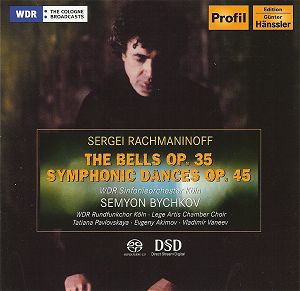
Sergei RACHMANINOV (1873-1943) The Bells (1913) [36:53] Symphonic Dances (1940) [35:55] Tatiana
Pavlovskaya (soprano); Evgeny Akimov (tenor); Vladimir
Vaneev (bass) (Bells)
West German Radio Chorus; Lege Artis Chamber Chorus
WDR Symphony Orchestra Cologne/Semyon Bychkov
rec. September 2006, Philharmonie, Cologne HÄNSSLER
CLASSICS PROFIL PH07028[73:04]
Rachmaninov
composed nothing finer than these two works. Towards the
end of his life he observed that he believed that The
Bells was his finest achievement, a statement that seems
compelling enough. This choral symphony on Constantin Balmont's
free translation of Edgar Allan Poe's The Bells is
preoccupied with the workings of Fate, concerning the four
aspects of human life - birth, marriage (love), terror and
death - as symbolised by four kinds of bells: silver, gold,
brass and iron.
The
imageries evoked by the four sets of bells proved to be a
potent source of inspiration, since their collective symbolism
provided that large scale integration of contrasts which
is implied by the title symphony. Rachmaninov uses his assembled
forces with resourceful imagination in order to characterise
the natures of the bells, believing that the symbolism was
highly significant: 'The sound of church bells dominated
all the cities of Russia that I knew: Novgorod, Kiev, Moscow.
They accompanied every Russian from childhood to the grave,
and no composer could escape their influence.' The music
attempts to capture the moods implied by these titles, and
Semyon Bychkov’s Cologne performance is most impressive in
the way that it generates special atmospheres. All praise
too needs be given to the Hänssler recording team, for the
recording has realistic perspectives and a strongly focused
presence.
The
first movement, The Silver Sleigh Bells, is scored
for tenor solo, chorus and orchestra. The initial rhythmic
idea is strongly characterised, largely because it is so
expertly scored, and the mood thus generated pervades the
whole movement save for the coda. The entry of the solo tenor,
Evegeny Akimov, is certainly distinctive memorable, and he
is also successful in the more lyrical moments.
The Mellow
Wedding Bells, a lyrical slow movement at tempo Lento,
employs a soprano solo with chorus and orchestra. The mood
is one of an idealised happiness, with music which is sensuous
rather than festive. The orchestral textures are more
delicate than those found elsewhere in the work, and again
the solo role is pleasingly taken, this time by Tatiana
Pavlovskaya.
The Loud
Alarum Bells of the third movement deploy chorus and
orchestra alone: no solo voice is used. The music is distinctive
and colourful, and the complex textures and rhythmic changes
contribute much to the drama.
The
finale, The Mournful Iron Bells, is a dark Lento
lugubre for baritone solo, chorus and orchestra, and
Vladimir Vaneev is another idiomatic soloist in this strong
team of performers. Heavy rhythms create the atmosphere;
so too instruments playing in their lowest registers. The
extended melody of the cor anglais is beautifully played
and sets the tone for the whole of this splendid performance.
Towards
the end of his life, Rachmaninov wrote of The Bells:
'I worked on this composition with feverish ardour; and it
remains of all my works the one I love the most.' Bychkov
does justice to the composer’s vision. Among recent recordings
that conducted by Neemi Järvi for Chandos (CHAN 8476) is
particularly successful, though on the whole it is eclipsed
by this new version, in both sound and musical experience.
Rachmaninov composed his Symphonic
Dances towards the end of his life, during the summer
and autumn of 1940. In Bychkov’s performance first
movement is immensely impressive in its rhythmic strength,
the colourful and subtle orchestration enhancing the distinctive
outlines of the material. The very opening, for example,
is sensitively paced in its release of the main theme.
And the long and expressive melody in the lyrical central
episode is atmospherically captured by the solo saxophone
and then the ensemble strings.
The
essential nature of the second movement is that of a slow
and expressive waltz. The influence of Tchaikovsky looms
large, with a brooding and powerful intensity as Bychkov
moulds the music carefully and expressively. The recorded
sound supports the music’s romantic indulgence. The finale
calls once again on two favourite sources of reference for
this composer: the music of the Russian Orthodox Church and
the Dies Irae plainchant. Thus in the closing stages the
music drives forward more urgently, and there is a struggle
for supremacy between a Russian chant and the Dies Irae.
At the point when the former becomes triumphant, Rachmaninov
wrote 'Alliluia' in the score, until resolving on a series
of huge crashes dominated by the resounding timbre of the
tam-tam. Bychkov is undeniably effective here, but not quite
as compelling as André Previn and the London Symphony Orchestra
(EMI 7 69025 2), who indulge the sound of the tam-tam more
fully.
Whatever
the response to details, this imagery was important to Rachmaninov,
who had for some time been in poor health. The three Symphonic
Dances, his final composition, form a remarkable tribute
to the strength of his creative spirit. In 1943, shortly
before his death, he remarked, 'I don't know how it happened,
it must have been my last spark.'
Terry Barfoot
Please support our advertisers below by clicking on the logos for further information.

























 Tatiana
Pavlovskaya (soprano); Evgeny Akimov (tenor); Vladimir
Vaneev (bass) (Bells)
Tatiana
Pavlovskaya (soprano); Evgeny Akimov (tenor); Vladimir
Vaneev (bass) (Bells)