Editorial Board
MusicWeb International
Founding Editor Rob Barnett Editor in Chief
John Quinn Contributing Editor Ralph Moore Webmaster
David Barker Postmaster
Jonathan Woolf MusicWeb Founder Len Mullenger
Gustav
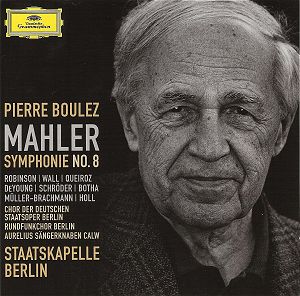
MAHLER (1860-1911)
Symphony No. 8(1908)
Twyla Robinson (soprano); Erin Wall (soprano);
Adriane Queiroz (soprano); Michelle DeYoung
(contralto); Simone Schröder (contralto);
Johan Botha (tenor); Hanno Müller-Brachmann
(baritone); Robert Holl (bass); Tobias
Berndt (organ)
Chor der Deutschen Staatsoper Berlin; Rundfunkchor Berlin;
Aurelius Sängerknaben Calw; Staatskapelle Berlin/Pierre Boulez
rec. Jesus-Christus Kirche, Berlin, April 2007 DEUTSCHE
GRAMMOPHON 4776597 [23:44 + 61:32]
The theme “Veni, Creator Spiritus” runs throughout
this symphony and there’s no mistaking how much the idea meant
to the composer: ignore it at your peril. Mahler doesn’t
place so much emphasis on the theme for nothing. Written
after a traumatic period in his life, the music is a powerful
affirmation of life and of the spirit of creative art. In
many ways it is perhaps the most critical of all Mahler symphonies
because here he crystallises many of the ideas he’s developed
up to this point. It also occupies a critical turning point
in his work, clearing his horizons for Das Lied von der
Erde and the Ninth Symphony. “Come, spirit
of creation” he most certainly meant. It’s in this light
that I write this review.
A composer’s manuscript comes alive when it’s transferred
to sound by a musician, even one just reading the score.
Music “exists” in interpretation. There are people who say “What
can any performer tell me what I don’t already know?” And
perhaps these people are indeed so clever they know everything.
But for others, the more they learn about something, the
more they realise how much there is yet to be discovered.
That’s why people end up with dozens of different performances.
It’s not about finding “the best” or ranking them, but about
engaging with what each performer has to say, in their own
different ways. Because we’re so used to thinking in terms
of recordings, it’s all too easy to forget that, in real
life, a performance is a whole entity,. It’s borne from a
performer’s vision of the piece as a whole, which comes from
the performer’s knowledge and experience, and from his sensitivity
to the composer’s ideas. That’s why it’s important to assess
performance as whole cloth. It’s not pick and mix, one bar
here, another passage from there. Music doesn’t work that
way in the real world.
That’s why I find this performance of Mahler’s great Eighth Symphony so
moving and so profound. It’s very deeply thought-through
indeed. Boulez has lived with this music for more than fifty
years, and approaches this particular performance with an
understanding gained through extremely extensive knowledge.
A lot of marketing
nonsense has been put forth about this being the last
instalment in a “cycle”, but how can a series of recordings
made of decades be a cycle? They are only staging posts that
happened to be recorded on the conductor’s lifelong journey
performing and listening to Mahler, and learning his idiom.
This performance, then, is the culmination of years of intense
involvement. Boulez has never played the usual conductor
circuit: he’s only ever performed what he loves and believes
in, regardless of whether it’s popular or not.
Being a free spirit has meant he’s been able to do innovative
things, such as Domaine Musicale and later the groundbreaking
Ensemble Intercontemporain, which changed how modern orchestras
are organised. He’s been a major champion of composers like
Varèse, Bartók, Carter, Stravinsky, Schoenberg, Debussy,
Wagner, Webern, Messiaen and others. His approach has always
been composer-focused: he goes straight to source and finds
something unique to explore. It’s not about crowd pleasing:
it’s about artistic vision. “Veni, creator spiritus” could
be his life’s theme-tune.
He doesn’t play the gallery like so many more popular
conductors. Perhaps that’s why he’s gained the reputation
for being cerebral, because what he does doesn’t provide
instant gratification, but provokes deeper thought. Persist,
though, past the easy clichés and assumptions, and listen.
There is intensity in his work that isn’t always apparent
on the surface. He doesn’t wear his heart on his sleeve,
but what he does burns with the white hot passion of deep
inner commitment. Even things I haven’t particularly liked
have taught me a lot, and I’ve been the better for the experience.
This man has something to say, and it’s valid even if it
might not be what you “want” to hear.
Now, at last to this particular recording. Earlier this
year, I was in Berlin for the live performance. Although
it’s quite a read, please take the trouble to read my review because it does apply to the recording made only a few days
later.
If nothing else it saves repeating!
This is not an easy symphony to conduct, and many conductors
are happy just to keep it from falling apart. More importantly,
it is sprawling. Mahler’s instructions for breaks between
parts - his word - serve a functional purpose. Note
that he wrote these parts just as carefully as he did complete
movements. Seldom has a performance delineated so clearly
the internal
architecture that shapes this great cathedral of a symphony.
For example, the slow, passages that open the second part
are sometimes glossed over in favour of the glorious finale,
but they are crucially important to creating the contemplative
atmosphere that leads into the super-charged realms to follow.
Just as in other Mahler symphonies, the summit is reached
through a steady climb.
As so often with Boulez, the sense of trajectory is
clearly defined. He knows exactly why details are written
into the score and what they contribute to the whole. For
example, chords ascend ever upwards and outwards to create
a sense of wide, soaring heights (heaven is after all where
we end up). Pater Ecstaticus’s
music expresses movement auf und ab schwebend (soaring
up and down). Later the angels lift Faust’s soul and they
fly off in der höheren Atmosphäre. Details like this
aren’t observed for their own sake, but because they are
thoroughly integrated in the grand progression. In this recording
the feeling of space becomes quite beautifully three dimensional,
as the sound fills the space of the Berlin church in which
it was recorded - with an audience, incidentally.
Similarly, Boulez observes details which connect the
symphony to other parts of Mahler’s work, enhancing the depth
of meaning. For example, the recurring
references to Das himmlische Leben, which again connect
to moments in the Fourth Symphonyand of
course to the Wunderhorn songs. Similarly, there’s
the passage in the second part which presages ideas from Von
Der Schönheit,
and links the piece to what is to come. This is an extremely
literate reading of the symphony, in the sense that Boulez
at once conducts the piece at hand, yet is totally attuned
to the composer’s whole repertoire and its subtle, intricate
relationships.
It’s
a good interpretation, too, because it shows the Eighth as
the ultimate Song Symphony, a genre Mahler so innovatively
created. Songs is so fundamental to everything Mahler does
that it is essential to understand its role and significance.
In the simplest terms, passages from songs amplify the meaning
and scope of the orchestration, such as in the First Symphony,
where the Lieder eines fahrenden Gesellen amplify
themes of spring and repose. Significantly, as the Second,
Third and Fourth symphonies
reach their destination, Mahler brings in song, for the vocal
parts express
meaning more specifically than music alone. By the Eighth
symphony the apotheosis of song symphony is reached. “So
far I have employed words and the human voice to express
symphonically”,
he said, “But here the voice is also an instrument … used
not only as sound, but as the bearer of poetic thoughts”.
With Das Lied von der Erde, Mahler is using song in
a completely different, almost minimalist way.
“Poetic
thoughts”. That’s significant, too, and contrary to common
assumption, perhaps the most important part of Boulez’s conception.
Mahler repeats over, and over, what the symphony means to
him. “Veni, creator spiritus” keeps recurring in words
and music, as does the “Accende lumen sensibus” motif. “Illuminate
our sense with creative light”. Mahler doesn’t mess about,
but emphasizes the motifs with brass fanfares, alarums heralding
that something very important is about to happen. So Boulez
thinks about what Mahler might be trying to say. Again, this
comes from a very profound understanding of Mahler’s ideas
and creative processes. For too long, we’ve assumed that
Mahler somehow “has” to be neurotic, death-obsessed and gloomy.
But notice how he ends nearly every symphony, with a finale
that speaks of resurrection, rebirth, reconciliation and
transcendence. Again and again, he uses the imagery of light,
upwards movement. The finale of the Second Symphony doesn’t
grow out of Urlicht for nothing. Even Boulez’s daring
experiments with high voices and low on his Mahler Songs
recording falls into place once this primary concept of light
and darkness is understood. Thus he illuminates the Eighth more
clearly and glowingly than I’ve ever heard it. The second
part of this symphony contains the most ecstatic, exuberant
music Mahler ever wrote, for in it he’s expressing no less
than triumph over death, and redemption through love and
art. It’s meant to be exhilarating. It’s all too easy to
assume it’s merely elaborate, and play up its theatricality,
drowning its real meaning in a cloying molasses of maudlin
sentiment. Here again, Boulez’s clear-sighted, uncompromising
vision comes to the fore. Indeed I can‘t remember any other
conductor approaching this part with such lucid intelligence.
Boulez’s light is clean, pure and refined, all the more moving
because it doesn’t employ conventional prettiness.
This
is a truly amazing performance, exceptionally vivid and life-affirming.
Performances throughout were excellent. It’s almost petty
to single out individual, singers in a performance as well
integrated as this where everyone seemed totally enthused
and motivated. That’s something often overlooked on recordings,
but here it’s palpable. This is a team effort and everyone’s
on the ball. “Veni, creator spiritus” touched them
all!
Usually,
I wouldn’t mention sound, particularly in a performance like
this which was so spiritually uplifting that mechanical processing
should be irrelevant, but before the concert at the Philharmonie,
someone from German radio gave a talk about how good recording
can enhance balance in a symphony as big as this. He was
right. Where I was sitting, the male voices didn’t come over
so well, but on the tapes, they are in better focus.
Altogether,
this is a performance recommended to anyone who wants to
get closer to Mahler, and to the very spirit of artistic
creativity. I’m proud to say that, after all these years,
Boulez has made me realize how much there is still to be
learned about Mahler, and why performers get so much out
of his music.
Anne Ozorio

























 Twyla Robinson (soprano); Erin Wall (soprano);
Adriane Queiroz (soprano); Michelle DeYoung
(contralto); Simone Schröder (contralto);
Johan Botha (tenor); Hanno Müller-Brachmann
(baritone); Robert Holl (bass); Tobias
Berndt (organ)
Twyla Robinson (soprano); Erin Wall (soprano);
Adriane Queiroz (soprano); Michelle DeYoung
(contralto); Simone Schröder (contralto);
Johan Botha (tenor); Hanno Müller-Brachmann
(baritone); Robert Holl (bass); Tobias
Berndt (organ)