Editorial Board
MusicWeb International
Founding Editor Rob Barnett Editor in Chief
John Quinn Contributing Editor Ralph Moore Webmaster
David Barker Postmaster
Jonathan Woolf MusicWeb Founder Len Mullenger
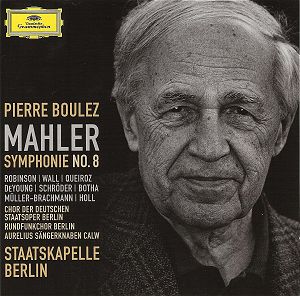
Gustav MAHLER (1860-1911)
Symphony No. 8 in E flat major (1906) [85:16] Magna Peccatrix:
Twyla Robinson (soprano)
Una poenitentium: Erin Wall (soprano)
Mater gloriosa: Adriane Queiroz (soprano)
Mulier Samaritana: Michelle DeYoung (contralto)
Maria Aegyptiaca: Simone Schröder (contralto)
Doctor Marianus: Johan Botha (tenor)
Pater ecstaticus: Hanno Müller-Brachmann (baritone)
Pater profundus: Robert Holl (bass)
Chor der Deutschen Staatsoper Berlin/Eberhard Friedrich
Rundfunkchor Berlin/Simon Halsey
Aurelius Sängerknaben CALW/Eberhard Friedrich
Tobias Berndt (organ)
Staatskapelle Berlin/Pierre Boulez
rec. April 2007, Jesus-Christus-Kirche, Berlin, Germany.
Texts and translations provided DEUTSCHE
GRAMMOPHON 477 6597 [23:44 + 61:32]
It’s
hard to believe that Pierre Boulez, the avuncular figure
with the bad comb-over, was one of the great musical iconoclasts
of the 1960s. Equally difficult to grasp, perhaps, is the
fact that he has been conducting Mahler for some time now,
starting with his tenure at the BBC Symphony Orchestra from
1971 to 1975. But his interest in the composer goes back
even further than that; in an interview with Süddeutsche
Zeitung in January 2007 he admits to ‘discovering’ Mahler
in 1958, mainly through the songs.
It’s
only with this DG cycle – of which the 8th is
the final instalment – that Boulez has gained wider recognition
as a Mahler ‘interpreter’ - a description Boulez dislikes,
preferring instead to see himself as a composer. Admittedly
the DG recordings span a number of years and include various
bands but there have been some very fine readings along the
way, most notably the 6th Symphony (DG 445 8352)
and the songs with Anne Sofie von Otter, Violeta Urmana and
Thomas Quasthoff (DG 477 5329). These stand out as remarkable
achievements and are worthy additions to the Mahler canon.
The other symphonies are less distinguished and in some cases – the
2nd and 7th for instance – one might
be tempted to think Boulez the composer gets in the way of
the music, with readings that sacrifice warmth and structure in
favour of forensic detail.
But
whatever one might feel about this cycle in general – and
few, if any, are recommendable in their entirety – the composer’s
eye does yield some wonderful insights, especially in the
more chamber-like song settings. There Boulez finds great
transparency and a limpid beauty that is utterly convincing.
No doubt the Wiener Philharmoniker have something to do with
that, as indeed they do in his blazing, trenchant reading
of the 6th, a symphony in which Boulez has few
rivals, let alone equals.
The
penultimate recording in this cycle, the ‘Resurrection’,
was a disappointment, not least because of its variable soloists.
Perhaps Boulez is less convinced of the merits of the two ‘choral
symphonies’ than, say the 6th and 9th.
That’s not necessarily a criticism – after all Klemperer
didn’t conduct them all – but the 2nd and 8th need
rather more advocacy than most if they are to succeed.
Superficially
at least these two symphonies have much in common, with their
extended choral writing and final sublimation, not to mention
their structural challenges. This recording of the 8th followed
hard on the heels of a much-praised Berlin performance last
April, the broadcast of which gave some idea of what to expect;
broad, but not too much so, analytical without being clinical,
a real sense of drama in Part I and some excellent choral
singing. But even making allowances for the differences between
a live performance and a recording the latter seems much
less cogent or involving.
One
of the major let downs in both the broadcast and recording
must be the soloists, a rather ill-matched team who never
really rise to the occasion. The men are perhaps more successful
than the women – Michelle DeYoung’s vibrato is just as much
a distraction here as it was in the Boulez ‘Resurrection’ – but
that isn’t saying much. Curiously, the soloists aren’t particularly
well blended in Antoni Wit’s surprisingly successful set
(Naxos 8.550533-34 - see review) but then he seems to have
a feel for the score’s ebb and flow that Boulez seems to
miss.
That
great first movement is all about ebb and flow. From the
start of Hrabanus’s great hymn it’s clear there is much weight
and drive in this reading, the choruses singing with great
precision and bite. The organ sound, massive as it is, rather
lacks body, which is a pity, but that’s more of a problem
at the end of Part II. For their part the soloists don’t
sound at all ‘possessed’ by the creative spirit, especially
in ‘Imple superna gratia’ (track 2).
The
choral contributions, though, are uniformly good, the soundstage
nicely tiered with the choruses spread convincingly from
left to right. For some reason Boulez soon puts on the dampers
and the creative fire begins to dwindle. Where other conductors
find a nervous energy Boulez seems to prefer a calmer, broader
approach, which only serves to point up the soloists’ shortcomings.
(Just listen to DeYoung’s unlovely contribution to ’Infirma
nostri corporis’.) At that great surge, ‘Accende lumen sensibus’,
the choruses do achieve a certain radiance, although there
is little of the ecstasy that others divine at this point
(and that strange, flat, organ sound doesn’t help matters
much).
After
the bitterness and the doubts the return of ‘Veni creator
spiritus’ should also be much more thrilling than it is here.
Boulez certainly doesn’t skimp on the volume but the reprise
just doesn’t have the incandescence that Mahler surely demands
(after all it is a work about creative regeneration, in part
at least). Nor is the ‘Gloria sit Patri Domino’ as transported
as it can be, although the timps and lower brass are
admirably presented. The choruses are the real stars here – how
clear their diction, how focused their sound – so it’s all
the more disappointing that the close of Part I doesn’t blaze
with the intensity of, say, Tennstedt (EMI 3615722) or Solti
(in his Decca Legends set 460 972-2).
It’s
not just about weight and thrust, of course. Boulez seems
to see this music as a precursor to Berg rather than a throwback
to the 19th century. In that sense he finds a
marvellous poise and transparency in the Faust setting
in Part II, especially in the Poco adagio. Rarely has this
music sounded so diaphanous. The Staatskapelle Berlin play
with real unanimity, their every note and nuance clearly
audible. So how does Boulez manage to make this music sound
so frigid, so detached? Other conductors find an ethereal ‘otherness’ here
without sacrificing overall warmth (Wit especially, with
some unexpected sonorities).
Full
marks to the two choruses, who manage to combine clarity
with a modicum of mystery and wonder. Hanno Müller-Brachmann
is a secure if not particularly characterful Pater ectaticus
in ‘Ewiger Wonnebrand’, but Robert Holl’s Pater profundus
is much less steady. Johan Botha acquits himself well as
Doctor Marianus, firm and ardent, while Erin Wall’s Una poenitentium
is suitably rapt. The DG engineers capture some gorgeous
sounds – listen to the harps in track 11 – but all too often
there is a sense of stasis that robs the music of its essential
drive and energy.
There
are moments when the flame is fanned into life – the boys
of the Aurelius choir are appealingly fresh and vigorous
in track 14 – but Boulez does his usual party trick and brings
the music to a standstill once more. Only at the Mater gloriosa’s
invocation ‘Komm! Hebe dich zu höhern Sphären!’ does the
pace pick up again but by then one might be forgiven for
thinking the movement is beyond repair.
Jascha
Horenstein’s classic 1958 account with the LSO and a fine
array of soloists (BBC Legends BBCL 4001-7) has an unmatched
sense of symphonic logic, of inevitability, that is just
remarkable to behold. The way he unerringly builds towards
that great climax makes Boulez seem positively soporific
by comparison. That said the Berlin choruses take the honours
again with some incandescent singing at the close; what a
shame that Boulez makes the final peroration sound hopelessly
overextended, bombastic even.
Few
performances of this great score are totally without merit
but, goodness, this comes close. As the final instalment
in Boulez’s Mahler cycle this could scarcely be more disappointing.
Indeed, it is the kind of performance that gives the nay-sayers – of
which there are many – reason to dismiss all Mahler’s music
as incoherent and overblown.
If
you are looking for a good performance of the 8th there
are plenty to choose from, all much more satisfying in their
different ways. The Solti/Chicago set is essential (even
if the sound is crudely compressed at times), as is the wayward
but visceral Bernstein with the LSO on Sony Classics 517493
2. Of more recent accounts the Wit is an excellent bargain;
even more so is Michael Gielen’s single-disc version recorded
at the re-opening of the Alte Oper, Frankfurt, in 1981 (Sony
SBK48281).
But
for something uniquely inspiring Horenstein’s live Albert
Hall performance – almost fifty years old but in excellent,
atmospheric stereo – has all the drama, intensity, intoxication
and spiritual grandeur you could possibly want. Now that’s what
this score is all about.
Dan
Morgan
Please support our advertisers below by clicking on the logos for further information.

























 Magna Peccatrix:
Twyla Robinson (soprano)
Magna Peccatrix:
Twyla Robinson (soprano)