Only last year I encountered
Lorraine
Hunt Lieberson’s wondrously expressive
recordings of two cantatas by Bach.
It was only the fact that this was not
a brand new recording – though it was
new to me – that, eventually, decided
me against nominating it as one of my
Recordings of the Year.
Now along comes another
extraordinary recording, which has similarly
bowled me over. This time it’s of contemporary
music, a set of five songs composed
for her by her husband, Peter Lieberson.
The texts are love poems by the Chilean
composer Pablo Neruda (1904-1973) and
they come from his collection, Cien
Sonetos de Amor. These, I believe,
were addressed by Neruda to his own
beloved, Matilde Urruitia. Lieberson
sets them in the original Spanish.
The songs were jointly
commissioned by the Los Angeles Philharmonic,
with whom Miss Hunt Lieberson gave the
première, and the Boston Symphony.
The present recording derives from public
performances given with the latter orchestra
only a matter of months before the singer’s
death in July 2006.
Inevitably, there’s
a great deal of emotion associated both
with the songs themselves and with the
performance. Lieberson wrote them for
his wife to celebrate their relationship
and in the full knowledge of her mortality.
In reviewing this disc I’ve tried to
listen as objectively as possible and
I believe that what we have here is
a collection of great songs.
Lieberson has scored
them with great subtlety and resourcefulness.
The orchestration is fairly light. The
orchestra consists of two flutes (one
doubling piccolo), oboe, two clarinets
(one doubling bass clarinet), two bassoons,
a pair each of horns and trumpets, harp,
piano, some percussion, which is sparingly
deployed, and strings. The scoring is
generally translucent and often quite
restrained. The vocal line, by contrast,
is simply glorious. Consistently it’s
full of melodic interest and the way
in which the composer responds to the
often-arresting imagery of the poems
is quite astonishing.
My colleague, Patrick
Waller, has pointed out to me that the
very opening of the first song carries
harmonic echoes of the Berg Violin Concerto.
Indeed, it seems to me that Berg casts
a beneficent shadow over the whole song.
Lieberson’s music is ardent, even when,
superficially, it appears to relax.
There’s a sultry languor to the writing
– in fact, that’s a feature of all the
songs – and Hunt Lieberson invests the
music with great emotion, especially
by savouring and using such words as
"fragrante" and "bienamada";
though sung here by a woman the original
poems were, of course, addressed by
a man to a woman.
The second song is
rather more lively and dramatic in tone
yet even here there are still long,
voluptuous vocal lines to savour. The
orchestration, though light, is vivid
and suggestive. In the third song we
confront, in the composer’s words, "the
fear and pain of separation". The
music is heavy with apprehension at
the consequences of parting, as is the
original poem. The richly expressive
vocal line is sparingly but tellingly
supported by the orchestra. The very
end of the song is especially moving.
Here the singer softly repeats several
times the single word, "muriendo"
("dying"), accompanied, eventually,
by a desolate little oboe counter-melody.
The fourth song is
the longest and it opens with exultant
cries of "Ya eres mia" ("And
now you’re mine."). Soon a slow
bossa-nova rhythm is established, enhanced
by gentle maracas. This is the most
overtly passionate of all the songs
and a few heady orchestral outpourings
- for example between 3:25 and 4:05
- illustrate vividly the poet’s sense
of exultation at possessing his beloved.
However, the setting of the last pair
of lines, beginning at 5:36, is delicate
and dreamlike. Musically and emotionally
these bars prepare us for the final
song.
This last song is where
the whole work has been leading. It’s
a profound utterance, a song of aching
sadness. Quite simply, it’s one of the
most moving pieces of music I’ve heard
in a long time and when I played the
CD through for the first time I played
this last song three times consecutively,
so great an impression did it make.
Neruda conjures up moving images of
infinity and wide-open spaces to suggest
the vast vistas of love. Above all,
I’m captivated by his image of love
as "como un largo rio" ("like
a long river") and by how Miss
Hunt Lieberson inflects those words
each time they appear! Particularly
striking is the passionate outburst
at "oh perqueño infinito!
devolvemos". ("O little infinity!
we give it back."), followed immediately
by the consolatory tone of Lieberson’s
music for the next line: "Pero
este amor, amor, no ha terminado."
(But Love, this love has not ended.").
The setting of the
last four lines (from 4:56) is as ineffably
moving as are Neruda’s words and Lorraine
Hunt Lieberson pours out her very self
into their delivery. At the end, thank
goodness, there is silence: applause
would have been a grotesque intrusion.
It’s very difficult
to judge these songs outwith the context
in which they were conceived. I hope
that other singers will not fear to
take them into their repertoire; perhaps
Joyce DiDonato or Susan Graham? Their
onlie begetter has given them
an unforgettable performance but they
must have a wider circulation – and
soon. As it is, I’m convinced that Peter
Lieberson has created a masterpiece.
Patrick Waller has listened to them
followed by the Berg concerto to which
I referred earlier and he tells me that
the two pieces make for a most satisfying
recorded concert. Might I suggest that
an equally apposite pairing might be
Mahler’s Ninth Symphony?
Though I’m impatient
to hear these songs performed by other
singers this present performance is
unlikely ever to be surpassed. For me
it represents the apogee of Lorraine
Hunt Lieberson’s uniquely intense and
communicative artistry. She is superbly,
sensitively supported by James Levine
and the Boston Symphony in what is surely
a landmark recording.
It has been a deeply
moving and satisfying experience for
me to become acquainted with these wonderful,
luminous songs on this outstanding disc.
John Quinn
See also review by Anne
Ozorio February Recording
of the Month
























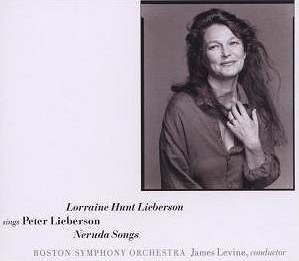

 Lorraine Hunt Lieberson (mezzo)