Editorial Board
MusicWeb International
Founding Editor Rob Barnett Editor in Chief
John Quinn Contributing Editor Ralph Moore Webmaster
David Barker Postmaster
Jonathan Woolf MusicWeb Founder Len Mullenger
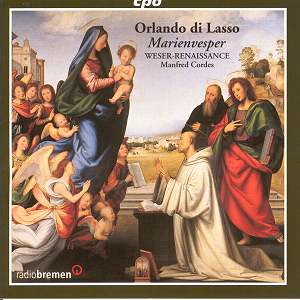
Orlando di
LASSO (LASSUS) (1532-1594) Marienvesper Introitus [1:16] Dixit Dominus [7:05] Laudate Pueri [6:13] Laetatus sum [8:25] Nisi Dominus [6:55] Lauda Jerusalem [10:02] Responsorium [5:13] O gloriosa Domina [5:05] Salve Regina [3:16] Magnificat [6:28] Salve Regina [3:18] Benedicamus [0:39] Weser-Renaissance:
Susanne Rydén (soprano); Monika Mauch
(soprano); Marnix De Cat (alto); Hans Jörg Mammel (tenor);
Johan Linderoth (tenor); Kees Jan De Koning (bass); Job
Boswinkel (bass); Gephard David (cornett); Frithjof Smit
(cornett); Ole Andersen (trombone); Wim Becu (trombone);
Adam Woolf (trombone); Adrian Rovatkay (dulcian)/Manfred
Cordes
rec. 11-13 July, 2005, Stiftskirche Bassum, Germany. DDD CPO 777 182-2 [64:22]
This excellent CD consists of a series of compositions
representative of the variety of sacred pieces that Lassus
wrote for the celebration of Vespers at the court of the
Wittelsbach dukes at Munich in the second half of the sixteenth
century.
It was in 1556 that Lassus, born in Mons in what is now
Belgium, was first engaged at the court in Munich. Not until
1563, though, did he also assume full responsibilities for
sacred music at Munich, when he was able to build on a rich
and solid tradition that had been established in recent generations
by his predecessors. Particularly loved by the dukes were
the psalm motets composed by Lassus for Vespers as sung regularly
at court.
Munich was a court, it is to be noted, where veneration
of the Virgin Mary played an important part in that city’s
role in the Counter-Reformation. And it’s sure that the motets
presented on this CD were amongst those heard on the many
feast days devoted to the Virgin in the sixteenth century.
Celebrations actually began with Vespers on the day before
the official feast… on the evening of 14 August for the Assumption
on 15 August, for example. Then, second Vespers were celebrated
in the next early afternoon in order for Compline to complete
the day’s liturgical events before the evening meal.
There were many variations on what could constitute Vespers
in Lassus’ time. The importance of the occasion dictated
what was included and what was not; and the forces at Lassus’ disposal;
and which members of the ducal family and entourage were
in attendance. Psalms with simple monophonic chants were
simplest though Lassus also wrote polyphonic (up to eight-part)
settings with attendant antiphons, responsories and hymns.
He is known to have incorporated material by Ludwig Senfl,
who had been at Munich since 1523, in some of the works he
composed for various of these Vespers services.
Performance of the dozen items here is necessarily in some
senses speculative: we know both that the organ played colla
parte and that the vocal ensemble probably consisted
of between fifteen and twenty adult males and a dozen or
so boys’ voices. Soloists would have taken passages that
were intended to have special emphasis. Contemporary accounts
also describe some instrumental accompaniment (by cornets
and trombones, for instance) where this was consistent with
the building and its acoustics. As the informative notes
(which also include original Latin texts with German and
English translations) in the CD liner point out, there will
have been many occasions when restrictions dictated by court
etiquette meant that there would have been as many players
as listeners!
Weser-Renaissance (an ensemble of singers and instrumentalists
some thirteen strong) is ably led by Manfred
Cordes. Perhaps the single most striking qualities of their
performance here are dignity and gravitas. Which is not to
say that their approach is over serious: you only have to
hear the zest and lift which they elicit from the Dixit
Dominus or Lauda Ierusalem, for example, to understand
how closely they are in touch with Lassus’ idiom and musical
and liturgical intentions.
The
next attribute of their performance style that impresses
is a meticulous attention to pure and purposeful articulation:
the embrace of words and melody, texture and structure in
the Laudate Pueri, for instance, truly does make the
listener - or participant – pause to appreciate the object
of the praise, rather than merely walk though a perfunctory
orison. There is real compassion and empathy, for instance,
at ‘et de stercore erigens pauperem’… the pauper lifted from
the mud.
Nor
is this identification with the soul of the music the result
of a spurious ponderousness in pace (though most of these
pieces are indeed taken slowly) or lack of effusiveness.
You feel as though you are being allowed to respond to Lassus’ intentions
directly as much as anything because the integrity of what
he wrote here is so closely respected by Weser-Renaissance.
The composer’s
individual imagination is rendered as prominent by these
sensitive interpreters as is his use and adaptation of contemporary
conventions. The deliberate and calm (not to say almost calming)
unfolding of Laetatus Sum, could so easily become
a dance-like or superficial exposition of emotions (fulfilment,
gratitude) which we may know in one form or another. Instead,
the soloists and ensemble here approach the rather scant
weave as if this were the first time either performer or
listener had encountered those emotions.
The stated aim of Manfred Cordes, one of whose specialities
is the relationships between key and affect in Renaissance
music, is to present the best blend possible between ‘flawless
musicology’ and ‘animated presentation’. That they do not
make this aim sound at all contradictory on this disc is
indicative of their – and the CD’s – success. It’s thoroughly
recommended, then, both as an introduction to this corner
of sixteenth century polyphony and as an example of how to
capture the musico-liturgical intentions of one of its greatest
exponents when working in this devotional framework.
Mark Sealey
Please support our advertisers below by clicking on the logos for further information.

























 Weser-Renaissance:
Susanne Rydén (soprano); Monika Mauch
(soprano); Marnix De Cat (alto); Hans Jörg Mammel (tenor);
Johan Linderoth (tenor); Kees Jan De Koning (bass); Job
Boswinkel (bass); Gephard David (cornett); Frithjof Smit
(cornett); Ole Andersen (trombone); Wim Becu (trombone);
Adam Woolf (trombone); Adrian Rovatkay (dulcian)/Manfred
Cordes
Weser-Renaissance:
Susanne Rydén (soprano); Monika Mauch
(soprano); Marnix De Cat (alto); Hans Jörg Mammel (tenor);
Johan Linderoth (tenor); Kees Jan De Koning (bass); Job
Boswinkel (bass); Gephard David (cornett); Frithjof Smit
(cornett); Ole Andersen (trombone); Wim Becu (trombone);
Adam Woolf (trombone); Adrian Rovatkay (dulcian)/Manfred
Cordes