Liszt first coined
the phrase Symphonische Dichtung in 1853 to describe
works inspired by poetry, painting or historical characters.
Of course he wasn’t the first to write programme music – Beethoven
did it with his Pastoral Symphony in 1808 and Berlioz
did it with his Symphonie Fantastique in 1830 – but unlike
his predecessors Liszt sometimes adds a philosophical framework
as well. It’s a gamble because the music has to bear some extra-musical
weight that can – and often does – impede the free flow of musical
ideas.
That is why Liszt’s
symphonic poems really need the strongest and most sympathetic
of advocates if they are to succeed in either sphere. Mazeppa,
based on the fourth of Liszt’s Études d’exécution transcendante
for piano, is a good old potboiler about illicit love, cruel
punishment and just revenge. It is Liszt at his most descriptive,
without the cumbersome philosophical bolt-ons, and the BBC Phil
respond to the challenge with some heroic brass and percussion
playing. With subject matter as raw and atavistic as this one
might expect rather more red-blooded music and music-making
but that just isn’t Liszt’s – or Noseda’s – way.
And that, in a nutshell,
is what this disc delivers – playing that is never less than
accomplished, occasionally spectacular and rarely moving. Admittedly
Liszt is part of the problem here, with orchestral textures
that are apt to thicken and coagulate and. thin material that
is simply not substantial enough to generate musical momentum.
Just listen to the overlong final peroration in Mazeppa which,
despite some sizzling orchestral playing, teeters on the edge
of bombast.
The Héroïde funèbre
of 1857 is perhaps most similar in its sound-world to Berlioz’s
Symphonie Funèbre et Triomphale of 1840, although
there is little to be triumphant about here. Conceived as a
hymn to the transfiguring power of Art, this three-movement
funeral march is pretty bleak. The mood of the opening Lento
lugubre, with its bass and military side drums, is briefly
lightened in the Più lento, where a noble melody rises from
amidst the devastation to be joined by augmented timpani and
brass. As ever Noseda seems to hold back, tempering nobility
with stoicism. Even when the bells ring out and the work moves
to its ambiguous close it is clear that this victory, hard fought,
is hard won.
The theme of ‘suffering
and apotheosis’ - Liszt’s own words - is carried through to
Prometheus of 1850. The players easily capture the ‘sultry,
stormy and tempestuous mode of expression’ (Liszt again) with
an arresting staccato opening; but, oh, how one longs for them
to really let rip in those big tuttis. Chandos can usually be
relied upon to provide a deep, sonorous soundstage with plenty
of bite and detail but here the sound is much too claustrophobic,
adding to the general air of bloat and congestion. Sadly Prometheus
is the work that promises the most yet delivers the least. For
genuine Promethean fire Scriabin’s Prométhée (1910) is
altogether more visceral. Try Riccardo Muti and the Philadelphia
Orchestra on EMI 5677202. Now there’s an example of strong advocacy
aided by music-making of incandescent power.
Festklänge
(1854) is the only symphonic poem that isn’t based on a programme.
That said Liszt referred to it as ‘my wedding music’, its central
polonaise inspired by his intended betrothal to the Princess
Carolyne von Sayn-Wittgenstein. Liszt made quite a few cuts
to the score at a later stage but it is the original version
that is played here.
At just over 19
minutes the not very festive Festklänge is one of the
longest works on this disc – and it shows. The close recording,
the dragging tempi and the succession of rhetorical flourishes
is more than the music can bear. Noseda’s approach is just too
prosaic, crying out as it does for more joie de vivre, more
light and air.
If you must have orchestral Liszt then Masur
on EMI’s double fforte label and Haitink on Philips Duo
are good alternatives, generally well played and well recorded.
But one cannot pretend this repertoire is Liszt at anywhere near
his best – for that you need to look to his piano pieces – and
with performances as resolutely earthbound as this you will need
to search elsewhere for real musical inspiration.
Dan Morgan
























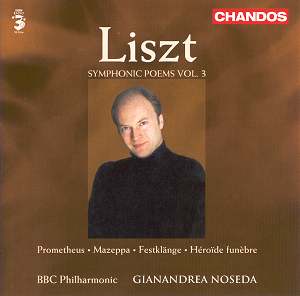

 BBC Philharmonic
Orchestra/Gianandrea Noseda
BBC Philharmonic
Orchestra/Gianandrea Noseda