Editorial Board
MusicWeb International
Founding Editor Rob Barnett Editor in Chief
John Quinn Contributing Editor Ralph Moore Webmaster
David Barker Postmaster
Jonathan Woolf MusicWeb Founder Len Mullenger
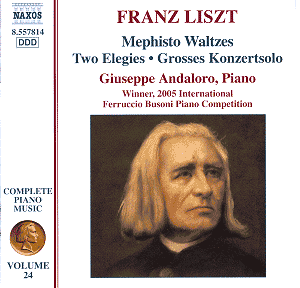
Franz LISZT (1811-1886) Complete Piano Music, Vol. 24 Four Mephisto Waltzes (1856-85) [36:04]: (No.
1, (1856-61) S514 [12:05]; No. 2, S515 (1878/79-81) [11:12];
No. 3, S216 (1883) [9:48]; No. 4,
S696 (1885) [2:59] ) Two Elegies (1874-78) [10:58]: (No. 1,
S196 (1874) [5:45]; No. 2, S197 (1878) [5:13]) Grosses Konzertsolo, S176 (1849-50) [23:08] Giuseppe
Andaloro, piano
rec. 8-9 March 2005, Potton Hall, Westleton, Saxmundham,
Suffolk. DDD NAXOS 8.557814 [70:10]
This twenty-fourth volume in
the Naxos series of Liszt’s complete
piano music contains a mixture of the known and the relatively
unknown. Performed by Italian pianist Giuseppe
Andaloro the music on this disc comprises works of
a mixture of lengths, including a fine example of one of
Liszt’s ventures into larger forms, namely his substantial Grosses
Konzertsolo, S176.
The Palermo-born Giuseppe Andaloro has been successful
in a number of piano competitions including the prestigious
2005 Ferruccio Busoni competition in Bolzano. A student of
the renowned pianist and teacher Sergio Fiorentino from Naples,
Andaloro is also active as a conductor and a composer.
Liszt is best known as a virtuoso pianist, although, he was
also a major influence as a progressive composer who according
to
biographer Cecil Gray created, “some of the greatest and
most original masterpieces of the nineteenth century.” A
prolific and versatile composer Liszt produced over seven
hundred scores covering most genres of which over half were
piano compositions.
Although Liszt’s name is extremely well known a large proportion
of his compositions remain neglected. With the exception
of
a small number of frequently recorded warhorses and the temporary
resurgence in interest for the centenary of his death in
1986, Liszt is, I believe, a composer who is currently out
of vogue. The same could be said about Gounod and Franck
whose music seems to be suffering the same ignominious fate.
Liszt’s Four Mephisto Waltzes were undoubtedly inspired
by Faust, Ein Gedicht by the Hungarian-Austrian
Romantic poet Nikolaus Lenau. The Mephisto Waltz No. 1,
the second of the Two episodes from Lenau’s Faust,was
originally known as ‘Der Tanz in der Dorfschenke’ (The
Dance in the Village Inn). The score was first heard
in Liszt’s orchestrated version with the piano score dedicated
to Liszt’s former pupil the young pianist Carl Tausig. In
this interpretation the wild and thrilling heights of the
opening section contrast superbly with the melting tenderness
of the central Espressivo amoroso.
Dating from the years 1878-81 the Mephisto Waltz No. 2 was
heard in its orchestral version at Budapest in 1881 and dedicated
to Saint-Saëns. Andaloro once again provides an assured change
of mood from the devil’s diabolical activities to the welcome
mood of absolute relaxation from 3:01 (track 2). Most impressive
is the thrilling conclusion, overflowing with zest and ardour.
Composed in 1883 the Mephisto Waltz No. 3 is dedicated
to Liszt’s
former pupil Marie Jaëll, the piano prodigy and composer.
Here Andaloro builds up an impressive degree of tension providing
powerful and exhilarating playing. From 1885 the Mephisto
Waltz No. 4 lay unfinished and unpublished for some time.
Liszt left some sketches for a contrasting Andantino section
that he probably intended to incorporate into the score.
In this brief Mephisto Waltz No. 4 our confident Italian
soloist provides robust playing with a gripping sense of
urgency.
Liszt’sTwo Elegies were written in 1874 and 1878 respectively.
The First Elegy was composed in memory of Madame Moukhanoff-Kalergis
(née Countess Marie Nesselrode) who was a talented pianist
and member of Liszt’s circle. A work notable for an intense
sense of grieving evident throughout. The Second Elegy bears
a dedication to Liszt's biographer Lina Ramann and has been
described as being, “a work of tender melancholy.” In
the First Elegy Anadaloro displays a deep concentration
in a heartfelt performance and in the Second Elegy one
feels a deep sadness from our accomplished communicator.
The passionate climax that builds from 3:04 (track 6) is
just sensational.
Liszt composed his substantial and single movement Grosses Konzertsolo,
S176 between 1849 and 1850. Although intended as a
competition score for the Paris Conservatoire, the dedicatee,
the gifted virtuoso pianist Adolf Henselt, declared that
he was unable to play it. Liszt also produced an extended
version for piano and orchestra titled the Grand Solo
de Concert, S365. Some time before publication in 1851
Liszt revised the Grosses Konzertsolo by adding
an Andante sostenuto central section also reworking
later stages of the piece creating a single span three-sections-in-one
movement. In 1856 Liszt went on to make an arrangement
of the Grosses Konzertsolo for two pianos titled
the Concerto pathétique, S258.
The extended Grosses Konzertsolo is a study of technique and
concentration in which Andaloro takes a vice-like grip and
directs the listener on a remarkable musical journey. An
epic score, the Grosses Konzertsolo deserves to be
heard far more frequently in recital. Sadly the accessibility
of the work is hindered by its substantial length.
Closely recorded at Potton Hall in Suffolk this Naxos disc
has the advantage of an exceptional sound quality being bright
and
crystal clear. Keith Anderson’s booklet notes match his usual
high standard.
For
those wishing to explore outside the more usual genre of Liszt’s
piano works and symphonic poems I have prepared a list of a
number of performances of fascinating Liszt works that have
provided me with considerable enjoyment. Given the
relative neglect of the music in recent times it is hard to
imagine just how esteemed he was in his day. As a strong advocate
of the music of Liszt I believe one of his most enduring genres,
and frequently his most neglected, is his often revelatory
sacred music. The listing is
contained at the end of my review of
Liszt’s Via Crucis on the Naïve
label.
Pianist Giuseppe Andaloro is indeed an inspired choice as soloist.
One senses his complete involvement with the significant
demands of Liszt’s challenging music.
Reviews
from previous months Join the mailing list and receive a hyperlinked weekly update on the
discs reviewed. details We welcome feedback on our reviews. Please use the Bulletin
Board
Please paste in the first line of your comments the URL of the review to
which you refer.













 Giuseppe
Andaloro, piano
Giuseppe
Andaloro, piano