When
I was young Erich Wolfgang Korngold was not held in very high
esteem by the musical establishment. True, he had written a
violin concerto that was played by great violinists like Heifetz
and Perlman, but in the main he was written off as a composer
of kitschy film music for Hollywood. The standing and now desperately
stale joke was that his music was more corn than gold. I still
came across some of his music. On a German opera recital by
the young Herrmann Prey there was Pierrot’s song from Die
tote Stadt, which I fell in love with and an LP album with
historical recordings by Lotte Lehmann included both Glück,
das mir verlieb (with Richard Tauber) from the same opera,
and Ich ging zu ihm from Das Wunder der Heliane
– eternal favourites both. Then in the mid-1970s came a renewed
interest in Korngold: the violin concerto appeared in a new
recording from Ulf Hoelscher (EMI), the symphony with Rudolf
Kempe (Varese-Sarabande), two volumes in RCA’s Classic Film
Music series and, on the same label, Die tote Stadt under
Leinsdorf with Neblett, Kollo, Luxon and Prey. The wagon continued
to roll: piano music, chamber music, more orchestral music and
the operas Violanta, Das Wunder der Heliane and Die
Kathrin, his last stage work, which is a mix between opera
and operetta. By the time Hitler had come to power, Korngold,
who was a Jew, had emigrated to the USA and was in the midst
of his Hollywood career. Die Kathrin was premiered in
Stockholm in 1939. In spite of some well-crafted and inspired
music it is possibly his weakest stage work; he regarded Das
Wunder as his masterpiece, though it never achieved much
of a success. Brendan Carroll, vice-president of the Erich Wolfgang
Korngold Society, writes in the accompanying booklet to this
issue that there were two reasons for this: firstly a kind of
anti-Korngold atmosphere, caused by his father Julius Korngold’s
activities as a critic, where he often condemned ‘modernistic’
music; secondly the tremendous success of Krenek’s ‘jazz opera’
Jonny spielt auf, which eclipsed Das Wunder der Heliane,
with its religious-mystic concept. I need not go into a detailed
analysis, since Brendan Carroll has already done the job; suffice
to say that the plot is elusive, that parts of the opera
are dramatically long-winded and that some of Korngold’s most
advanced harmonic writing may be off-putting to some. That said,
weighing pros and cons I have to agree with the composer that
by and large this is among his most absorbing writing.
It
is a lavish score, rich and colourful in the vein of Richard
Strauss with some dashes of Mahler and more than a few drops
of Puccinian sweetness. One can even trace some sentimentality
à la Franz Lehár, but this is compensated by bold, even harsh
harmonies that remind us that another key figure in Vienna at
the time was Arnold Schönberg. The young Korngold sponged up
influences from everywhere but managed to create a tonal language
all his own. Anyone familiar with Die tote Stadt will
know what the music sounds like, only a bit more daring, a bit
more colourful and – yes – even more powerful. Sometimes one
feels, also in his other operas, that the orchestration is too
rich, that there are passages where a little more restraint,
a sparser orchestral texture wouldn’t come amiss. But it happens,
as in Die tote Stadt, where the famous Glück, das
mir verlieb is so much simpler than the surrounding music
and then it becomes the more telling. This also happens in this
opera: in the first act, when Heliane sings O wüsstet Ihr,
wie weh mir ist um Euch (CD1 tr. 8), which is a lyrical
outpouring, accompanied by harp, woodwind and high strings.
The second act ‘aria’ Ich ging zu ihm (CD2 tr. 6) is
another resting point of great beauty, but it grows gradually
to the grandiose and ends in full ecstasy. The prelude to the
same act is Korngold at his most magnificent, out-Straussing
Strauss, while the interlude before act 3, with long, string-dominated,
sweeping melodies, points forward to his Hollywood career which
was to blossom within a decade. It is followed by a grand chorus
of the people which has tremendous power, jagged, aggressive
with echoes of Turandot, which was premiered just a year
earlier and which Korngold probably saw. Decca’s state-of-the-art
recording in the grateful acoustics of the Jesus-Christus-Kirche
in Dahlem catches all this to perfection and with a good amplifier
and a set of first class speakers one can wallow in the rich
sonorities of the orchestra, held on a tight rein by John Mauceri,
who up to that time had exclusively been known for his recordings
of Broadway musicals. The Berlin Radio Choir also impresses
greatly. The leading soloists have been picked more for their
suitability to their respective roles than star quality.
The
world premiere was in Hamburg on 7 October 1927 with Maria Hussa
in the title role and three weeks later it was played in Vienna,
not as intended with Maria Jeritza but with Lotte Lehmann as
Heliane. Lehmann made that famous recording of Ich ging zu
ihm, a yardstick recording if ever there was one, the following
year and so has always been associated with the role. The choice
of Anna Tomowa-Sintow for the role on this recording was an
inspired one, since she has all the stamina needed for the part,
the dramatic conviction and also the ability to float those
heavenly high pianissimos so characteristic of Korngold’s soprano
heroines. As her husband, the Ruler, Hartmut Welker has a suitably
nasty voice, on the dry side and hurling his venomous phrases
in the face of his opponents. The third main character, the
Stranger, should be a lyrical heldentenor - a Lohengrin - and
the first one hears of John David de Haan, who later dropped
David – I reviewed a fascinating disc with him singing Dave
Brubeck’s songs a couple of years ago – is certainly lyrical,
almost weak, but very expressive. Later on it turns out that
he has a lot of power in reserve and, though occasionally strained,
he delivers first-rate heroic singing. This Messiah-like character
needs nobility and warmth and that is exactly what de Haan provides.
Among the lesser, but still important, characters we note the
young René Pape as a steady and humane Porter, Reinhild Runkel
as a viciously dramatic Messenger and Nicolai Gedda, forty years
after his debut, in admirable fresh voice and with his usual
care over words and nuances as The Blind Judge, a kind of equivalent
to the Grand Inquisitor in Don Carlo.
It
was a great pity that the critical failure of Das Wunder
der Heliane discouraged Korngold from further opera composing.
He was only thirty at the time and even Mozart had to reach
that age before he wrote his real operatic masterpieces. But
instead of mourning the loss of Korngold’s unwritten operas
we have to be grateful for what we have and Das Wunder der
Heliane is certainly worth any opera-lover’s attention.
Since there will probably never be a new version, it should
be snapped up before it vanishes from the catalogue again.
The
mystery play may be a bit hard to penetrate but it has a humane
message we sorely need in this cruel world and it abounds with
gorgeous music, gorgeously played and sung in a gorgeous recording.
The booklet is a model of its kind.
Göran
Forsling
























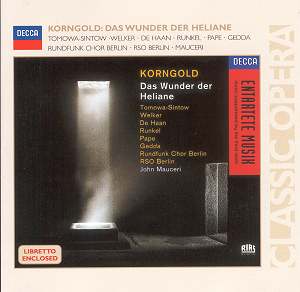

 Anna Tomowa-Sintow (soprano) – Heliane; Hartmut Welker (baritone)
– Der Herrscher; John David de Haan (tenor) – Der Fremde; Reinhild
Runkel (mezzo) – Die Botin; René Pape (bass) – Der Pförtner; Nicolai
Gedda (tenor) – Det Schwertrichter; Martin Petzold (tenor) – Der junge
Mensch
Anna Tomowa-Sintow (soprano) – Heliane; Hartmut Welker (baritone)
– Der Herrscher; John David de Haan (tenor) – Der Fremde; Reinhild
Runkel (mezzo) – Die Botin; René Pape (bass) – Der Pförtner; Nicolai
Gedda (tenor) – Det Schwertrichter; Martin Petzold (tenor) – Der junge
Mensch