Editorial Board
MusicWeb International
Founding Editor Rob Barnett Editor in Chief
John Quinn Contributing Editor Ralph Moore Webmaster
David Barker Postmaster
Jonathan Woolf MusicWeb Founder Len Mullenger
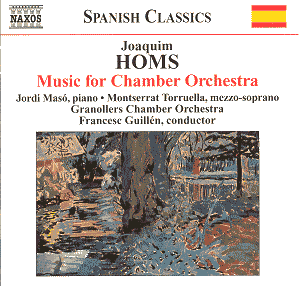
Joaquim HOMS (1906–2003)
Suite “Between Two Lines” (1948) [9:52]
Concertino for Piano and Chamber Orchestra (1946/7)a [16:42]
Suite for Piano Op.1 (1921)a [5:34]
Adagio for Strings (1950) [10:55]
Cycle I “El caminant i el mur” (1962)b [9:11] Diptych I (1976)a [4:58] Soliloquy II for Strings (1974) [6:26] Jordi Masó (piano)a;
Montserrat Torruella (mezzo-soprano)b;
Granollers Chamber Orchestra/Francesc Guillén
rec. Teatre Auditori de Granollers, Spain, January 2006 NAXOS 8.570306 [64:24]
Though
mostly perfectly apt, the collective title of this release
(Music for Chamber Orchestra) is a bit misleading.
In fact it includes two works for solo piano, not previously
included in Masó’s near-complete survey of Homs’ piano output
released by Marco Polo. This release provides a most interesting
appreciation of Homs’ stylistic progress over the years since
his Suite for Piano Op.1 was written in 1921
when he was a mere fifteen year old budding composer and Diptych
I at the other end of his composing life.
Although
a youthful essay in composition inevitably displaying a number
of stylistic influences, the Suite for Piano,
to which the composer proudly affixed his first (and apparently
last) opus number is far from negligible. It already displays
several Homs hallmarks such as concision, clarity of line
and of thought. Of course, echoes from older Spanish composers
and from French Impressionism may be heard throughout these
short movements, but the young composer’s assurance is quite
remarkable. The Concertinofor Piano
and Chamber Orchestra (1946/7) and the Suite “Between
Two Lines” (1948), still display some of the earlier
influences, although the composer is now fully the master
of his trade. The Piano Concertino, written for the Belgian
pianist Pauline Marcelle who performed several piano works
by Homs, is clearly Neo-classical with some echoes of Stravinsky
and Prokofiev. The strongly contrapuntal nature of much of
the music is still emphasised by the clear-cut, light scoring
for small orchestra. The first two movements function as
a sort of Prelude and Fugue leading into a spiky, slightly
ironic Scherzo. The fourth movement restates some of the
earlier material and swiftly moves through a fugal episode
before heading for its abrupt and slightly enigmatic ending.
The contemporary Between Two Lines is a suite
of short didactic movements originally composed for piano.
When preparing this version for chamber orchestra, the composer
incorporated an earlier piano work Vals desuburbi (1931).
Again, the scoring for small orchestral forces emphasises
the Neo-classical and hints at Stravinsky, Bartók and Les
Six.
Homs
composed eight string quartets - a priority for future recordings
- that span more than forty years of his composing career.
In 1952 he arranged the slow movement of his Third String
Quartet (1950) for string orchestra as Adagio for Strings heard
here. By that time, the composer had matured and was reaching
the peak of what is often referred to as his first compositional
period. This is a deeply-felt, intense, unsentimental but
strongly expressive elegy in spite of its apparent restraint.
By
the time he composed Cycle I “El caminant i el mur” in
1962, he had absorbed twelve-tone writing, although he never
fully adhered to it. This short song-cycle was originally
written for voice and piano. Much later, in 1976, the composer
scored it for voice and small orchestra, which is what we
have here. The cycle sets short poems by Salvador Espriu,
and consists of a suite of almost haiku-like songs. The music
may be serial but nevertheless retains its strong expressiveness
for all its succinctness and economy of means. One might
be tempted to compare Cycle I to some of Webern’s
song-cycles for voice and instruments, but Homs is certainly
much warmer than Webern although the scoring for small orchestra
is tellingly calculated to bring the most expressive strength
from a minimum of orchestral gestures. For all its brevity, Cycle
I is a minor masterpiece.
Diptych
I and Soliloquy II date
from the composer’s last period,
in which he achieved a sort of stylistic synthesis. He
composed Diptych I for harpsichord in 1974
and made the piano version in 1976. It consists of two
strongly contrasted studies: a rather stern, dissonant
Adagio and a somewhat lighter Allegro. In 1972 Homs wrote Two
Soliloquies for piano. This diptych was composed
after the death of the composer’s wife and of his teacher
and friend Roberto Gerhard. He went on making several
versions of the work for various instrumental combinations
as well as one for orchestra. He arranged the Second
Soliloquy for strings in 1974. Although the music is
rather more austere and more astringent, the string version
of Soliloquy II resembles the earlier Adagio
for Strings, in its expressive strength.
Thanks
to Jordi Masó’s untiring championing and to a handful of
adventurous recording companies - principally Marco Polo,
Naxos and Columna Musica - Homs’ music may now be appreciated
for all it is worth. I have no doubt about it: Homs was an
important composer, whose music never excludes expression
and emotion, even when adopting dodecaphony or serialism.
It generously repays repeated hearings. This release, obviously
recorded to mark the composer’s centenary, offers the best
introduction possible to his personal, endearing sound world.
Reviews
from previous months Join the mailing list and receive a hyperlinked weekly update on the
discs reviewed. details We welcome feedback on our reviews. Please use the Bulletin
Board
Please paste in the first line of your comments the URL of the review to
which you refer.













 Jordi Masó (piano)a;
Montserrat Torruella (mezzo-soprano)b;
Jordi Masó (piano)a;
Montserrat Torruella (mezzo-soprano)b;