Editorial Board
MusicWeb International
Founding Editor Rob Barnett Editor in Chief
John Quinn Contributing Editor Ralph Moore Webmaster
David Barker Postmaster
Jonathan Woolf MusicWeb Founder Len Mullenger
Buy
through MusicWeb
for £11.00 postage
paid World Wide. Try
it on Sale or Return You
may prefer to pay by Sterling cheque or
Euro notes to avoid PayPal. Contact
for details
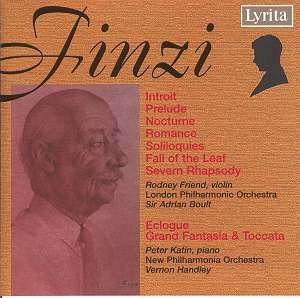
Gerald FINZI (1901-1956) A Severn Rhapsody, Op. 5 (1923) [6.14]
Nocturne,Op.
7 (c.1925) [10.23]
Three Soliloquies for small
orchestra (1946): (Grazioso[1.40]; Adagio [1.40];
Allegretto[1.19])
Romance for
string orchestra, Op 11 (1928) [8.08]
Prelude for
string orchestra, Op 25 (date uncertain) [5.16]
Introit for
small orchestra and solo violin, Op 6 (1925) [9.48] The
Fall of a Leaf - Elegy for Orchestra Op 25
[9.14]
Ecloguefor piano and orchestra (1956) [10.33]
Grand Fantasia and Toccata for piano and orchestra (1953) [15.14] Rodney
Friend (violin), Peter Katin (piano)
London Philharmonic Orchestra/Sir Adrian Boult
New Philharmonia Orchestra/Vernon Handley (Eclogue, Fantasia)
rec. 1978 (Boult); 1977 (Handley), venues not given. ADD LYRITA
SRCD.239 [79.26]
I
was especially pleased to see that at last the Boult ex-LP
of Finzi miniatures was on CD. First, because on the LP the
tracks ran quickly into each other and as the mood of several
of the pieces is somewhat similar it was more than easy,
after a lapse of concentration, to forget which piece you
are on. Secondly because having Boult, and for that matter
Handley, conducting Finzi is somehow to possess the authentic
voice of a British, mid-20th century sound. Thirdly
this disc also draws into its compass the ‘Grand Fantasia’ and
the ‘Eclogue’ with the irrepressible Peter Katin. In addition
the recording is warm and friendly and the whole enterprise
oozes a long lost world never to be recaptured. Also, at
seventy-nine minutes it is extremely good value.
But
before I get too sentimental, I must stop and emphasise that
although Finzi has been or might be termed the best example
of the ‘cow-pat’ school as purportedly coined by Elizabeth
Lutyens, this music is not a mere wallow in nostalgia for
an old England. There is pain and suffering here; this is
music from the heart to the heart. True, it can and does
evoke a landscape of serenity and beauty but scratch the
surface and you will definitely find much more.
So
we should begin with Op. 3, ‘A Severn Rhapsody’, composed
in the Cotswolds at Painswick, also the home of another composer
C.W. Orr. It was in 1988 that I sat in Ashmansworth Parish
Church, just in Hampshire, where Finzi is buried and heard
this piece whilst looking at Laurence Whistler’s window.
Engraved on that window are fifty names of important and
less well known English composers from Dunstable to Britten.
It is good to think of Finzi in the polyphonic tradition
of the madrigalists listed and with the earlier names. His
use of these old modes and related characteristics are to
be found in the Rhapsody, as in another early work, the ‘Introit’.
When you hear these pieces and then a late work like the ‘Grand
Fantasia’ you realize how far Finzi had travelled on his
musical journey.
The
title ‘Rhapsody’ only appears once on the CD yet it is a
form which could easily apply to several of the works. It
implies a free piece in no fixed structure, or a piece which
creates its own form, it is to be hoped, not in too rambling
a way. The ‘Nocturne’ Op. 7 is typical. It is subtitled ‘New
Year Music’ and begins in a Sibelian gloom as if Finzi was
not looking forward to the year ahead. The CD booklet calls
it a ‘sober sadness’. It gradually rises to a climax which
at its height is some of the loudest, most passionate music
on the disc. This lasts for at least two minutes before falling
away and ending as it began. These central climaxes are common
to most of the early pieces.
The
earlier works tend towards the pastoral and are not so searching.
The melodies fall more readily into equal length phrases,
but even by the time of the rather Elgarian Op. 11 ‘Romance’ for
strings a stronger voice is emerging. That said, a preference
for single movement utterances was to remain with him for
some time to come. True, it is rather less introverted, more
outgoing, than the earlier works, but it’s the sense of line,
of melody, which is now much more striking.
Then
comes ‘The Fall of a Leaf’ - which again rises to
a massive central climax - and the Prelude Op. 25. They were
thought
of as a pair. The Prelude was originally called ‘The Bud’ evoking
spring. ‘The Fall of the Leaf’, the title taken from a harpsichord
piece by Martin Peerson (c.1600) evokes Autumn. Perhaps,
as Diana McVeagh comments in her excellent booklet notes,
they should be thought of as part of a triptych along with ‘Nocturne’s’ winter
landscape. Finzi never finalized these ideas and Howard Ferguson
completed ‘The Leaf’ after Finzi’s death.
The
Eclogue Op. 10 has proved an especially popular work of late.
Scored for piano and strings I always think that this is
a prime example of an orchestral work by a song composer … and
what a melody! It post-dates the ‘Grand Fantasia’ and may
have been meant as the slow movement of a Piano Concerto.
The Eclogue has the early opus number as it was first drafted
in the 1920s and redrafted in later life. Both ‘Eclogue’ and ‘The
Fall of a Leaf’ received their first performances early in
1957 just after the composer’s death.
Perhaps,
at the end of his all-too-short life, Finzi was contemplating
a piano concerto to match the two other wonderful concertos
for clarinet and cello although at this time the latter must
have been just fermenting in his mind. In the event he produced
a much more original, arguably eccentric, work: ‘The Grand
Fantasia and Toccata’. The extravert ‘Fantasia’ inspired,
I should think, by Handel’s great keyboard preludes, is almost
entirely dominated by the soloist. The Toccata is a vibrant,
contrapuntal even fugual tour-de-force demonstrating the
need for showmanship and virtuosity and reaching a rousing
conclusion - all singularly successful.
For
anyone new to Finzi this disc is an ideal place to start:
music which sums up his style, superbly recorded and incomparably
performed.
Reviews
from previous months Join the mailing list and receive a hyperlinked weekly update on the
discs reviewed. details We welcome feedback on our reviews. Please use the Bulletin
Board
Please paste in the first line of your comments the URL of the review to
which you refer.












 for details
 Rodney
Friend (violin)
Rodney
Friend (violin)