Lyrita’s reborn line
of CDs continues to unfurl at the rate
of six issues per month. We now have
24 added to the fifty or so already
issued. At this rate the reissue programme
will continue well into 2008 and will
be making serious inroads into the bank
accounts of the lovers of fine music
everywhere.
Finzi was always close
to Lyrita’s heart. Their earliest stereo
LPs from the late 1960s included two
albums of Finzi’s Hardy songs in which
the accompanist was Finzi’s friend the
composer, Howard Ferguson. I hope that
these will be reissued as part of the
programme. To date we have had three
Finzi CDs (Intimations;
Boult
short orchestral works; Concertos)
and this is the fourth disc. It’s usual
because it is generously timed but unusual
because it gives us a Finzi recording
never previously issued.
That new recording
is the ten movement half hour long suite
of music from Finzi’s score for a BBC
1946 broadcast of Love’s Labour’s
Lost. It’s for full orchestra so
you can ignore the statement on the
tracklisting that it is only for string
orchestra. It’s the same score as that
first recorded in 1987 by William Boughton
with the English String Orchestra (augmented)
most recently on Nimbus CD NI 5665.
There are some typically smooth Finzian
touches such as the wide Nobilmente
theme in the Introduction.
Moth is fanciful and flighty
and includes a rather Holstian viola
solo. The Hunt has plenty of
rustic playful antiphonal brass work.
One of the nicest episodes is the floating
string writing with wind solos above
in Dance. Clowns has a
touch of toytown pomp about it. Who
would ever guess this was by Finzi –
perhaps Prokofiev or maybe Arnell. The
Three Soliloquies are core Finzi
and have been recorded freestanding
by Boult on his Lyrita anthology. It’s
a pleasing suite.
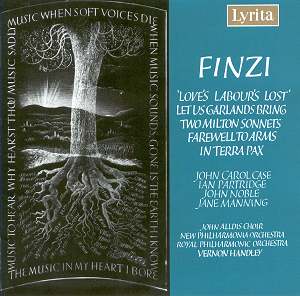
The cover of the booklet
is taken from the LP cover design of
SRCS 93 on which was issued in 1983
the remaining tracks on this CD. Let
us Garlands Bring was written for
Vaughan Williams birthday in 1942. It
is here sumptuously recorded and sung
with unparalleled attention to meaning
and variation in hue and emphasis by
John Carol Case. The warmth and texture
of the strings pleases still but by
this stage in Carol Case’s career his
vibrato had developed a serious wobble
which asserts itself whenever the voice
is put under pressure in slow music.
This is especially true in Fear No
More The Heat of the Sun and Come
Away Death. Because of the other
qualities of this recording one can
and does forgive this but best to be
aware of this. The buoyancy and ardent
smiles of the last two songs O Mistress
Mine and It was a Lover and his
Lass erase all the demerits.
The voice and intelligent
apprehension of Ian Partridge is a national
treasure. This is to the fore in the
two diptychal works for tenor and orchestra:
Two Milton Sonnets and Farewell
to Arms. Making what could so easily
have become mournful and lachrymose
Partridge and Handley reveal the transcendent
starry majesty of When I consider
and the lightly melancholic How
soon hath time with its characteristic
absorption in the transience and sweetness
of life. In Farewell to Arms
Finzi sets two poems which in related
imagery conjure the stuff of war to
that of peace and of youth to idealised
old age. In Terra Pax brings
us to the grander choral Finzi in a
starry ice-crystal Christmas scene recalling
for me the wintry wanderings of Arnold’s
Scholar Gypsy in RVW’s Oxford Elegy.
This is the version for full orchestra.
John Noble is a leonine-toned rustic-accented
narrator. It is most nobly paced by
Handley and should always be unhurried.
The heart’s ease of the perfectly judged
string statement at 8:53 followed by
Jane Manning’s clarion Fear Not is
breathtaking as is her ethereal ascent
to the words ‘which is Christ the
Lord’. Then we get the great bell
carillon of the skies as the choir sing
out Glory to God in the Highest at
11:50 topped off by the eager excitement
of the strings at 11:34. The music curves
down into a contented evocation for
the baritone and strings on the words
‘th’ eternal silence’ reaching
across to Finzi’s own 1949 Intimations
of Immortality which use exactly
the same words in a similarly heart-stopping
moment.
The extensive notes
are by the first of Finzi’s biographers,
Diana McVeagh whose new book on Elgar
is just out. She has been a fixture
with Lyrita since the issue in 1975
of Intimations of Immortality on
SRCS75. All the sung words are printed
in the booklet.
Rob Barnett
























 for details
 Royal Philharmonic Orchestra/Vernon Handley
**
Royal Philharmonic Orchestra/Vernon Handley
**  Sound
Sample
Sound
Sample