Pristine Audio has
unveiled its new XR technology and this is one of the first of
the batch to reach me for review. Others include the Thibaud/Cortot
Kreutzer Sonata, the 1936 Weingartner Eroica, Boult’s
1949 Vaughan Williams 6, the Schnabel-Sargent Emperor Concerto
and Hüsch’s Die Schöne Müllerin. I’ll be reviewing them
all in due course. And I reviewed the pre-XR transfer here
some time ago. As it shares the same catalogue number, but has
different booklet artwork, and as it the earlier transfer is now
presumably withdrawn by the company, it would be prudent for collectors
to note the changed state of play. I’ll reprise the comments on
the music, which is entirely the same, and then add my comments
on the new transfer philosophy.
I happen to be delighted
to see Kathleen Long’s early 1950s Decca Fauré recordings once
more available. The correspondence on these performances “in
another place” prompted me to dig out her 78s. This involves
not just the slew of Mozart recordings she made for Decca, some
of which have been collated by Dutton on an all-Long disc, but
also her first recordings. She began her career in the studios
recording for Compton Mackenzie’s National Gramophonic Society
(N.G.S.). Whilst even then she was pegged as a Mozart specialist
she was also to record Bach. As an aside someone should really
get to grips with the N.G.S. discs, the market for which may
well prove small, but the recordings of which - not always perfectly
recorded it’s true - did enshrine some outstanding traversals
of often unusual repertoire.
Long was for some time probably Britain’s leading exponent of
the French repertoire. An allied assurance can be seen in her
recording of the Third Delius Sonata with Sammons (Dutton) and
in altogether less wistful form in Walter Leigh’s Concertino.
Her Fauré recordings were not many but they were well received;
I believe that this is the second of her recordings of the Thème
and Variations. As one might imagine, her technical competence
is high, though not infallible. She sounds especially harried
in passages in the Fourth Nocturne.
She’s a direct exponent of the repertoire, clear-sighted, architecturally
sure-footed, tonally bright. She may be considered bracingly
extrovert where others prefer pastel. In this performance of
the Nocturne in E flat major she hammers away in the treble
– maybe the rather unhelpful original Decca set up exaggerates
it – and points bass rhythms with a certain ebullience. Turn
to the recordings of Germaine Thyssens-Valentin, made a few
years later in 1956, and we find a totally different sound world;
caressing, slower (always slower) and with subtler colouration.
That very open Decca sound is present throughout but especially
the Sixth Nocturne where Long can sound too urgent after immersion
in Thyssens-Valentin – though she does bring a forceful romanticism
to bear.
Long’s view was a consistent and entertaining one even if I
find her rhythmically muddled in the B minor Nocturne. With
the Barcarolles she tends to play the blunt outspoken guest
to Thyssens-Valentin’s more coy and rhythmically more teasing
host, the one rather rushing and the other wryly amused. Try
the G major for an explicit contrast of that kind and the A
minor Barcarolle for moments where the French player’s hinterland
of expression proves too great and expansive for the Englishwoman’s.
In the great Thème and Variations we hear Long’s clipped
and highly accented approach bringing no-nonsense authority
– though note that she gets through the theme in 1.38 and Thyssens-Valentin
in 2.15, an indicator of their expressive responses throughout.
The performances were originally released on two ten-inch discs.
Pristine Audio has embarked on wholesale XR (Extended Range) restorations
which are claimed effectively to double the range of electric
78s and to be equally effective in recordings made later in the
1950s and 1960s and 1970s. I will leave you to pursue the complexities
and scientific ramifications by going to the company’s website
- www.pristineclassical.com.
These are difficult
Deccas to deal with. The earlier transfer had a hint of stuffiness
at the treble but was otherwise clear. The XR effect has been
to make the sound very much more “present.” Noise reduction
has given the sound a certain omnipresent “steeliness” but to
compensate the definition is more palpable; as a result the
performances have a greater aural profile. This is my first
experience of Andrew Rose’s latest XR work – he has utilised
a modern recording as a reference file for these new transfers
in much the same way that he did with his transfer of the Moeran
symphony. He claims his XR work will make all previous transfers
“entirely obsolete.” This is a bold claim and I’ll be investigating
it in the other releases to come.
Jonathan Woolf
























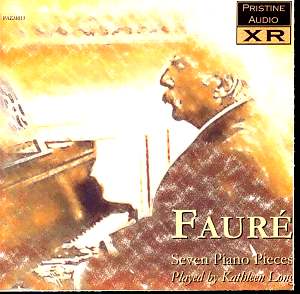

 Kathleen Long
(piano)
Kathleen Long
(piano)