I first read Whitman’s
remarkable poem ‘When Lilacs Last in the Dooryard Bloom’d’,
as a teenager, in a fine anthology, The London Book of
English Verse, edited by Herbert Read and Bonamy Dobrée.
Read and Dobrée printed the poem in a section they headed ‘The
Symphonic Poem’, made up of poems characterised by, as they
put it, “the complexity of the emotions or ideas to be expressed”
and demanding of the poet the skill of “comprehending a diversity
of emotional responses within a single artistic form”. Their
use of the word ‘symphonic’ is no accident; such poems are especially
suited to large-scale musical setting, to the creation of extended
musical works which express “a diversity of emotional responses
within a single artistic form”.
Whitman’s poem is
essentially an elegy. First published in 1865, occasioned by
the assassination of Abraham Lincoln in April of that year,
Whitman’s poem is a rich text full of elaborate patterns of
image and sound; its construction around a triad of images (lilacs-star-hermit
thrush) offers opportunities at the level of overall design
to an interested composer; its insistent use of anaphora, alliteration
and assonance perhaps suggestive of more ‘local’ musical possibilities.
Lincoln’s death is lamented and reflected on in the wider context
of “battle-corpses, myriads of them”, of the temptations and
joys of “lovely and soothing death” – it is, short, an extended
(over 200 lines) meditation on death and its meanings, on nature
and the human.
It has attracted
a number of composers, including such works as Holst’s Ode
to Death (1919), Paul Hindemith’s When Lilacs Last in
the Dooryard Bloom’d (1946, commissioned by Robert Shaw)
and Roger Sessions’s When Lilacs Last in the Dooryard Bloom’d
(1966-70), described as a Cantata for Soprano, Contralto, Baritone,
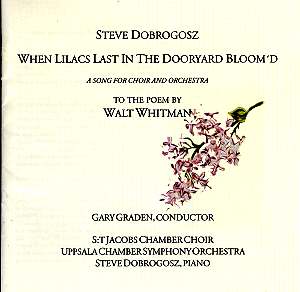
Mixed Chorus and Orchestra. Now here is a setting by Steve Dobrogosz.
Born in 1956, Dobrogosz
was brought up in North Carolina, before attending Berklee College
of Music. Since 1978 he has lived and worked in Sweden, based
in Stockholm. Classically trained, Dobrogosz’s early reputation
was in the fields of jazz and jazz-influenced popular music.
His work as accompanist on the 1982 album Fairy Tales,
with the memorable Norwegian vocalist Radka Toneff has rightly
attracted a great deal of praise. In later years he has worked
with other fine vocalists such as Jeanette Lindström and Anna
Christofferson. Since the early 1990s he has also been writing
‘classical’ scores, including chamber and orchestral works and
his choral works (notably his Mass of 1992) have been
quite widely performed. His writing, including this setting
of Whitman, is traditionally tonal. I have no objection to that,
of course, but I have to confess that, overall, I find this
setting disappointingly unmemorable, even a little bland at
times.
There are some good
things – Dobrogosz is perhaps at his best in the more purely
pastoral passages. The opening orchestral introduction has a
restrained dignity that is appealing and he responds attractively
to the lovely lines early in the poem (“In the dooryard fronting
an old farm … A sprig with its flower I break”. The disappointment
is that there isn’t enough distinction of musical idiom between
the writing here and that for the immediately preceding, far
more exclamatory passage (“O powerful western fallen star! …
O harsh surrounding cloud that will not free my soul”). The
setting too often lacks the kind of rhythmic variety necessary
to so justice to a poem which, to quote Read and Dobrée for
a last time, is characterised by a “diversity of emotional
responses” (my italics). It is that diversity that I largely
miss here. Dobrogosz’s music is everywhere very competent, sometimes
much more than that. Some of the writing for the soprano voices
is very beautiful. But it isn’t sufficiently differentiated,
sufficiently full of contrasts to do justice to the sheer variety
of attitude in Whitman’s complex text. More than once I wondered
if the decision to write a piece for choir (without soloists)
and orchestra wasn’t perhaps a mistake? The presence of passages,
set pieces even, arias, recitatives or whatever, for individual
voices might have helped to generate that absent sense of contrast
and juxtaposition, that musical registering of poetic and linguistic
differences which seems to me not sufficiently pronounced. Naturally
Dobrogosz splits his choral resources, writing passages for
male or female voices alone, for example, but this doesn’t prove
sufficient to break up an over-homogenous (i.e. over-homogeneous
for this text) musical texture.
This is by no means
a bad piece of work; it is intelligent, technically assured
and well performed. But to listen to what either Sessions or,
especially, Hindemith do with the poem is to hear the limitations
of Dobrogosz’s version of it. Where Hindemith draws on a huge
variety of resources – including a sinfonia, marches with chorales,
arias, double fugues, choruses, fanfares, complex polyphony
and much else – this newer setting is content to operate within
narrower parameters. Hindemith’s setting opens with grainy orchestral
textures, some of his almost violently expressive writing, and
moves to closing raptness and acceptance. The musical trajectory
of Dobrogosz’s setting is less dramatic, its emotional antitheses
less marked than those of Hindemith and, more relevantly, less
vivid than those of Whitman’s poem. This new setting does what
it seeks to do, musically speaking, pretty well – but it seems
to me that what it wants to do isn’t really enough to embrace
the poem’s power.
The CD comes handsomely
packaged, with the full text of the poem and some fascinating
historical photographs.
Glyn Pursglove

























 Steve
Dobrogosz (piano)
Steve
Dobrogosz (piano)