Capriccio launched its Gary Bertini Edition in 2006, a year after
his death in Tel Aviv at the age of 77. Of the six discs released so far,
three feature the music of Mozart, one disc focuses on each
of Ravel and Debussy,
and this disc offers an all-Berlioz programme. All are SACD
hybrids and all of the performances come from the archives of the
Kölner Rundfunk-Sinfonie-Orchester. This is the second
disc I have reviewed of the first tranche of releases, and
both have been of such high quality that I am impatient for
Capriccio to issue more.
There are two main interpretative approaches
to Berlioz's Symphonie fantastique:
the one symphonic, and the other fantastic! Conductors who
opt for the former approach include Dutoit, Paavo Järvi
and Klemperer, whose bizarre reading Germanifies this
quintessentially French score. In the opposite camp are Bernstein, Munch and Tilson
Thomas. Somewhere in between you will find Sir
Colin Davis.
Bertini's
approach tends towards the symphonic. His performance is not
without excitement, but the excitement does not ever really burst
into exhilaration. The hallmarks of this performance are beauty
and long-breathed phrases. The strings glow and shimmer
throughout, and the woodwinds splash colour. Bertini also has that
Karajan-esque knack of drawing sudden fortes from brass and
woodwind without a noticeable attack. It all feels a little too well behaved,
but that is a criticism I would also apply to Dutoit and Järvi.
The first movement
is beautifully shaped, and I love the way Bertini brings out
the dark chiding of the lower strings that caution the dazed
hero as he trips about dreamily after the idée fixe.
The waltz movement has bright strings,
gleaming harps and more than a little swagger, rather than subtle
charm or dreaminess. The pacing is just
right, but comparison with Davis (his LSO
Live recording), for example, finds Bertini a touch
wanting in flexibility and grace. That is not to say that Bertini
is necessarily inferior. He prefers a more robust approach,
introducing little hesitations and managing dynamics acutely to
keep the ear interested. The Cologne strings really make
this movement sing, but some will miss the optional cornet,
which Bertini does not employ.
Bertini does not
get stuck in the mud of the third movement's rustic byways,
shaving a minute and a half off Dutoit's reading on Decca,
Järvi's on Telarc and Davis' on LSO Live. Munch's 1954
account is a couple of minutes quicker still. The immaculate playing
of the Cologne strings and woodwind are a joy.
The March to
the Scaffold has plenty of energy and excitement, moving
at a good clip. Here Bertini scores heavily over Davis'
exaggerated account of this movement in his recent LSO
Live recording. Phrasing is clipped and the big tuba
notes that underpin the second subject come through loud and
clear, with plenty of menace. The playing is immaculate and the
balance fine. The brass interjections could afford
to shock more, though.
Similar comments
apply to the final Witches Sabbath. There is a little
untidiness in the explosion that interrupts the understated
introduction at 1:45. The woodwinds distinguish themselves yet
again in this movement. The bells are nice, but carry no terror. Nor do the brass, even when intoning the Dies
Irae.
Overall this is
a carefully prepared and beautifully played account of Berlioz's
first symphony. So what is missing? For me, there is not
enough fantasy. I crave the sheer mania and delirium of Munch and
Bernstein. Sonically, though, Bertini is much better served than
either of them in any of their various recordings. His orchestra,
too, is a match for any of theirs. Though not a
first choice, Bertini's account is worth seeking out if you
want to hear the beauty in this score or are looking for an
alternative to put beside the more frenetic accounts of this
symphony in your collection. Bertini's Symphonie fantastique is
one of the better recordings of its kind - the measured, symphonic
kind, that is.
The two overtures are welcome fillers. Le Carnaval Romain gets a
sensitive performance, with the gentle bucolic theme that follows
the opening burst of orchestral frenzy given a lovely turn. The
whole works well, but does not match the excitement of Previn
or Munch,
who both shave about 1:40 off Bertini's time. The impact of
the Cologne orchestra brass's final chord, though, is
impressive. The
overture to Benvenuto Cellini also receives a carefully
crafted performance, though one lacking something in excitement,
especially when I compared it to Previn's 1970s romp with the
LSO.
The orchestral playing, as may be gleaned from
the above, is of a high standard. The brass are confident and
project a big, dark sound. The woodwind have character and the
strings have a bright sheen. Those
with an eye for dates will notice that these performances were
taped around the time that the orchestra - under its new name
of the WDR Sinfonieorchestra Köln - was beginning its award-winning
Shostakovich symphony cycle with Rudolph Barshai (see reviews 1, 2 and 3). The
orchestra's continuing excellence is confirmed by a series
of acclaimed recordings on Avie under its current chief, Semyon
Bychkov (see, for example, reviews 1 and 2).
Though I listened
to this disc in conventional stereo, the sound is fabulous -
clear as a bell and perfectly balanced with a realistic dynamic
range. The
liner notes offer a short biography of Bertini, a short biography
of Berlioz and a brief description of the Symphonie fantastique. No
mention of the overtures though!
Tim Perry



 Kölner Rundfunk-Sinfonie-Orchester/Gary
Bertini
Kölner Rundfunk-Sinfonie-Orchester/Gary
Bertini  [73:14]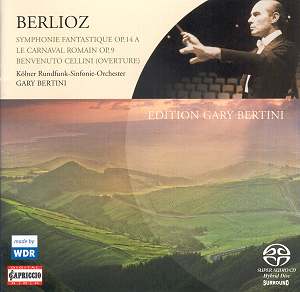
 for
details
for
details












