The C minor Concerto
performance was given a bit of a roasting in The Record Guide.
The contributors there briefly lambasted Ormandy’s “sentimentalised
and vulgar” conducting before consigning the whole thing to
the out tray of critical taste. Well times change but it’s hard
to see quite what so annoyed the writers regarding Ormandy.
Maybe it was the rather over grazioso string phrasing in the
first movement, something that might then have smacked of Rachmaninovian
excess to more puritan sensibilities. Or maybe it was the balance
between piano and orchestra – not especially well judged – that
skewed critical favour against the performance. However one
views these things Arrau has considerable reserves of power,
and in the finale demonstrates a rather striking balance of
command and caprice when it comes to phraseology. In the slow
movement there is perhaps too much of a patrician reserve. He
avoids, if I can put it this way, quiescent chording – and I
find some of the right hand runs strangely cursory. Not vulgar,
just rather unthinking. So whilst I can’t concur with the adjectival
chorus of disgust evinced by The Record Guide the performance
as a whole strikes me as oddly unsatisfying and not properly
thought-through. I will say that Mark Obert-Thorn has tamed
the fierce treble - the highs are still there and it’s still
not altogether comfortable but there’s certainly a richer, mellower
string tone now.
The Weber Konzertstück
was recorded a year earlier than the Beethoven. The accompanist
was Désiré Defauw whose performance here is usually written
off. Defauw was a good musician – violinist and conductor –
but he wasn’t helped by the recording which was very cloudy,
a problem that Obert-Thorn has sought to address in his transfer,
and by his own rather stolid approach. Arrau always remembered
a pre-War performance of the work given in Berlin by Schnabel
– played beautifully he added – and it was a work Arrau kept
in his repertoire until the end, by which time his work-list
had shrunk to Thibaud-like parsimony. Arrau’s articulation has
a bejewelled beauty to it, despite the limitations of the recording,
and a ripe aplomb in the finale. The Sonata was Arrau’s first
American studio recording. It was boxy, sounding rather like
some of those pre-war Parisian ones, and pressed on inferior
wartime shellac, but the playing is vital and communicative.
The transfers as
noted seek to address inherent recording limitations in a variety
of ways – stiffening the bass, cushioning boxy, unreverberant
acoustics, trying to clarify muddied frequencies and ensuring
pitch correction. It’s all been most sensitively done.
Jonathan Woolf
see also Review
by Colin Clarke
























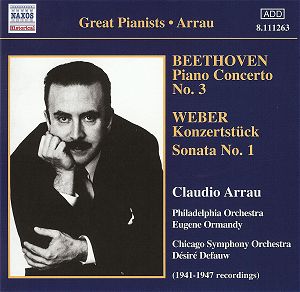
 Claudio Arrau
(piano)
Claudio Arrau
(piano)