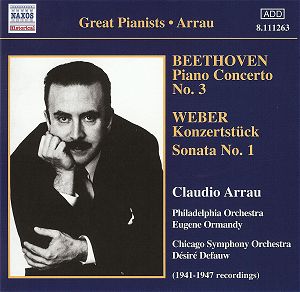
Although
there is a documented live performance dating from 1944, the
present account stands as Arrau’s
first official recorded account of the Third. This performance
was originally issued on American Columbia; indeed an American
LP was the source of this Mark Obert-Thorn transfer. Arrau’s 1964 recording with Haitink and the 1958 one with
Galliera are probably his most famous. There is also a live
Testament performance with Klemperer.
The
first movement orchestral exposition under Ormandy and the Philadelphians
is perhaps rather literal at times, with violins shrill. Arrau,
too, is stand-offish, yet his trademark polish and aristocratic
bearing are in evidence. The perfect, polished trills are a
marvel, while Ormandy maintains his reputation as an accompanist
par excellence by sticking to his soloist like superglue.
Beethoven’s cadenza
is an oasis of lyricism in an already lyrical reading. The final
trills are seamless undulations of energy that retreat gently
into the return of the orchestra and those heartbeat-like timpani
taps. Unfortunately the orchestral close tends towards the fierce
on this transfer.
The
Largo is rapt through and through. The orchestra cannot really
meet Arrau‘s intensity of thought, though and some might find
the soupy string portamenti a little hard to take. Amazing,
given the recording date, that the bassoon emerges beautifully
clearly, and yet one can also relish Arrau’s
watery arpeggio accompaniment. Just before the seven minute
mark there is some rawness to the sound which may have come
from the pressing used, although it quickly rights itself. Ensemble
suffers slightly around 8:30 although Ormandy redeems himself
at the very close, with cellos acting as a heartbeat to the
final bars. The finale is a model of expert articulation from
Arrau. Pedal is on the light side - as was to become a lifelong
characteristic of this pianist. There is lyricism from the orchestra:
the clarinet subject around 3:30, for example. I just wish that
the orchestral fugato at 4:40 was a touch tighter from the Philadelphians,
but in fairness there are compensatory factors later on, when
the players seem more alive. And who can forget Arrau’s roulades
just before the coda, worth the minimal price of the disc alone?
Dryness is again felt in Arrau’s rendition of the coda, but
there is playfulness here, too.
There
is a commercial account already available of Arrau in the Konzertstück
on an EMI GROC (reviewed
by myself earlier this year). There are in fact no fewer than
four versions by this pianist - the other two are with Erich
Kleiber in 1947 and Horst Stein, live in Berlin in 1982. The
Chicago strings in the Naxos transfer make a lovely sound. Obert-Thorn
used a post-war American shellac pressing and brought out some
of the bass to excellent effect. Arrau seems more spontaneous
in this earlier 1946 version; the London one dates from 1960.
He seems also very keen indeed to bring out the darker side
of Weber, especially in the later stages of the opening section
- Larghetto affetuoso. His fingerwork sparkles equally in both
versions, so if anything will swing it, it is the rather murky
orchestral contribution in the Chicago Allegro appassionato,
where detail is easily lost. Miraculously, detail is there every
step of the way in the case of Arrau’s contribution. The March seems to bring out the best from all orchestras
and here is no exception. It must be fun to play!
Nice
to hear the complete Weber First Sonata instead of just the
Perpetuum Mobile - the finale. The piano sound is close, but
not unduly so. Arrau provides Weber playing that is as svelte
as one is ever likely to hear. His way with the first movement
continually had me asking why this piece is not heard more often.
It is not Arrau’s way to pussyfoot around his scores, so be
aware that there are real contrasts here, between the more robust
side and an elfin delicacy unequalled elsewhere. The second
movement Adagio is a thing of the greatest beauty under Arrau’s
fingers. His legato - again, minimal pedal - is stunning. One
is gripped from first to last. True, this is no world-shattering
late-Beethovenian musical statement, and Arrau does not pretend
that it is. Instead, it is beautifully proportioned and wonderfully
heartfelt. The Minuetto is playful but somehow shadowy at the
same time, as if reluctant to come out into the sunshine. The
finale is a miracle of articulation without a hint of the frenetic
rushing by which it is sometimes assailed. Tremendous.
This
performance has appeared on a number of other labels, including
Pearl (GEMS0070). This is an account that does Weber proud and
should ever be available. The documentary nature of this disc
makes it a mandatory purchase for those interested in the great
work of Claudio Arrau.
Colin Clarke