It’s odd how the way
in which certain musicians – usually
singers, in my experience – phrase or
inflect a passage of music obstinately
lodges in the memory. So it is for me
with a few bars in one of the pieces
on this disc. Years ago, when most of
the contents of this CD were issued
as an LP, I heard it several times –
though I never owned the record – and
I’ve never been able to forget the way
in which John Carol Case sang the line
"Nor no witchcraft charm thee"
in the song ‘Fear no more the heat o’
the sun’ in Let us Garlands bring.
Actually, I can be more specific still.
It’s the way he sings the word "witchcraft"
that I’ve never forgotten. He adds a
definite letter "h" so that
the word is like a word from a sorcerer’s
spell. I haven’t heard the recording
in years so when the review copy arrived
the disc went straight in the player
and, sure enough, there it still is:
my memory hadn’t been playing tricks
all these years and it still strikes
me as marvellously imaginative.
Other things in the
performance hadn’t burned themselves
into my memory in the same way and,
sadly, I see why. Truth to tell, re-acquaintance
with this recording proved to be something
of a disappointment. For me there are
two major flaws in Carol Case’s performance.
For one thing the voice of this much-admired
artist seems thinner, more grey, more
dry than I recall it from other occasions.
Secondly – and, for me, more seriously
– in his desire to enunciate the words
clearly he overdoes things significantly
on several occasions, often breaking
up the line as a result. A couple of
examples will suffice. In the first
song, ‘Come away, come way Death’, at
the line "A thousand thousand sighs
to save" the letter d at the end
of each "thousand" is over-emphasised
to the extent that it verges on caricature.
In ‘Fear no more the heat o’ the sun’,
surely one of the very greatest of all
English songs, the word "tyrants"
is broken up into two very distinct
syllables. Finally, in the same song,
at the line "The sceptre, learning,
physic must all follow this…" each
comma is treated as a major event and
the whole flow of the line is lost.
Turn to Stephen Varcoe (Chandos, 1989)
and you get a plainer, more straightforward
but ultimately more natural delivery
of the text. To be sure, the commas
are observed at the point I’ve just
mentioned but it’s done in a properly
natural way that is much more convincing
and much more enjoyable to hear.
In fairness, Carol
Case does some good things, as you’d
expect of an artist of his experience
and perception. The last two songs in
the cycle flow much more freely and
I still find his delivery of the fourth
stanza of ‘Fear no more the heat o’
the sun’ to be imaginative. I did two
things to check my reactions to Carol
Case’s singing. First I listened to
extracts from the aforementioned Varcoe
recording and also to Christopher Maltman’s
version (Hyperion, 1998) conducted by
Martyn Brabbins. It’s kindest to draw
a veil over their account of ‘Fear no
more the heat o’ the sun’, which, at
6:24, is easily the slowest of the three
performances – and sounds as if it lasts
twice as long! But both of these singers
sound more at ease than does Carol Case.
Then I briefly listened to part of Boult’s
1968 recording of Vaughan Williams’s
Sea Symphony. There was the John
Carol Case I remembered! The voice is
still produced forwardly, the words
crystal clear but the sound is rounder,
fuller and the clear diction is achieved
without contrivance. Lyrita don’t give
a recording date but I see that the
recording was first published in 1979.
I think I’m right in saying that Carol
Case retired from the concert platform
around 1976 to concentrate on a distinguished
teaching career. I can only conclude
that he was invited to make this recording
too late in his career. A great pity.
The other baritone
on show is John Noble – was ever a baritone
more appropriately named? He’s the principal
soloist in Finzi’s marvellously evocative
In Terra Pax and he makes a strong
impression. For myself I find John Shirley-Quirk
incomparable on Richard Hickox’s Decca
recording but Noble runs him close.
There are two versions of the score.
The original version (1954) was scored
for an orchestra of strings, harp and
suspended cymbal. Two years later Finzi
made a fuller version incorporating
woodwind and brass and he himself conducted
the first performance of this version
at the Three Choirs Festival in Gloucester
in September 1956. It was the last music
he was ever to conduct. Within weeks
he was dead, having succumbed to an
infection picked up while in Gloucester.
I rather prefer the
1954 version to the 1956 scoring – it’s
the later version which is employed
here. For much of the time the differences
are not so great but the addition of
brass at the two climaxes of the work
makes it into a more public piece and
I like the greater degree of intimacy
in the 1954 score. But the performance
here is a very good one. John Noble
sings with a nice full tone and good
imagination. The cruelly high lying
passage at the very end is negotiated
comfortably and, indeed, he sings the
whole of that last solo – one of Finzi’s
most inspired passages – beautifully.
Jane Manning is good in the short soprano
solo and the John Alldis Choir contributes
well. Vernon Handley conducts with all
the understanding and finesse that you’d
expect from him – but that comment applies
to everything on this CD.
And so we come to the
final solo singer on this CD. I sometimes
wonder if there is a singer who is more
suited to Finzi’s music than Ian Partridge.
We’ve already had his magnificent Lyrita
recording of Intimations
of Immortality - still to my
mind the best recording of that work
by some distance. These shorter pieces
show just as much how right his plangent,
sappy tones are for Finzi’s muse. Although
it’s not a big voice he can deliver
the climaxes when required and his ease
in the upper register of his vocal compass
is a decided asset. In her admirable
liner note the Finzi authority, Diana
McVeagh, describes the Milton Sonnets,
which almost certainly date from 1928,
as "powerful and sombre" in
overall effect. That’s certainly how
Partridge puts them across. In the first
he does the dark, plaintive aspect of
the opening lines most convincingly
but at the words "His state is
Kingly" the music becomes much
more ecstatic and Partridge responds
with fervour. The simple dignity with
which both Finzi and Partridge invest
the last line – "They also serve
who only stand and wait" – is almost
unbearable in its restrained intensity
and eloquence. In the second sonnet
Partridge again displays complete identification
with the text and with the music. He
builds the last six lines to a proud,
elevated conclusion. Ian Partridge’s
account of these two short, fine pieces
is masterly.
He’s just as good in
Farewell to Arms. This, too,
is in two movements. The first is like
an extended recitativo. The seventeenth-century
words aren’t easy to put across but
Partridge makes good sense of them.
The second movement, an Aria, breathes
the same air as the concluding section
of Dies Natalis and Partridge’s
account of it is beautifully poised.
Mention of Dies Natalis prompts
the thought that, to the best of my
knowledge Ian Partridge never recorded
the work. If that’s so it’s a great
shame since on the evidence of what
we hear in these performances and his
Intimations of Immortality his
could have been a recording to challenge
the hegemony of the peerless Wilfred
Brown.
The recording of the
only non-vocal work on this disc appears
for the very first time, I think. The
date when it was recorded is not given,
but it must be more recent than the
other recordings as it’s in digital
sound. Finzi’s incidental music for
a radio production of Shakespeare’s
Love’s Labour’s Lost is unique
in his output. Originally scored for
just sixteen instruments, it was written
in a mere three weeks in1946. Later,
in 1952, he turned the music into an
orchestral suite, omitting the songs,
and this suite was further revised in
1953 for another production of the play,
with the addition of some fanfares and
an extra movement, ‘Hunt’. It’s the
1953 score that’s recorded here. Collectors
wanting to know more about the music
are referred to Diana McVeagh’s biography,
Gerald Finzi. His Life and Music
(2005) pp 216-8, where she goes into
more detail than in her note accompanying
this disc.
In her book Diana McVeagh
describes this music as "enchanting
– Finzi’s Wand of Youth"
and that verdict seems to me to be spot-on.
The Introduction features stirring fanfares
and a splendid, flowing tune worthy
to rank beside anything in Walton’s
Shakespearian film scores. The Nocturne
has a gentle melancholy while the ‘Hunt’
movement’ is brilliant with a fine touch
of dash about it. The sixth movement,
‘Clowns’, which quotes the tune ‘The
British Grenadiers’ is merry and carefree.
I loved the poignancy of the eighth
movement, ‘Soliloquy II’ and the scurrying
exuberance of the Finale is irresistible.
This is quite delightful music and Vernon
Handley directs a sparkling account
of it. There is at least one other recording
of the piece, conducted by William Boughton
(Nimbus). I haven’t heard that but Handley’s
marvellously fresh reading will do nicely
for me.
Despite my disappointment
over Let us Garlands Bring this
is an excellent disc overall, containing
some fine and completely idiomatic performances,
all captured in first rate sound. It’s
both essential listening and a self-recommending
issue for all Finzi lovers.
John Quinn
See also review by Rob
Barnett






















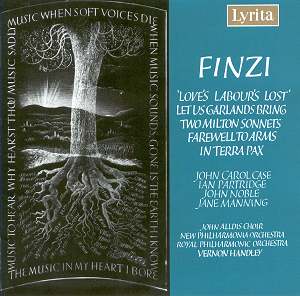
 for details
 Sound
Sample
Sound
Sample  Royal Philharmonic Orchestra/Vernon Handley
**
Royal Philharmonic Orchestra/Vernon Handley
**