In
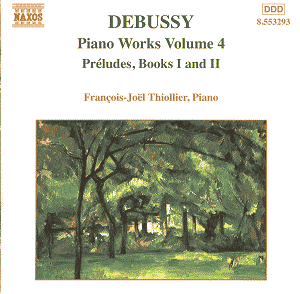
the CD age, recordings of the Debussy Préludes divide into those
that fit onto a single CD and those that don’t. Some of the
latter are not far off the 90-minute mark, while Thiollier’s
70:23 almost looks like short measure! Timings obviously don’t
tell us everything, but we might take as our starting point
the consideration that Thiollier’s overall length – the individual
pieces are another matter – has a certain authority on its side,
since it is practically identical with that of the legendary
Gieseking. The latter can be marvellously volatile while retaining
such poise as never to seem hurried. I have not heard the recordings
by Robert Casadesus, which I understand are slightly swifter
still. Casadesus had been a friend of Ravel, and significantly,
Thiollier studied with Casadesus at the Juilliard School. So
his credentials in this repertoire have to be taken very seriously
even though, as we have seen in earlier volumes, he also has
a tendency to interpolate expressive freedoms of his own. I
have already discussed the matter of timings in my review of
a recording allegedly by Joyce Hatto. This latter mainly takes
tempi close to the Gieseking tradition, but expresses a sunnier,
more relaxed view. Internal variations of tempo within the single
preludes are smaller, resulting in a timing of 75:08.
But
apart from the stopwatch, is it possible to verify the correctness
or not of these tempi? Well, we might take a look at the score.
For seven of the preludes in the first book – but only one in
the second – Debussy provided metronome markings. Now heaven
forbid that this music should actually be played metronomically
and in fact the Modéré (quaver/eighth note = 88) of Voiles
has added in brackets after it Dans un rythme sans rigueur
et caressant. Still, you’d think the markings must mean
something. The first prelude, Danseuses de Delphes, is
marked Lent et grave, as well as doux et soutenu,
but it is also a dance, however mysterious and shadowy a one,
and Debussy thought 44 to the crotchet/fourth-note quite slow
enough. Most performances are far slower than my metronome will
tick and even Gieseking was fairly measured here. “Hatto” was
nearer the mark. I haven’t actually checked Thiollier against
the metronome but he sounds about right and his timing shaves
about fifty seconds off Gieseking, thirty off “Hatto”. At last
it no longer remains true that if I want to hear this prelude
at the tempo Debussy asked for, I have to play it myself. But
on the other hand, if I want to hear the tempo Debussy asked
for and the dynamics he wrote I still have to play it
myself, since Thiollier adds some expressive bulges of his own,
for example where the melody goes up high at the bottom of the
first page and Debussy asks for a consistent pianissimo. Still,
the idea is right and I don’t want to give the impression that
these performances systematically reinvent Debussy’s dynamic
markings; elsewhere Thiollier is often more observant of them.
Where
no metronome mark is given, Debussy’s prescribed tempi can possibly
be interpreted in the light of the evidence that he didn’t want
his tempi too slow. Brouillards, the first prelude of
book two, is marked Modéré and Thiollier’s swirling mists
are surely preferable to the dead slow performances which serve
only to analyze the bitonality on which the music is based.
On the other hand, a few of Thiollier’s tempi are a shade too
easy-flowing even for me. I did like his La terrasse des
audiences, which some may find insufficiently timeless.
It is marked Lent, but as the time is 6/8 it is the dotted
crotchets/fourth-notes that should be slow, not the single quavers/eighth-notes.
But Canope is surely a bit too much of an Andante to
be Très calme et doucement triste. Better this than dragging
it out interminably, however.
Something
curious happens in La cathédrale engloutie. In the passage
near the beginning where a chant theme is heard against high
bells – bb.7-13 for readers with scores – Thiollier doubles
the tempo, as he does for similar passages elsewhere. I understand
a piano roll exists of Debussy doing something of the kind,
or could Ravel have told Casadesus that this was how Debussy
played it? The result in performance is completely convincing.
My
only reservations, tempo-wise, are in a few pieces where a straightforward
dance rhythm seems called for. The fairies in Book II/4 seem
not so much exquisite dancers as schoolchildren on half-term
holiday – Gieseking’s ethereal poise is still the ideal here
– and the Minstrels risk tripping over one another. The
blues theme near the end is marvellously done, however. More
often than not, though, I find Thiollier marvellously responsive
to Debussy’s genius.
He
is helped by a recording that recaptures, but in modern sound,
much of the gentle translucency of Gieseking’s 50-year-old recordings.
All too often, recent recordings of this music, however magnificent
in their way, give the piano a physical presence which seems
inimical to Debussy’s world.
A
word about pedalling, since this is a matter which has been
raised on this site. Thiollier, like Gieseking, uses a great
deal, though without any of the messiness which sometimes results
from lesser attempts to follow this lineage. Some have suggested,
however, that a clearer, drier style is in order, and that Gieseking’s
supposed supremacy in this repertoire has distorted our ideas
of the music.
In
one sense, the scores help us very little here. There is only
one actual pedal marking by Debussy in the whole of the two
books of preludes – at the end of Les sons et les parfums.
There are plenty of implicit pedal markings, though, when a
chord is marked to be sustained and the hand that is supposed
to be sustaining it is required to do other things at the other
end of the keyboard. Obviously, the chord must be sustained
with the pedal or, if things get too swimmingly dissonant, sustained
as far as possible with nifty little half-pedals. But if you
do this only where specifically called for and keep things clear
and dry elsewhere, there will be too much disparity between
the actual sound of pedalled and unpedalled passages. Let’s
take a specific example – La puerta del Vino. The persistent
habanera rhythm in the bass has its third and fourth notes marked
staccato. On an old Saga LP, Livia Rev took this literally,
making it crisp and dry without a touch of pedal. Debussy then
adds two further elements: the long, sinuous melody that gradually
develops into arabesques, and the chords in between. You can
sustain all this with just the fingers up till a certain point,
then as the arabesques start you have to use at least some pedal
or you’ll lose the chord in the middle. And bang goes your dry
staccato. Rev manages to keep her staccato better than most
of us could, I will say that. Then comes a sudden fortissimo
chord, which has to be sustained while the left hand takes up
the habanera again. Lev manages to keep it crisp and dry even
here. Evidently she is sustaining the chord with the Steinway
third pedal, which was coming in by Debussy’s time, but which
he apparently didn’t like. So I don’t think he really wanted
this solution. Gieseking et al doubtless felt that, since
the pedal has to be brought in at some stage, then it should
be there from the start, so the habanera rhythm does not change
character with the introduction of the pedal. It can also be
argued that Debussy had in mind the throbbing of a distant guitar,
which cannot damp its sound like a piano, and the staccato dots
indicate a type of touch rather than a literal separation of
the notes. I have no doubt which approach I prefer. Rev was
very clever to keep it all so clear, but did she not notice
how desiccated it sounded?
The
question of touch, though, is fundamental. With a suitably transparent
touch, it is surprising how much the pedal can be used without
confusion. This is why those who imitate Gieseking’s pedalling
but not his touches create disorderly cathedrals of sound, and
then slow down their tempi in the hope that more of the notes
will be heard. None of this applies to Thiollier. For those
who don’t always want to listen to a fifty-year-old recording,
despite a few reservations this seems to me as good a modern
alternative to Gieseking as you are likely to get. A slightly
sunnier, calmer view, still using authentic tempi, was offered
by the “Hatto”. It has been suggested that this may be at least
partly the work of Izumi Tateno. I am trying to obtain this
and I hope to comment later. In the meantime, if a volatile
view appeals to you, don’t hesitate.
Christopher
Howell
Earlier
reviews of this series:
Volume
1
Volume
2
Volume 3

























 François-Joël Thiollier
(piano)
François-Joël Thiollier
(piano)