 |
|
|

|
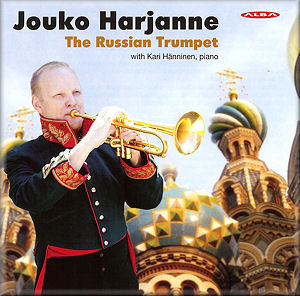
The Russian Trumpet
see end of review for track listing
 Jouko Harjanne
(trumpet) Jouko Harjanne
(trumpet)
Kari Hänninen (piano)
rec. YLE, Dec 2007/Jan 2008, DDD.
Full track-listing below
ALBA ABCD276 [68.12]
 |
|
|
Two things stuck me immediately about this disc. The first is
the lack of programme notes on the pieces. At least two of these
composers are not very well known so it would be beneficial to
the listener to have some information about them and their works.
The sleeve-notes only include a bibliography of the performers,
and the dates of the compositions are not mentioned.
The second was
the placing of the microphones. Brass instruments are directional,
meaning that where the end of the instrument faces in relation
to the audience will greatly affect the amount of detail
heard.
In this case, the microphone seems to have been placed
very near the bell of the trumpet, resulting in a harsh representation
of Jouko Harjanne’s playing. I believe that he does have
a range of articulation between very smooth and very short
and
spiky, but unfortunately it seems that the extremes are
all that have been picked up in this recording.
The opening collection of three pieces
by an unknown composer, Sergei Bolotin, set off with
a suitable amount of drama. Similar in style to Rachmaninov
and Grieg, especially in the piano accompaniment, the Romantic
Etude has a dark, brooding character without the academic
air that its title would suggest. Harjanne plays in the Russian
style, meaning a heavy use of fast vibrato, as a violinist
would use. This is far apart from the sound of classical brass
players in the UK. That aside, his sound is full of personality
throughout. The Fantasy is incredibly flamboyant,
with some technically challenging cadenzas that are executed
to
perfection from both players. I would love to know if Harjanne
wrote the cadenzas. From what little information is included
with the disc, the pianist, Kari Hänninen, is known for
being a brass specialist accompanist. This shows from the
perfect
sense of ensemble, with all changes of speed working beautifully
at all times. The vibrato can sometimes be overpowering,
but
it is used for expressive means in the Elegy, and all embellishments
are well handled.
The makeshift
suite of Shostakovich pieces are a great contrast
to the Bolotin as they are very stark at times. These demonstrate
different skills, mainly Harjanne’s short articulation,
which is marked by the close placement of the microphones,
making
the trumpet sound brisk and choppy. The Romance is
similar to Chopin or Franz Strauss, with clean slurs and supportive
piano accompaniment. Swagger is applied in buckets to the
Dance, and features some great light character with
a cheeky ending. The simplicity of these pieces wears a little
thin by the Clockwork Doll, and I wonder whether these
were written for students. Again, the sleeve-notes tell the
listener nothing of the pieces or composers.
Skyrabin’s Prelude for Trumpet and Piano is not
dissimilar to his piece for horn and piano by the same
name (Canções Lunares
Lunar Songs, J. Bernado
Silva – horn, Alfinaudio, 2007).
It features some delicate phrasing of the singing trumpet
line with flowing piano accompaniment.
The latter half of
the disc is slightly confused. It is customary to place pieces
by the same composer together in recitals and recordings,
especially for singers. Various tracks in the second half
have a vocal attribute in the style of writing and performance,
and it seems odd to separate the two works by Rachmaninov.
The reason may be due to their similarity of character. O,
du wogendes Feld is incredibly beautiful, with a folk song quality that suits
the trumpet and Harjanne’s lyrical playing perfectly. The
Romance is almost a recitative for trumpet, with
a controlled ascent by Harjanne to the heights of the trumpet’s
range at the time of composition. Shchedrin’s In the Style of Albeniz is a showy,
dramatic piece of theatre, which makes a bold contrast to
the previous piece. The work demands unity between the players
and this recording has a fantastic sense of ensemble and communication.
It would have made a much more suitable finish to the album.
It’s a shame that
the piano overpowers in Prokofiev’s Melody as
Harjanne demonstrates his supreme control of his instrument
at a quiet dynamic. A change of colour comes with a wonderful
cup muted section towards the end of the piece. Peskin,
a composer I’ve not come across before, compose two pieces
on this album, which are unremarkable. Harjanne and Hänninen
make a valiant effort to tease out the character in these
pieces, but alas they do not stand up to the Prokofiev
and
Rachmaninov works that frame them. The whole album is a
touch long, and perhaps these pieces could have been omitted.
The three Tchaikovsky compositions
are charming and reflective of clean, stylish trumpet playing,
particularly in the Waltz. The ability of the trumpet
to sing is present in the Serenade, and the mighty
piano skills of Hänninen are exhibited in the Romance.
The obvious folk song by another famous Russian, Balakirev,
closes the disc in an expressive and understated fashion.
Sabrina Pullen
Tracklisting:
Sergei BOLOTIN (1912-1994)
- Romantic
Etude (2’42)
- Fantasy
from the ballet Taras Bulba (4’38)
- Elegy (5’19)
Dmitri SHOSTAKOVICH (1906-1975)
- Overture and
dance from the ballet The Lady and the Hooligan (1’41)
- Romance
from the film Gadfly (1’57)
- Dance
(0’55)
- Gavotte
(1’28)
- Waltz
(2’24)
- Elegy
(2’42)
- The Clockwork
Doll (0’56)
Aleksandr SKYRABIN (1872-1915)
- Prelude (2’13)
Sergi RACHMANINOV (1873-1943)
- O, du wogendes Feld (4’47)
Rodion SHCHEDRIN (b. 1932)
- In the Style
of Albeniz (4’12)
Sergi PROKOFIEV (1891-1953)
- Melody Op.35
No.2 (3’48)
Vladimir PESKIN (1906-1988)
- Poeme No.1
(6’28)
- Prelude No.1
(3’08)
Sergi RACHMANINOV (1873-1943)
- Romance
(4’08)
Pyotr TCHAIKOVSKY (1840-1893)
- Serenade
(3’28)
- Romance
(3’31)
- Waltz (1’35)
Mily BALAKIREV (1837-1910)
- Georgian Song
(4’15)
|
|























