No recording details are given for this release, but it seems
to be a straight reissue of a MusicMasters disc from 1992. It’s
a very welcome one.
The earliest work on the disc is the Short Symphony.
Charles Brider, in his engaging booklet note, tells us that
this work was identified in a 1946 symposium of eminent American
musicians as one of the most seriously neglected major works
of its time. It is Copland’s first essay in symphonic
form and its three movements amount only to a little over a
quarter of an hour. Its complexity ensured that a couple of
planned early performances were abandoned, and though this might
surprise us listening to it now, there’s no doubt that
the first and last movements do set down serious rhythmic challenges
for any ensemble. There are many moments in these two movements
that could almost be by Stravinsky - with signs even of The
Rite of Spring in the last finale - but those clean, open
intervals, in the melodic line, the harmony and scoring, which
we associate with Copland, and which we might also be guilty
of associating with imagined wide, open spaces of the American
landscape, are very much present too. The slow movement is very
beautiful indeed and rises to a fine climax. The work receives
an outstanding performance here, but potential buyers should
be aware that it is not the original version of the symphony
which is given, but an arrangement by the conductor for chamber
orchestra. The composer apparently gave his blessing both to
the project and to the result, stating, so we are told, that
for much of the time he could not tell the difference between
the two versions, hmm … In any event, the piece certainly
works in this version, especially given this fizzing performance.
When the American poet Emily Dickinson died in 1886 at the age
of fifty-six she had led a solitary life for many years, not
leaving her home, receiving few visitors and shunning all contact
with people she didn’t know. Very little of her work was
published in her lifetime, and indeed much of her mature work
was discovered in her desk after her death. Though her poems
deal with a number of themes - in Copland’s words “…nature,
death, life, eternity” - there is about them also a feeling
of the essential loneliness of the creative artist, combined
with the enclosed, almost claustrophobic atmosphere born of
the way of life she adopted. Over several years Copland set
twelve of her poems to music for voice and piano, assembling
them into a cycle in 1950. It is an exquisite work in which
the composer almost miraculously found exactly the right tone
for these very particular poems. He later produced versions
for voice and chamber orchestra of eight of these songs, the
version recorded here, and though the orchestrations are masterly
- and quite recognisably Copland - I have always found that
the essentially public utterance of a work for voice and orchestra
suits these poems much less well than the more intimate voice
and piano duo. Such features as the repeated triplets in the
accompaniment of Dear March, come in, for example, sound
prosaic and studied here, where a fine accompanist gives them
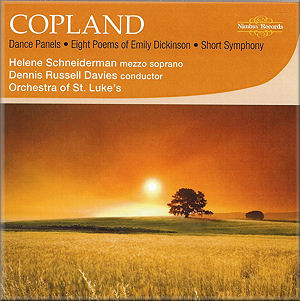
a spontaneous feel when played on the piano. Helene Schneiderman,
a name new to me, has a voice of the utmost beauty which she
uses with great intelligence, and listening to her in these
songs brings a lot of pleasure. She enters very well into the
spirit of the words, but perhaps in too general a way: there
seems little doubt that Dawn Upshaw, for example (last encountered
on a Teldec Ultima double CD 3984-28169-5) makes more of each
phrase and each word. Then Miss Schneiderman is listed as a
mezzo-soprano, and takes the lower octave alternative for the
final note of the work. This is a real pity, and not the minor
point that it might seem. This is a beautiful performance, but
there is rather more to these songs than comes out here, and
in any event getting to know the original twelve-song cycle
in its piano version is essential. There are many performances
of this, but my perhaps unlikely favourite is by Robert Tear
and Philip Ledger, originally recorded on the Argo label, and
last seen on Belart 461 6102.
Dance Panels, the latest of the three works presented,
is a ballet, but one which, unlike the composer’s other
ballets, tells no story. I had never heard this work before,
and I am very much taken by it. The first of the seven short
pieces of which it is composed is austere in style, with repeated
unisons like sad little fanfares. A tender, smoothly flowing
piece in triple time follows, which in turn is followed by a
delightful scherzo. Wistful sadness returns for the exquisitely
scored fourth piece, and the explosive rhythms of the fifth
bring further signs of Stravinsky’s influence. The piece
closes with a curious cymbal and side drum tattoo. A short,
lyrical piece then prepares the way for the challenging finale,
five fast beats to the bar before a lovely, and somewhat unexpected,
calm close. It is one of the lesser known of Copland’s
works, but a most rewarding one. The performance is superb as
is the whole disc.
William Hedley
see also reviews by William
Kreindler
see also Review by Nick
Barnard (August Bargain
of the Month)
























 Helene Schneiderman (mezzo)
