Editorial Board
MusicWeb International
Founding Editor Rob Barnett Editor in Chief
John Quinn Contributing Editor Ralph Moore Webmaster
David Barker Postmaster
Jonathan Woolf MusicWeb Founder Len Mullenger
George
Frideric HANDEL (1685–1759) Alcina (1735) [203:00] Joyce DiDonato (soprano) – Alcina
Maite Beaumont (soprano) – Ruggiero
Sonia Prina (mezzo) – Bradamante
Karina Gauvin (soprano) – Morgana
Kobie van Rensburg (tenor) – Oronte
Vito Priante (bass) - Melisso
Laura Cherici (soprano) – Oberto
Il Complesso Barocco/Alan Curtis
rec. Chiesa di Sant’Agostino, Viterbo, Italy, September 2007 ARCHIV PRODUKTION 477 7374 [3
CDs: 76:24 + 72:16 + 54:36]
The Handel anniversary year has
brought us many new treats, but this, to my mind, is the
best of them all so far. Alan Curtis and Il Complesso Barocco
have been gracing us with some fantastic Handel opera recordings
since the 1970s. They started on EMI, but their more recent
work on Archiv has been even more exciting than their early
projects. Alcina, perhaps Handel’s greatest opera,
is also perhaps their greatest recording.
I have not always been complimentary
about Handel’s operatic style in these pages, but what
marks this set out as something special is not just the
fantastic singing: it is the way that this set sparkles
with dramatic tension and real human emotions in a way
that many other struggle to do. The sorceress Alcina stands
for anyone who has felt - or who has feared - their powers
of attractiveness fade away and Handel’s music traces her
journey into despair and powerlessness, from her love-besotted
opening aria to her abject sorrow in the final act when
she realises that nothing is left for her except tears.
Joyce DiDonato, who has made an extraordinary name for
herself internationally, here gives an astonishing portrayal
of the sorceress. You can take the beauty of her voice
for granted: her entrance aria, Di’, cor mio is
voluptuous and fulsome, a real depiction of the infatuation
that comes with love, and to match it DiDonato sings with
rich, creamy tone that is quite marvellous. There is more
to her assumption than just beauty, though: the portrayal
changes with the character. She captures venom and hysteria
for the dramatic arias that accompany Alcina’s steady realisation
that she is losing her powers, and her final aria, Mi
restano le lagrime, drips with overwhelming poignancy
without losing its beauty. Perhaps her greatest moment,
however, is Ombre pallide, the aria that ends Act
2, when Alcina calls to the spirits who she can sense around
her but are now refusing to listen. The first run of the
aria carries a mood of quiet desperation, while the da
capo is full of understated terror. DiDonato owns this
territory and in this recording she has made herself the
greatest Alcina on disc.
She, however, is not the only great
vocal actor on this set: there is not a single weak link
in the cast. Karina Gauvin’s Morgana is as alluring as
her sister: Ama, sospira in the second act is seductive
with an edge of malice which is entirely appropriate to
the dramatic context, while the famous Tornami a vagheggiar is
carried off with panache to match even Sutherland or Dessay:
the da capo ornamentations are really astonishing!
Ironically the Ruggiero of Maite Beaumont sounds much more
feminine than the Bradamante of Sonia Prina. Beaumont has
an alluring lovelorn quality to her voice which matches
the enchantment of Act 1 and the wistful nostalgia of Verdi
prati, but she is capable of the character’s more intense
utterances, such as his self-reproach at the start of Act
2. By contrast, Prina sounds positively masculine in Acts
1 and 2, though I suppose that’s not entirely appropriate
for a character who spends most of the opera disguised
as a man. Her voice carries beauty, but her real triumph
is in the dramatic arias: E gelosia in Act 1 and Vorrei
vendicarmi in Act 2 are jaw dropping in their vocal
acrobatics but without ever losing their innate musicality
and dramatic purpose. Laura Cherici’s Oberto really sounds
like a boy, plangent and vulnerable in his first aria but
growing into the beginnings of a hero by the final act.
Importantly in an opera like this, all the female voices
are distinctively different so that the vocal texture never
suffers. Vito Priante’s Oberto is suitably authoritative
and if Kobie van Rensburg’s Oronte has the occasional unsteady
moment they are very few and far between.
Anchoring the whole set, though,
is the orchestra and continuo. Il Complesso Barocco give
us lithe, transparent playing throughout and Curtis’s conducting
is flexible and responsive at every turn. It is he more
than anyone who understands the drama of the work. To see
what I mean listen to Alcina’s Act 1 aria Si, non quella.
This beautiful aria features Alcina trying for the first
time to come to terms with the fact that she is no longer
what she was: the singing is very beautiful, but there
is a subtle reticence to the accompaniment which suggests
that, in spite of her words, she is unable fully to convince
herself that she really is as “true” as she claims to be.
There have been other great recordings
of Alcina. In Richard Bonynge’s 1962 set there are
some wonderful musical moments, though one can barely detect
a single consonant in the whole of Joan Sutherland’s performance
of the title role. Richard Hickox’s 1986 recording on EMI
has some really remarkable singing with safe-pair-of-hands
playing and conducting, while William Christie’s 1999 recording
from the Paris Opéra features an outstanding - if somewhat
inauthentic - cast including Renée Fleming, Susan Graham
and Natalie Dessay. Interesting as Nigel Bolton’s Munich
recording was it didn’t quite match Christie’s. Until now
the Christie was the version that came closest to the ideal,
but this new recording jumps straight to the top of the Alcina pile.
In fact I would go even further and say that if you have
never heard a Handel opera before or are a little nervous
about where to start then this is the best introduction
to that world that I can think of.
Simon
Thompson
Please support our advertisers below by clicking on the logos for further information.
























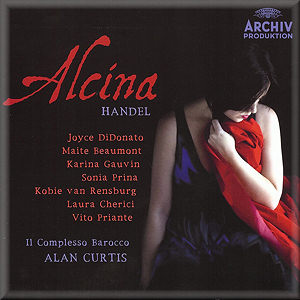

 Joyce DiDonato (soprano) – Alcina
