Editorial Board
MusicWeb International
Founding Editor Rob Barnett Editor in Chief
John Quinn Contributing Editor Ralph Moore Webmaster
David Barker Postmaster
Jonathan Woolf MusicWeb Founder Len Mullenger
Nikolai
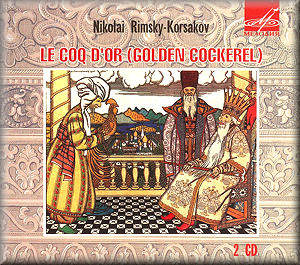
RIMSKY-KORSAKOV (1844-1908) The Golden Cockerel(1908) [122:48] Tsar Dodon – Yefgeny Nesterenko
(bass)
Queen of Shamakha – Elena Ustinova (soprano)
Astrologer – Boris Tarkhov (tenor altino)
Tsarevitch Gvidon – Viacheslav Svistov (tenor)
Tsarevitch Afron – Vladimir Svistov (baritone)
Voyevode Polkan – Alexei Mochalov (bass)
Amelfa – Raisa Kotova (contralto)
All-Union Radio and Television Academic Grand Choir
Academic Symphony Orchestra of Moscow State Philharmonic/Dmitri Kitaenko
rec. no details provided. ADD MELODIYA
MELCD1001398 [57:42 + 65:06]
The
Golden Cockerel was
Rimsky’s final opera, in fact probably his final work,
and he never lived to see it performed. Like most of
his operas it’s full of magic and fantasy, but the circumstances
of its composition are grounded in earthy reality. Rimsky
lived through the momentous events of Russia’s almost-revolution
in 1905. He was appalled by the heavy-handed manner
in which the government dealt with the events of Bloody
Sunday and the subsequent unrest. His students at the
St. Petersburg Conservatory went on strike to protest
and Rimsky wrote an open letter of support for them,
for which he was promptly dismissed from his teaching
post. The Golden Cockerel is his response: he sets the story of an
overly authoritarian but incompetent Tsar who makes appalling
decisions which ruin his country and eventually himself
too.
As the start of the opera Tsar Dodon is considering
war and his advisers come up with a series of ever more
preposterous methods of defending the kingdom. A mysterious
astrologer appears with a golden cockerel which he says
will crow if there is danger and will point in the direction
the danger will arrive from. Dodon is delighted and
offers the Astrologer anything his heart desires. He
goes off to war and discovers that his enemy is the beautiful
and magical Queen of Shamakha. He falls in love with
her and marries her. When he returns to the city, however,
the Astrologer claims the Queen as his reward. Dodon
refuses and kills the Astrologer with his sceptre. The
cockerel then flies down and pecks him on the head and
Dodon falls down dead. There is also a prologue and
epilogue wherein the Astrologer appears and warns the
audience not to take the story too seriously as it is “a
nightmare, dream, a pale ghost, emptiness.”
Consequently, the story is actually pretty grim, especially
if compared to Rimsky’s other fairy tale operas like Sadko and Christmas
Eve. Rimsky’s astonishing orchestration makes it something
special, though. Musically the structure is straightforward
enough: like Wagner’s Parsifal, Dodon’s court is associated with steady, diatonicism,
while the magical world of the Astrologer and the Queen
is sinuous and chromatic. The opera’s opening sequence
showcases this: the Prologue uses the orchestra impressionistically,
and it isn’t a million miles away from Melisande’s forest,
but then immediately afterwards we arrive in Dodon’s
court where heavy chords and cadences dominate. The
two worlds collide in the final act when Dodon brings
the queen home with disastrous consequences for himself.
There are very few recordings of this work currently
available, and this Melodiya issue is very welcome. The
singing is good, and undeniably Russian, not least in
the pronunciation. Nesterenko will be familiar to many
western listeners through his performances in Trovatore and Nabucco on
DG. This performance is clearly of a different
order, though. His voice is higher and less boomy than
in his Verdi recordings, and his pronunciation resembles
a drone rather than clear, western enunciation. There’s
nothing wrong with any of this, though, and of all people
the Russians should know how to handle this music. Either
way, you soon accept it and stop noticing the difference. Boris
Tarkhov’s ghostly voice is just right for the Astrologer:
the character’s other-worldly, spectral quality is captured
well, not least through the bizarrely high range he is
given. The star of the recording, however, is Elena
Ustinova’s Queen. Rimsky’s chief method of differentiating
her from the other characters is with the altitudinous
top notes he gives her. They really are quite extraordinary,
and often it sounds like they are being made by a different
instrument, not being sung. Ustinova is given a little
help by some judicious splicing (noticeable a couple
of times) and the engineers provide a slightly artificial
shine to her voice, but this only serves to heighten
her characterisation. It is very successful. The lesser
roles are fine, if nothing special. Givdon sounds heroic,
when he probably shouldn’t, and the housekeeper Amelfa
fusses in a way that all operatic busybodies should. The
orchestral playing is very fine and shows Rimsky’s orchestration
to its full, astonishing effect. Kitaenko’s conducting
is fine, if unremarkable. The sound is impressive, if
rather too resonant at times, and there are times when
an echo feels a little intrusive, but this never gets
in the way of the performance.
All in all, then, this is an impressive and enjoyable
performance of a very worthy opera. Be warned, though:
Melodiya don’t make things easy for you. There is no
libretto in the set, just a minimal synopsis which isn’t
even cued. The opera is easy enough to follow, but this
inevitably means you miss out on many of the subtleties,
and it becomes particularly wearing during Dodon’s long
duet with the Queen in Act 2 which, as half an hour without
text, runs the risk of becoming tedious.
Simon
Thompson
Please support our advertisers below by clicking on the logos for further information.

























 Tsar Dodon – Yefgeny Nesterenko
(bass)
Tsar Dodon – Yefgeny Nesterenko
(bass) 
