The opera semiseria “La Sonnambula” - to a libretto by
Felice Romani - is a slight thing compared with the grandeur and
complexity of the tragedia lirica
“Norma”. Both were first performed in 1831, but are worlds apart;
“La Sonnambula” has a formulaic plot, little depth of characterisation,
banal action and could be said to consist of little more than
a pleasing succession of pretty tunes. Unless, that is, excitement
is injected through the sheer virtuosity of a charismatic diva
who has coloratura fireworks and an unearthly, limpid beauty of
utterance at her disposal – in other words, unimpeachable bel
canto technique. Visconti understood this when, in his La Scala
production upon which this recording is based, he had Callas come
front-stage to deliver the second verse of Ah! Non giunge
with the all the house lights turned up. The story is told of
Callas demurring when he asked her to play Amina dressed as a
simple village maiden but wearing a diva’s diamonds; he reminded
her that the audience had come to see the Maria Callas sing Amina.
Furthermore, it was more likely that a conductor such as the young
Bernstein would invest “La Sonnambula” with more verve than a
traditionalist like Votto – as the 1955 live recording confirms.
Not that Votto does
a bad job; he conducts with the right lilt and charm. Mono sound
is much less of a disadvantage in so light and graceful a piece
and Votto delivers gracefully the minimal accompaniment required
to the arias and the simple, rustic choruses. He never obtrudes
and ensures that the ensemble concluding Act 1 is a highlight.
The raison d’être
of this set must be Callas. Hers was never a voice as sheerly
beautiful as that of Sutherland or Sills but the compensations
are many and it is a pleasure to hear in a role which makes
no inordinate demands on her vocal technique beyond its capability.
She successfully lightens her voice throughout; it is strange
to think that only the following September she would record
Turandot – not entirely successfully. So many things are right
here: the heart-stopping downward portamenti; the lapidary
staccati; the subtle variation of vibrato to enhance
emotion; the haunting, plaintive cantilena – all these are immediately
and gratefully encountered in Come per me sereno and
the subsequent aria Sovra il sen. There is little edge
or beat except in the stratospheric E-flats at the end of Act
1 and of course in the concluding showpiece Ah! Non giunge
– and here, despite the wobble, she amazes with a spectacular
diminuendo. Callas creates a vulnerable, infinitely touching
Amina, full of pathos - and her characterisation is matched
by peerless vocalisation. The last fifteen minutes provide a
suitably climactic conclusion to a thrilling performance; this
is a great bel canto singer in full flight.
Her supporting cast
are more than adequate, although some are bettered elsewhere.
Many have complained about what they hear as the slightly whining
tone of Nicola Monti but I find him perfectly acceptable; he
was, after all, thought good enough to partner Sutherland in
her first studio recording, too. His voice is of the light,
attractive kind probably envisaged by Bellini himself: it is
sure of intonation, artfully modulated and produced with a minimum
of vibrato. The duet Son gelosa is delightful and he
is a model of grace in such phrases as “mio bene”. True, his
mezza-voce is not as honeyed as that of Valletti or, especially,
Tagliavini but they are all three of the same voice type – with
the significant difference that Monti’s high C in Ah vorrei
trovar parole is a bit of a bleat and he has far less heft
in reserve. Nonetheless, he combines sensitively with Callas
and understands the idiom perfectly. A young Fiorenza Cossotto
lends distinction to the small role of Teresa and the ubiquitous
Zaccaria sings the Count smoothly and nobly; it is only when
you hear what Cesare Siepi makes of Rodolfo that you realise
what is missing in Zaccaria’s assumption. A blot on the set
is Eugenia Ratti’s pert, acid Lisa; hers is the edgy “Minnie
Mouse” type of soubrette voice that I can well live without.
A welcome bonus
is provided in the form of four “classical” arias performed
by Callas in grand, stately, impassioned style. These 1955 recordings
find her in fine vocal estate, the voice huge and healthy.
This Naxos re-engineering
by Mark Obert-Thorn is, as always, sonically a great success
and this bargain issue is worth buying from every point of view:
economically, artistically and historically. However, there
are other options. I am very attached to the 1952 Cetra recording
conducted by Capuana, which is almost contemporary but seems
to come from an earlier age. It features a wonderful cast: Tagliavini,
who has the most apt and beautiful voice of all those tenors
who have essayed Elvino; Pagliughi, at the end of her career
and bereft of the money notes but making the most convincing
and childlike of Aminas with her clear, infinitely touching
innocence and purity; and Siepi, who brings extraordinary warmth
and sparkle to a potentially dull rôle. It is the most consistent
and authentic version of “La Sonnambula” and I would not part
with it. As much as I admire Sutherland, her first recording
is blighted by her droopy characterisation and indistinct words;
her second was recorded too late and is compromised by Pavarotti’s
inappropriate, gung-ho style. I like the modern Naxos version
with Luba Orgonasova and Raúl Giménez: she, warm and vibrant,
if rather anonymous; he, stylish and experienced – but it has
little “star quality”. I have not yet heard the new set with
Bartoli and Flórez, but the reports are that she does exactly
what I feared, and pulls the music about self-consciously while
appearing to be recorded in a different acoustic to accommodate
the smallness of her voice; he is as good as you would expect.
There are two important
live recordings: the aforementioned 1955 Bernstein/Callas occasion
and the 1961 New York performance with Sutherland. The sound
is pretty dire in both. They have their adherents, but for a
studio recording the choice remains between this Callas version
and the Cetra (Warner-Fonit) classic.
Ralph Moore
























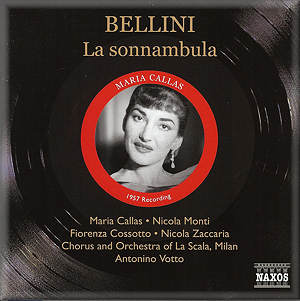
 Amina - Maria Callas
(soprano)
Amina - Maria Callas
(soprano) 
