Editorial Board
MusicWeb International
Founding Editor Rob Barnett Editor in Chief
John Quinn Contributing Editor Ralph Moore Webmaster
David Barker Postmaster
Jonathan Woolf MusicWeb Founder Len Mullenger
George Frideric
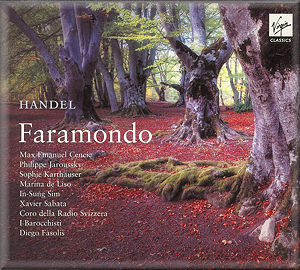
HANDEL (1685-1789) Faramondo- Opera in three acts, HWV39 (1738)
Faramondo - Max Emanuel
Cencic (counter-tenor)
Adolfo - Philippe Jaroussky (counter-tenor)
Clotilde - Sophie Karthäuser (soprano)
Rosimonda - Marina De Liso (mezzo)
Gustavo - In-Sung Sim (bass)
Gernando - Xavier Sabata (counter-tenor)
Teobaldo - Fulvio Bettini (baritone)
Childerico - Terry Wey (counter-tenor)
Coro Della Radio Svizzera; I Barocchisti/Diego Fasolis
rec. Radio Svizzera di lingua Italian, Lugano, Auditorio Stelio Molo,
19-24 October 2008. DDD.
Booklet with notes, text and English translation included. VIRGIN CLASSICS
2166112 [3 CDs: 65:59 + 48:52 + 51:17]
I came to this recording with not very high expectations, unsure
if it could be the answer to Robert Hugill's prayers.
Reviewing a Brilliant Classics recording (99777/21-3 - see review),
licensed from Vox, in November,
2003, he made a plea for 'a modern recording with a
star cast. Rather than re-recording 'Ariodante', 'Alcina'
or 'Rinaldo' could not someone give us a new 'Faramondo.'
Until then, we must be grateful to this recording which does
its duty pretty well'.
That recording has now reverted to the Vox label (37536)
and
is on sale for around £17-£18 in the UK.
I've 'sat' on this review for far too long trying
to decide my answer to that initial question. I must admit to
feeling like the Rump Parliament, famously dismissed by Cromwell
for having sat too long for the good they had done. So long,
in fact, that my colleague Margarida Mota-Bull has got her review
online before me.
Finding the new recording on sale for much less than the Vox
from several on-line dealers (less than £14) made me suspect
that they, too, expected not to find too ready a market for
it. Then, too, Markus Cerenak's notes in the booklet don't
exactly enthuse about the opera itself; though he writes that
it 'belies suggestions that Handel was feeling under par
during its composition and that it is a no more than average
work', he does over-stress the contrast between its reception
and 'the great success' of its successor, Serse.
Yes, of course, Serse warrants an entry in the Oxford
Companion to Music and Faramondo doesn't but,
in fact, it is posterity, inspired largely by the beauty of
arias like Ombra mai fu, rather than the contemporary
taste which has elevated Serse. Serse fared better,
but not spectacularly better, with the original audiences.
The shorter description of the work on EMI/Virgin's web
site is more positive than Cerenak's notes, concluding with
Diego Fasolis's own words about the music's 'tonal
subtlety and a palette of emotional colour that compel admiration
... While being lively and playful, it is never aggressive or
superficial.' A preliminary listen-through confirmed the
truth of those words and served to allay misgivings about the
quality of the opera. In fact, I had almost completed this review
and decided that the recording was worth a thumbs-up, when I
discovered that MM-B had come to the same conclusion.
It is true that the plot is very complex, but Faramond, ou
l'histoire de France by Gautier de Costes de la Calprenède,
the source of the libretto, is as convoluted as its author's
name. It's one of those works on the fringe of Arthurian
romance which were inspired by Ariosto, Boiardo and Tasso, with
all that that implies; if anything, Handel's unknown librettist
cuts through some of the undergrowth, though not as successfully
as is the case with Orlando. Indeed, in cutting, he has
created as many problems as he has solved, leaving too many
loose threads. I've omitted the summary of the plot which
I originally intended to include in this review, since MM-B
has given an admirable synopsis.
The other reason for my initial trepidation concerns Philippe
Jaroussky as Adolfo. It isn't that I'm averse to countertenors,
far from it, but his voice is very much an acquired taste
and,
as I wrote in my May 2009 Download
Roundup of his singing on another Virgin recording, (Un
Concert pour Mazarin, 5 45656 2), it's a taste which
I haven't yet completely acquired. Johan van Veen reacted
much more positively to that earlier recording: 'Only
in the last item ... the most dramatic elements are not
fully exploited.
Considering the general level of his performance, and the fact
that he is still at the beginning of his career, we may
expect
a lot more from him in the future.' (see review).
Could Faramondo be the occasion for him to shine dramatically,
as JV expected?
The Overture goes well -a little solid, perhaps, but stylish,
with none of the impetuosity which contemporary Italian conductors
so often bring to baroque music. By comparison, the Vox version
sounds rather stately; it observes repeats which the new version
ignores. Throughout the opera I Barocchisti never give any cause
for complaint.
Virgin's publicity material makes much of the unique status
of this 'complete recording of a Handel opera with men singing
all the male characters cast for singers with high voices.'
In 1738 only Faramondo was sung by a man, the star castrato
Caffarelli; the other high-voice male parts were taken by women.
There are four countertenors on this recording: Max Emanuel
Cenci as Faramondo, Philippe Jaroussky as Adolfo, Xaxier Sabata
as the Swabian King and Terry Wey as Childerico.
Form his first brief appearances on CD1, I warmed to Jaroussky's
singing more than I had on previous occasions. Yes, his voice
has a different timbre from that of most other countertenors,
higher, more boyish and more feminine-sounding, but that is
not inappropriate in view of the fact that the part was sung
in 1738 by a woman. That may have had more to do with financial
than artistic considerations, but the fact remains valid.
For all the quality of Jaroussky's singing, however, when
Adolfo and Clotilde are together, as in Scene 3 (CD1, trs.7-8)
it is very difficult to distinguish between the two characters,
so similar is Jaroussky's voice to that of Sophie Karthäuser
in the latter role. I see that MM-B had the same problem occasionally
in differentiating between male and female singers, though she
doesn't mention this particular example.
Even that similarity, however, I can readily forgive when Karthäuser
offers such a beautiful performance of Conoscerò,
se brami ch'io t'ami (tr.8). Nor is Jaroussky's
singing in Chi ben ama (tr.10) in any way inferior to
hers. These may not be up there with the very best of Handel's
display arias, but both singers make strong cases for them.
Next to appear, briefly, at the opening of Scene 5, is Terry
Wey's Childerico, vainly defending Rosimonda from Faramondo's
intrusion. It is apparent that he has a much more 'conventional'
counter, more easily distinguished from a female voice. Conventional
or not, he sings well here and throughout.
Max Cencic's Faramondo, too, has a more conventional countertenor
timbre. He has no great chance to shine in this scene;
even so, the quality of his singing is such that we can readily
appreciate the effect which he has on Rosimonda - though he
is her enemy, she immediately finds him attractive. When he
does, later, come into his own, he rivals - perhaps even outdoes
- Jaroussky as the star performer.
The other singers are all very good - I agree with MM-B that
In-Sung Sim's Gustavo and de Liso's Rosimonda are particularly
good. On the other hand, though Xaxier Sabata as Gernando sings
attractively and dramatically, he is a little too overtly dramatic
at times.
I normally like to get my thoughts together and online before
any other reviews have appeared. On this occasion, my delay
means that not only MM-B but other reviewers have expressed
their opinions before mine. As it happens, I didn't need
to be influenced by them in ending much better satisfied than
I expected to be, but I'm pleased to see that they generally
agree with me in liking a performance of an opera which some
of them hadn't much expected to enjoy. If you're not
convinced, you can sample the whole opera free on We7, though
you'll have to put up with intrusive advertising on each
track. Don't dream of buying it from them, however, for
half as much again as some dealers are selling the CDs.
The recording is good, the notes, texts and translation are
well presented and the whole thing is attractively packaged
- a 3-CD case with separate libretto, all inside a slip-case.
My review copy arrived with a broken hinge, however, a strong
argument for the kind of stiff cardboard gatefold triptych which
Carus and others employ.
I note that we now have a recording of Ezio, another
neglected Handel opera (DG Archiv 477 8073). I intend to make
that my next port of call. Meanwhile, I'm pleased to welcome
this recording of Faramondo.
























 Faramondo - Max Emanuel
Cencic (counter-tenor)
Faramondo - Max Emanuel
Cencic (counter-tenor) 
