I’ve been noticing these Melba label releases increasingly of
late, and I must say their presentation is remarkably good.
Housed in a sturdy gatefold, the well documented booklets are
not only firmly attached to the inside of the card, but properly
stapled. You can read the booklet notes as a proper ‘book’,
rather than having to open the thing gingerly, trying not to
break some high-tech and probably short-lived glue spine. The
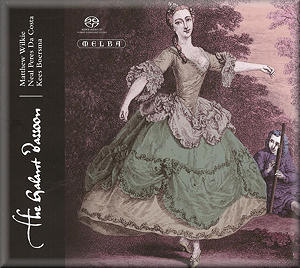
design is also very clear and distinctive, although the 18th
century lady does look somewhat stalked by the furtive looking
bassoon man in the bushes on the illustration for this release.
The folder comes housed in a sturdy clear plastic sleeve which
is worth hanging onto, in case the boards start bending due
to heat or moisture. Can’t you just tell I’m the son of a bookbinder?
The title The Galant Bassoon is not really inappropriate
here, but might as easily have been The Baroque Bassoon.
The ‘style galant’ is associated with the mid 18th
century, but more usually accepted as referring to the generation
which followed on from the ‘high baroque’ - one son of J.S.
Bach, J.C. Bach, being a prime example. Another, C.P.E. Bach,
might be considered as falling partially outside this category
due to the emotional intensity he frequently brought to his
work. Either way, all but one of the pieces performed here
have been transcribed for bassoon from original versions for
other instruments, but they are all highly effective and deliver
great enjoyment.
Beginning with Telemann’s Sonata in E Minor we are
immediately bathed in the succulent sounds of deep double-bass,
crisp harpsichord, and Matthew Wilkie’s superb bassoon playing.
It’s like a wonderful expensive restaurant dish, full of different
layers of flavour and textures to tease the palette. Throughout
this disc Wilkie transcends all technical problems and delivers
sheer musical joy and panache. His sound is round and mellifluous
without being in any way sad and soggy, and he has plenty
of ways of introducing variety even beyond the natural character
of the various ranges of the instrument. His melodic phrasing
is uncomplicated but effortlessly expressive, coloured with
a satisfying and perfectly tasteful vibrato. The instrument
played is also thankfully non-clattery in terms of key noises,
something which can be a turn-off with bassoons. This BWV
1030 sonata and the Sonata in A minor were originally
written for viola da gamba, coming from Telemann’s own final
published collection, the Essercizii musici of 1740.
The range of the viola da gamba is comparable with that of
the bassoon, and with just a few details of transcriptional
licence for elements of the solo part which are idiomatic
for strings but unplayable on a wind instrument, these pieces
sound every bit as natural as the originals.
The J.S. Bach sonatas are both transcriptions from flute
sonatas, the Sonata in E Minor BWV 1034 now appearing
in the key of A minor, and the great Sonata in B Minor
BWV 1030 transcribed for bassoon into A minor. As a flute
player I know these pieces as well as I know my own toenails,
and therefore how tough they both can be. BWV 1030 is highly
technically demanding, and correctly played here without the
addition of the double-bass. The conversation between bassoon
and harpsichord and the change in tonality inevitably alters
the character of the music, but is in my opinion none the
worse for it. The flow of the first huge Andante movement
is gorgeously elegant, and that beautiful Largo e dolce
is taken with great expressive depth. The only marginal
point is that the bassoon’s dynamic range doesn’t really go
truly soft, and where a flute can’t go truly loud it does
have the potential for a deal more dolce extremes than
a double-reed instrument. This takes little away from the
excellent playing here, and with the rousing rows of semi-quavers
of the Presto to finish things off there can be no
complaints.
The Sonata BWV 1030 opens with a delicious Adagio
ma non tanto in which there is melodic interest for the
double-bass continuo as well as plenty of opportunity for
marvellous legato in the bassoon. The tricky Allegro is
full of technical fireworks, and given plenty of drive by
all players it sometimes seems as if Matthew Wilkie has an
external pneumatic pump instead of lungs. With a muted stop
on the harpsichord and pizzicato bass, the third Andante
movement acquires an almost Jacques Loussier swing, and
for those of us who are of a ‘certain generation’, it’s Hamlet
cigars at the ready. No compromise in tempo for the final
Allegro, which becomes a wild ride one wouldn’t have
expected to be possible on a bassoon.
As the only piece here written specifically for bassoon,
Telemann’s Sonata in F minor deserves special mention.
This comes from the collection Der getreue Musik-Meister,
and exists in a version for recorder. Like many of these pedagogical
compositions, it could be played on almost any melody instrument,
but the dramatic opening Triste and generally reflective
feel of the minor key does seem ideal for the melancholy resonance
of the bassoon. This is particularly true of the lovely Andante,
although the Allegro and closing Vivace do have
plenty of lively energy.
In quite a brave move, the programme closes with a solo work,
C.P.E. Bach’s Sonata for solo flute in A minor,
here transcribed into D minor. Once again, this is a piece
I must have played hundreds of times, but there is no sense
of discomfort in hearing it through Wilkie’s wooden tones.
In fact, I’m quite jealous. There is a good deal of counterpoint
in the writing for this piece, and one of the challenges for
a flute player is to give a separate identity and character
to the different lines. The bassoon, with its greater resonance
and clear definition of timbre in the lower registers, does
this with far greater power and differentiation than most
flute performances I’ve heard. Wilkie is light and playful
in the middle Allegro, always giving the notes plenty
of space. While he never allows the sometimes busy textures
to crowd his instrument, his sense of the pulse in the music
is unerring. The only moment that he stretches a bit beyond
my taste is the upward arpeggio opening theme to the final
Allegro. The harmony is well enough established by
that triad, and the ‘ground tone’ needs no extra rubato emphasis
in my humble opinion.
To conclude, this is a real winner. The chapel acoustic is
quite resonant, but the engineers have managed to keep this
part of the background rather than allowing it to swamp the
instruments. The effect of transposing these works so that
a double-bass works as a continuo works extremely well, and
both the bass and the harpsichord are well balanced and support
and interact with the bassoon in an ideal fashion. The surround
SACD effect is the icing on an already quite rich musical
cake, creating a luxurious aural space around the musicians
which is quite intoxicating. People who ignore this disc merely
because it’s played on bassoon are missing one of the best
chamber music discs I’ve heard in a long time.
Dominy
Clements


























 [73:23]
