The German Audite label has been a friend to the works of Franck,
father and son. This has nothing to do with César. We are talking
here about Eduard and Richard, father and son. Audite’s commitment
extends to four CDs of the father’s music and one of the son’s
(see below). Eduard’s music shattered no shibboleths but it was
intensely tuneful in the lively manner of Mendelssohn – perhaps
with the occasional zest from Schumann and the Elysian voice of
Beethoven heard intermittently. Richard Franck is also a romantic-conservative
– at least he is judging by these works. He seems to have had
no truck with the expressionists or the first stirrings of dissonance.
For him the Grail lay with Schubert and Brahms with a modicum
of Schumann.
Audite have given us one CD of Richard’s chamber music (92.522
- see
review).
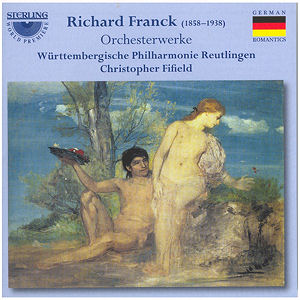
It is reviewed on this site by the conductor of the present Sterling
release. Bo Hyttner’s Sterling label now allow us to hear, in
superbly polished and exuberant performances, a cross-section
of Richard’s orchestral works. To date it’s unique though there
is certainly plenty of material for a second and even a third
CD.
There’s no symphony or concerto here but the Olympian symphonic
manner is alive in the opp. 21 and 31 works. The
Symphonische
Fantasie has the mien of the first movement of a symphony.
It veers between the harp-decorated
himmlische vision of
Schubert’s
Great C major and Brahms’ Fourth. It’s a much
better than capable piece of work – and is only let down by a
surrender to the obligatory Teutonic fugal episode at 6.32. The
orchestra appear rapt and at the close the brass benches deliver
a romping aureate roar which gladdens the heart.
There are two
Serenades here. The one for violin is placidly
Beethovenian in the manner of the two
Romances. The cello
one is again pacific in its humour and the solo line foreshadows
the main melody in Korngold’s Cello Concerto. The four movement
Suite is charming – toasty warm, in fact with its Griegian
cool flute in the
Präludium and a wheezy Magyar-inflected
Marsch. The
Liebesidyll -
Amor und Psyche
lives up to its name. It lacks the sensuality of César Franck’s
Psyché but it is sweetly intoned with Bruch taking a handsome
bow. The cello acts as a sort of ‘precentor’ at the start. The
concert overture could hardly have a more romantic title but do
not expect anything like Rachmaninov. Franck’s pantone admits
of melody with undulant unjagged contours but the language is
firmly locked between the poles of late Schubert and late Brahms.
It’s all very pleasant, at times strikingly beautiful and not
at all folksy.
There’s plenty more to record including a Symphony in D minor
from 1905 (manuscript), three piano concertos (1880-1907), a Prelude
to a romantic play (1926) and a 1906 Violin Concerto. All in due
time!
There is just that undercurrent of complacency in this music which
some might condemn as reactionary. It is there but is not at all
damaging. Only once does the mask slip – and that is when the
plaguey and irritating fugue in the
Fantasie puts in an
appearance. Otherwise serenely-shaped Germanic romance. Bring
it on.
Rob Barnett
Reviews of Audite releases of Eduard Franck
20.025
Violin concerto, Symphony
20.032
String quartets
20.033
String quartet, piano quintet
20.034
Violin concerto, Symphony

























 Fabian Wettstein (violin);
Tim Strüble (cello)
Fabian Wettstein (violin);
Tim Strüble (cello) 