I looked at Glyn Pursglove’s review
of Volume I as I was listening to this follow-up recording and
found that he had exactly predicted my own reaction. Volume II
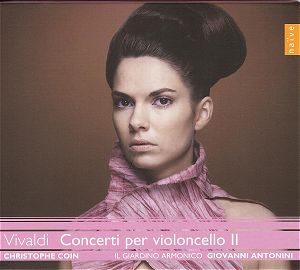
takes up where that first CD left off; even the lady with the
bouffant hairstyle on the cover of Volume I is still with us,
though now she is facing the camera.
Like GPu, I find the cello concertos to be some
of the most attractive of Vivaldi’s works – but, then, I’ve
yet to find a single work in his output that I didn’t find at
the very least highly enjoyable. One of the attempts to interpret
Elgar’s mysterious words at the head of the score of his Violin
Concerto, Aquí esta encerrada el alma de ..., suggests
that the soul which the music encapsulates is that of the violin
itself. I used to think that the earliest works which encapsulated
the soul of the cello were the two Haydn concertos; I still
very much warm to those Haydn concertos, but I’ve come to realise
that Vivaldi captured that soul even before Haydn.
Part of that realisation has come via two of the
volumes in Naxos’s series of the Vivaldi cello concertos with
Raphael Wallfisch and the City of London Sinfonia directed by
Nicholas Kraemer – a very good set of performances on modern
instruments with much more than a nod in the direction of period-performance
practice. Volume 3 of that Naxos series (8.550909) contains
a performance of RV403 and Volume 4 (8.550910) offers RV411
and 417 from Naïve’s Volume II.
If Wallfisch offers heart-felt performances which
reveal the depth of Vivaldi’s understanding of the cello, the
new CD does so equally well, if not even better. Modern Italian
interpreters of their baroque heritage often indulge in fast
and exciting tempi, though Il Giardino Armonico are by no means
the worst offenders, especially when they are in tandem with
Christophe Coin – indeed, I treasure several of their older
recordings, still available on the Warner/Teldec label and available
as very inexpensive downloads from the warner.freshdigital website.
Try Coin and Il Giardino in Il Proteo, a CD of double
concertos with no overlap with the current CD, 4509-94552-6,
which can be downloaded for a mere £3. (It’s also still available,
albeit more expensively, on CD, with the suffix -2 in place
of the -6).
Most modern period ensembles now play with the
same expertise and confidence as if they were handling modern
instruments, but Il Giardino are especially adept performers
– not a hint of the stridency and even out-of-tune playing which
often characterised the early days of the ‘authentic’ movement.
In RV411, which opens the new recording, tempi
are remarkably consistent with those on Naxos – only in the
final Allegro molto (track 3) are the Naïve performances
very slightly faster (1:58 against 2:12). As so often happens,
when the two performances are compared in actuality, the paper
differences in timing matter not at all – both are very satisfying.
In RV417, the Naxos performers are marginally faster in the
first two movements and marginally slower, again, in the finale;
once again, these marginal differences melt away when one listens
to the two performances, each of which makes excellent musical
sense within its own context. The same is true, too, of the
marginal differences in RV403.
Both sets of recordings are thoroughly idiomatic
and thoroughly enjoyable – there’s plenty of room in my collection,
overcrowded as it is, for duplication when the performances
are as good as these. I had expected the Naxos recordings to
sound a shade unimaginative and unexciting when hearing them
immediately after the new Naïve CD, but such was not the case.
If I have a preference, it has to be too marginal to be significant
in an objective review.
If I’ve spent much of this review looking at alternatives,
that’s largely because GPu has already said most of what I wanted
to say, particularly in respect of the way in which Coin and
Antonini make the slow movements into something especially heart-felt
without ever a hint of the slow tempi which used to be associated
with anything of the sort. It’s no longer a case of choosing
between sentiment indistinguishable from sentimentality and
allied with slowness in the manner of I Musici or Karl Münchinger,
on the one hand, and whiz-kid ‘authenticity’ on the other.
I speak thus of those older interpreters with regret; they opened
the door for me to baroque music.
GPu suggested that some listeners might find the
cello a little too close; I concur, but this is the only fault
– if fault you find it – with the otherwise very good recording.
I’ve grown tired of asking for the continuo to be a little more
audible on modern recordings; as is now usual, it’s virtually
inaudible here.
The informative and readable notes - by Michael
Talbot, guaranteeing that the English is idiomatic - round off
a first-class achievement. I was especially interested in the
suggestion that Vivaldi may have been acquainted with the violoncello
di spalla, a kind of jumbo viola played horizontally, an evolutionary
dead-end in the development of the modern instrument but perhaps
influential on the composition of these concertos.
Brian
Wilson