|
EXPLORE
Musicweb - CLICK
------------------
Message Board
Announcements
Twitter @MusicWebINt
------------------
RECORDING
OF THE MONTH
Shostakovich Symphony 8
RCO, Nelsons

HALLÉ WALKURE
4+1CDs £22 post free
RECORDING
OF THE MONTH

Complete Orchestral Works

EMI Complete Ferrier

Storyteller

Mahler
Symphony 7
Bamberger Symphoniker
Jonathan Nott
................
RECORDING OF THE MONTH

Simone Young
RECORDING OF THE MONTH
Italia Nicola Benedetti

Only complete set
on the Market
35CDs £67

RECORDING
OF THE MONTH
Momentous!
BARGAIN
OF THE MONTH

Italian Cello Concertos
and Sonatas
3CDS £10.95

Brahms Symphonies Zinman
£26.85
RECORDING
OF THE MONTH
Beethoven Symphonies
Thielmann


Magic Moments of Opera
10 Operas Arthaus £95

Brilliant Classics 40CDs

Brilliant Classics 60CDs

9 Symphonies Chailly
£31.90

9
Symphonies C Davis
£18.70
BARGAIN
OF THE MONTH
Absolutely marvellous!
£5.99 post free

Bruch VC1 Gluzman
Quite the finest performance of the Bruch concerto
I have ever heard.

The best opera DVD of the year so far [ST]

Mahler Song Cycles
Katarina Karnéus
Available
again
The Raga Guide
4CDs + 196 page book
£33 post-free world-wide
15,000 copies sold
Editorial
Board
Classical Editor
Rob Barnett
Seen & Heard
Editor Emeritus
Bill Kenny
Editor in Chief
Stan Metzger
MusicWeb Webmaster
Len Mullenger
Assistant Webmaster
David Barker
|
 |
 |
|
alternatively
CD: Crotchet
|
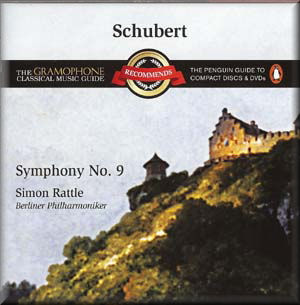
Franz
SCHUBERT (1797-1828)
Symphony No. 9 in C major (The Great) (1825-8)
Berlin Philharmonic/Sir
Simon Rattle
rec. 8-11 June 2005, Philharmonie, Berlin. DDD
EMI CLASSICS 2285332 [57.43]  |
|
|
There was a time when one expected recordings of Schubert, Beethoven,
Haydn, Mendelssohn and so on to be played by a full-scale modern
symphony orchestra. That all started to change around 1988 as
far as Schubert's Ninth was concerned when Sir Roger Norrington
recorded it with the London Classical Players for EMI Reflexe.
Apart from the size of the band (about 60) and the so called period
instruments producing a pitch much higher than we were used to
Norrington took less than an hour over the piece including, quite
deliberately, all of the repeats. Gradually, since then, if a
'great orchestra' has recorded works such as this the conductor
has been what is known as "historically informed". Rattle as a
young man in the late 1980s was fully aware of these developments
and where possible has tried to adopt them.
I listened again to Norrington's recording before listening to
Rattle's version. It's interesting that the tempi are very similar.
Rattle knocks almost a minute off Norrington's time; this is especially
true of the second movement compared with the older generation
of maestros like Karl Böhm. Also one should note that Rattle is
using strongly accented bowing in and on the strings as in the
opening of the Scherzo. Note too the very clearly articulated
brass and the delicate woodwind work, although a little distantly
recorded. The effect is especially delightful in the second movement
which seems to be not a million miles from Schubert's incidental
music to 'Rosamunde' written in 1823. It all depends on whether
you are of the opinion that Schubert's Ninth marks the end of
the classical period - which is what Norrington prefers - or the
first symphony at the beginning of the Romantic. In this we leave
aside Beethoven who seems to straddle both classical and Romantic
eras and yet is of all time. Despite his stylistic awareness
Rattle falls most certainly into this latter category. Richard
Osborne in his interesting accompanying essay develops this further
and even alludes to Bruckner. He quotes Schumann as saying "years
must pass before the work will be thoroughly made at home in Germany".
I certainly cannot be the first listener to hear a little Brahms
in Schubert's slow movement and a soupcon of Dvorák in the Trio
section of the third.
Of the length of the work it is well known that Schumann, who
excitedly discovered the manuscript, described it as "heavenly"
( taking you on "a journey from which no-one returns"). For those
who are coming fairly new to the work Schubert's sense of development
coupled with his use of repetition can be a problem. Rattle overcomes
this by keeping up the interest by coaxing the orchestra into
constantly varied and new phrasing or dynamics. The playing and
ensemble are never less than outstanding.
The Berlin Phil still uses much vibrato and they are a large ensemble.
The timps do not use the now standard hard sticks which we all
expect to hear nowadays. There appears to be almost too much orchestral
control and at times a lack of spontaneity. Sometimes there is
quite fussy phrasing which will pall on repeated hearings. It's
almost as if Rattle, not having tackled Schubert for many years,
has been somewhat overawed and has tried too hard.
Undoubtedly Simon Rattle will want to record the work again one
day. However, having heard this recording right through you can't
help but feel that you have gained a firm grasp of the work's
architecture. Along the way you have been treated to some marvellous
orchestral playing. It's a journey after which life can never
be quite the same again.
Gary Higginson
|
|
Advertising
Rates
Visitor
stats
MusicWeb
International
has over 40,000 Classical CD reviews on offer
Discs
received
Having a problem
Donating?

Gerard
Hoffnung Concerts &
The
Bricklayer Story
New
Releases

New
Releases


MusicWeb
sells the Polish
catalogue CDAccord
£10.50 post free W-W

MusicWeb sells the
Arcodiva catalogue
£12.00 post free W-W

£11.75
post-free world-
wide
MusicWeb
can now offer
you discs from the following catalogues:
Prices include postage
Musicweb
Special
Offers
Monthly
Best Buys
Google
Ads - for information about privacy matters, click here.
Amazon Musicweb International is a participant in the Amazon
EU Associates Programme, an affiliate advertising programme designed to provide
a means for sites to earn advertising fees by advertising and linking to Amazon.co.uk
and Amazon.com
|