Giacinto
Scelsi was born into a titled family, studied music in Rome
with Giacinto Sallustio, and later studied composition with
a pupil of Arnold Schönberg’s, Walther Klein. He also received
tuition from Egon Köhler in Genève. Throw into this melting
pot the influences of Ottorino Respighi, Alfredo Casella, the
surrealists, fauvists and futurists of Paris and elsewhere,
and link the Preludi to Scriabin, Debussy, and even Chopin,
Liszt and Messiaen, and the potential for a rich mixture of
styles was always ever present.
The
younger Scelsi was a faithful follower of Schönberg’s serialism,
but after a personal crisis at the end of the 1940s all rules
were left up for grabs. He subsequently saw music as something
of three dimensions: Pitch, duration, and depth of tones. This
latter is hard to define, but it would appear that this had
much to do with both the resonances above and below the note,
and the perception of music: each listener at one point in space
always hearing a different music to someone in another point.
The logical conclusion was that Scelsi’s emphasis was on the
creation of the composition rather than its performance. Scelsi
also changed faith from Catholic to Eastern philosophies, another
aspect of his life which would deeply affect his works and lifestyle.
If little is known of Scelsi, then he succeeded in not wishing
to become well known. He allowed no photos of himself to appear
along with his work, and only after his death were a few pictures
of the man brought to light.
The
Preludi are in some ways as enigmatic as the composer
himself. They form a kind of musical diary which covers 20 years
of Scelsi’s life, and, mostly unpublished, reveal a depth of
exploration and expressive experiment which is quite an eye
and ear-opener. Even after a good deal of research and reconstruction
we can’t be sure that this recording presents the entirety of
these works, but as it stands this is a remarkable document
in sound. Alessandra Ammara is best known for her recordings
of Chopin and other romantic repertoire, and I find her style
of playing the perfect vehicle for these pieces. Her phrasing
and sense of rubato – always restrained and understated, nonetheless
provides this music with the expression it deserves. It would
be so easy to see these pieces as more aggressively avant-garde,
and use the notes to show the piano all four corners of the
room at once, but Ammara’s elegance of touch means that even
some of the more ‘difficult’ preludes take on an atmosphere
and an often magical presence all of their own.
The
programme notes give each prelude a sentence or two of descriptive
analysis, which helps untangle things much in the way of an
annotative label underneath a painting in an art gallery – in
other words, you can take them or leave them, but they will
be of use to the uninitiated. One can go further, and plunder
the analytical recipe books for additional comment, but for
our purposes you need more to know if this is going to be your
‘thing’ or not. This is of course subjective, and I don’t want
to ram music down your throat that you find you don’t like –
even after a few hundred words of rhapsodic recommendation.
At a basic level, all I can say is that if you do like
the piano music of Messiaen, and also appreciate the fragrant
complexities of Scriabin, the chromatic romanticism of Berg
and on occasion the atonal rigours of Kreňek or the quirky
imaginations of Ligeti or Janáček, then this will almost
certainly appeal to your tastes.
The
Preludi run chronologically, so the more immediately
dodecaphonic pieces open the programme. Even while the serial
elements may at first create some resistance in the listener,
the imposing drama of the first and the nocturnal atmosphere
of the second soon convince that there is ‘something going on’,
intriguing the ear and mind and drawing one in. Some pieces
develop from a single line of widely spaced but clearly undulating
notes, tracing patterns like a Paul Klee sketch. Some create
static, dreamy worlds, and others could be ‘songs without words’
– imaginary letters, sung and recited to a long lost love. Scelsi
was no isolated composer, and keen ears will spot the influences
of Bartók and others. The second prelude of Serie II quotes
Messiaen’s Quatuor pour le fin du temps, and shamelessly
shows Scelsi proving to himself that he could create an individual
piece in his great contemporary’s idiom. In some pieces the
piano is effectively allowed to converse with itself – extremes
of range and contrasting material pitting percussion against
chattering chords above. Moods from extremes of melancholy,
aggressive passion to even playfulness and jazzy abandon at
times, they’re all here. The later Preludi gain and develop
in terms of luminosity, meditative depth, Webernesque transparency
and extremes of expression and content. Ligeti cited that he
had been greatly influenced by Scelsi, and on hearing some of
the Serie III and IV pieces one can easily hear
why. In some of the pieces, the notes have all the significant
weight and variety of scale and perspective of stones in a Japanese
garden. In other of the later preludes we have to negotiate
craggy and unwelcoming landscapes, but in no sense is the journey
not worth the risk, and the rewards are always comparable with
the efforts demanded.
Apart
from a recording of the 1936-40 Preludi by Donna Amato
on the Stradivarius label (SVS33804), there seem to be no other
recordings of any of these pieces currently available. With
a superlative, demonstration standard piano recording and remarkably
insightful performances, I can’t imagine this repertoire being
bettered on disc any time soon, and only a further set of discoveries
to extend this collection would seem to warrant a re-appraisal.
The recording location is pleasantly resonant, and with plenty
of extra acoustic information in SACD surround mode. As mentioned,
the piano is captured in all its glory, with some stunning bass
notes and that often elusive quality of simultaneous warmth
and sparkle. The instrument must have been re-tuned a number
of times during the sessions, with one or two numbers showing
a few strings ‘on the turn’ as it where, but this is a miniscule
and overly-picky comment. The technical demands of the music
are often highly challenging, but Alessandra Ammara’s performances
are never anything less than impressive, and often breathtaking.
I for one am very glad to have been introduced to these fascinating
pieces in such an empathetic and technically outstanding way.
Dominy Clements
























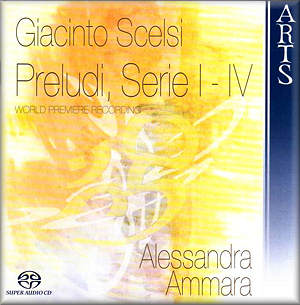
 Alessandra Ammara (piano)
 47721-8
[73 :10]
47721-8
[73 :10] 