I suppose I’m of a generation that grew up with
the idea that Herbert Howells was one of those composers you
only hear in church. With the odd slant, though, that unlike
most such composers, he was still alive. Then a recording came
along of “Hymnus Paradisi” and it emerged that he could write
big things as well as small. But still religious. If you looked
at the reference books you saw that he had started out by writing
secular stuff – orchestral pieces, concertos, chamber music.
But that had all stopped about fifty years before. Wild oats,
one supposed. Rather as – in the opposite direction – Dorothy
Sayers started out by writing religious dramas before settling
into whodunits. Then Boult, in his last years, set down a few
of the orchestral pieces for Lyrita. He also re-learnt the Concerto
for String Orchestra, of which he had given the première in
1938, giving it a few performances and making a recording that
was issued in 1974.
Gradually, as Hyperion and Chandos delved ever
deeper into British music, Howells’s earlier career was mapped
out and the disconcerting picture emerged of a brilliant young
composer all set for a great future, yet so unsure of himself
that he suddenly stopped composing after a single man’s protest
at the première of his Second Piano Concerto in 1925. The deaths
of Elgar and, more particularly, of Howells’s son Michael, drew
from him the Concerto for String Orchestra, yet it was his only
further orchestral work before he gave way to the stream of
religious music that occupied him until late in life.
The Three Dances are ostensibly escapist idylls,
written while the Great War raged around them. Yet there is
a sense of uncertainty behind them which may stem from the composer’s
own personality but more likely expresses a realization that
the “green and pleasant land” had its future threatened. The
first finishes with an ominous passage, brushed away by the
final bars, while drum beats invade the calm of the closing
measures of the gentle second dance. If the very short (01:52)
third dance seems untroubled, its very brevity gives it the
air of a question mark. There is more high art in these three
miniatures than in many a more pretentious piece.
I wouldn’t include the ambitious Second Piano
Concerto amongst such over-pretentious pieces, however. Though
frequently big-boned, extrovert and muscular, it also has moments
of brooding mystery and hushed withdrawal and handles the alternating
moods with complete conviction. More than of any English concerto,
it had me thinking of Prokofief, or of a post-impressionist
such as Roussel. This latter may have been evoked by Stott’s
performance. With a slightly recessed recording – truer to a
real concert balance than we usually hear but not quite what
we’re used to – and elegant texturing, and without playing down
the more boisterous elements, she somehow conjures up slightly
sepia-coloured images redolent of old French films. It would
be interesting to hear a no-holds-barred American-style interpretation
– I don’t know the Chandos recording by Howard Shelley – but
Stott’s is certainly one way of playing it, and may in the end
prove the best.
I recently listened to British piano concertos
by Rowley, Darnton and Ferguson. Even the latter inspired me
to no more than lukewarm enthusiasm. Here’s a British piano
concerto that really does have some stature.
More lauded than the other works on the CD, the
Concerto for String Orchestra says less to me. It’s certainly
a far cry from the pastoral meanderings of the “cow-pat school”.
Its brilliant – and, I think, protesting – moments are continually
interrupted by darker meditations and it has at its centre an
uneasy and obviously deeply-felt lament in memory of the composer’s
son. But being deeply-felt doesn’t of itself guarantee that
emotion will be conveyed to the listener. I’m afraid I grew
impatient with the stop-go nature of it all. The British string
orchestra repertoire is very large and I couldn’t escape the
feeling I’d been here before all too often.
Was Howells’s really a youthful talent that had
already run its course by the time he reached his Second Piano
Concerto? If he had died in 1925, would we keep the Second Piano
Concerto and a few other things in our repertoire as a constant
reminder of the brilliant talent cut cruelly short, one who,
like Hurlstone, Baines or Butterworth, would “undoubtedly” have
done great things had he lived?
Since I recently commented that Handley’s performances
of Stanford amount to time-beating rather than real conducting,
I am pleased to report that the music of this slightly later
generation seems to have fired him to a completely different
level of achievement. I noticed countless cases of flexible
phrasing and finely controlled dynamic shading that only a real
conductor could have produced. Though I don’t know the recording
of the Concerto for String Orchestra by his mentor Boult – or
that by Hickox either – I didn’t feel that my negative reaction
to the music was in any way due to the performance.
Christopher Howell
























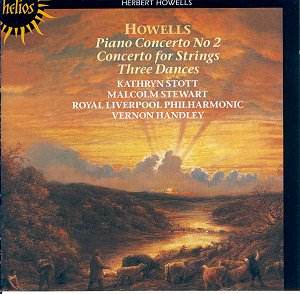

 Kathryn Stott (piano)**;
Michael Stewart (violin)*
Kathryn Stott (piano)**;
Michael Stewart (violin)* 
