Editorial Board
MusicWeb International
Founding Editor Rob Barnett Editor in Chief
John Quinn Contributing Editor Ralph Moore Webmaster
David Barker Postmaster
Jonathan Woolf MusicWeb Founder Len Mullenger
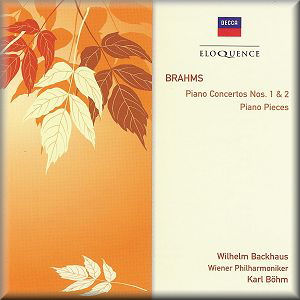
Johannes BRAHMS (1833-1897) CD 1 Piano
Concerto no. 1 in D minor op.15 [43:37]*
Capriccio in B minor op.79/2 [02:52]
Intermezzo in E flat op. 117/1 [04:21]
Rhapsody in B minor op. 79/1 [07:39]
Intermezzo in E op. 116/6 [02:33]
Intermezzo in E minor op. 119/2
[04:11]
Intermezzo in C op. 119/3
[01:28]
CD
2 Piano Concerto no. 2 in B flat
op. 83 [48:13]*
Six Piano Pieces op.
118 [20:22]
Wilhelm Backhaus
(piano)
Vienna Philharmonic
Orchestra/Karl Böhm*
rec. June 1953,
Grosser Saal, Musikverein, Vienna, Austria (PC 1), November 1956,
Victoria Hall, Geneva, Switzerland (solo pieces), April 1967,
Sofiensaal, Vienna, Austria (PC 2)
DECCA ELOQUENCE 480 0800
[67:04 + 68:42]
Wilhelm Backhaus was born in 1884, played to Brahms - among others
- in 1895, gave his first solo recitals in 1899, made his first
gramophone records in 1907, began giving complete Beethoven sonata
cycles in 1929 and gave his last concert less than a week before
his death in 1969. Brahms figured largely in his recording programmes
and his pre-war 78s of solo pieces have perhaps been reissued
more frequently - on Pearl for example - than the 1956 clutch
captured here in early stereo. He set down both concertos before
the war: no. 1 in 1932 with the BBC SO under Boult and no. 2 in
1939 with the Saxon State Orchestra under Böhm. He returned to
them both in 1953, pairing the present no. 1 with no. 2 under
Schuricht, also with the Vienna Philharmonic. I daresay most piano
buffs would rather have had this latter here. The re-engagement
of Böhm and the VPO for the late no. 2 means that the packaging
announces an "intégrale" which is more apparent than real.
The booklet has a thorough presentation of the music and, especially,
a detailed analysis of Backhaus's pianism, both by Walter Frei,
who clearly heard the pianist regularly. While welcoming this
sort of informed comment, I have to say that he back-pedals on
the case for the prosecution and some present-day listeners may
be puzzled at the disparity between what is claimed and what is
actually heard.
The performance which most lives up to Frei's description is that
of the First Concerto, not least thanks to Karl Böhm. Fundamentally
a more excitable Brahms conductor than you would know from his
comatose late symphony cycle, he launches the work at a grand
maestoso with enough movement for it not to get stuck. The rocking
second theme, which beaches many a performance, surges ahead unhurriedly
but inexorably and some decidedly Furtwänglerian impetuosity is
allowed in the climaxes.
When Backhaus enters he doesn't "do" anything in particular to
the music, he just plays it grandly and solidly. He fits perfectly
into the scheme which we now realize was shared from the beginning
by two artists well used to working together and whose art had
its roots in Brahms's own world.
At 12:36 the Adagio is the swiftest on my shelves. We're used
to the idea that fast movements got faster and slow movements
slower after the war - the "Karajan effect" - so it's interesting
to find that the slowest available to me is actually the 1938
Schnabel/Szell - 15:55. Backhaus and Böhm are warm and natural.
They do not sound hurried but I would describe the performance
as ardent rather than searching. The finale is steady but vital
and grand.
The short pieces completing this first disc provide a catalogue
of the sort of things that caused people to be wary of Backhaus.
It's certainly an energized view of Brahms but with ungainly accents,
snatched phrases and unsettled tempi. I turned with relief to
the disc of opp.116-9 by another pianist from a similar generation
and background, Wilhelm Kempff, and found myself in another world
of subtlety and imagination. Even in op. 119/2, the one piece
from Backhaus which did not actually contain any objectionable
features and which I consequently quite enjoyed, Kempff is nonetheless
magical in another way.
But Backhaus is not to be written off so easily. Op. 118
shows him at his best. It's still a forthright view compared with
Kempff but it works well as an alternative in all the pieces and
sometimes better. Both pianists play no. 2 faster than we usually
hear these days, in Kempff's case too fast for comfort, I find.
On the other hand, when the music goes into a slower tempo and
a major key in the middle section, Kempff produces a shaft of
poetic illumination such as doesn't seem to exist in Backhaus's
DNA. Backhaus's bold, knightly presentation of the Ballade, no.
3, is clearly preferable. Kempff sounds effete in comparison,
beautiful as his middle section undoubtedly is. Kempff is magical
in the first two pages of no. 4 where Backhaus is more conventionally
agitated, but then it is Backhaus who finds the tragic force called
for on the final page. Indeed, it may be said that, when Brahms
veers towards a black hole, Kempff elegantly cushions the descent
to the abyss while Backhaus follows him all the way. Thus, while
Kempff's account of the friendly "Romanze", no. 5, especially
the birdsong in the middle, is a miracle of grace, it is Backhaus
who excels in the desolate no. 6.
Nor was Backhaus a spent force when he rerecorded the Second
Piano Concerto in 1967. By chance I listened to this not long
after hearing the 1929 Rubinstein/Coates version and it brought
home to me just how much is lost if the music is sped through
too easily. The gentle opening suggests that this performance
is going to be a nostalgia trip but Böhm soon has things sitting
up. Within a broad tempo his phrasing is detailed - more Gardiner
than Karajan - and the sound is lean and muscular. He perhaps
relaxes more than he did in the earlier no. 1, but then this is
a work with a wider range of moods. Backhaus is still pretty well
in command. Once again, he doesn't "do" a lot with the music,
just presents it boldly and firmly. But somehow, in its unvarnished
way, it seems to be enough, especially with such splendid orchestral
support. Böhm is really inspired in the slow movement, perhaps
encouraging Backhaus to tap a vein of poetry we don't always associate
with him. The finale is a little slow, but Backhaus finds considerable
delicacy, while Böhm ensures that things don't get heavy. I began
by regretting that the earlier recording with Schuricht had not
been chosen - and I would still like to hear it - but I must say
this is a version worth having and of course the sound is far
better than anything else here.
On account of the mixed vintages it's difficult to know who this
album is aimed at. I daresay the perennially-lauded Gilels/Jochum
is a safer recommendation from the analogue era (in stereo) but
seekers after Brahms cannot ignore Backhaus.
Christopher Howell
Please support our advertisers below by clicking on the logos for further information.

























 Wilhelm Backhaus
(piano)
Wilhelm Backhaus
(piano)

