Period instrument renditions of Vivaldi’s perennial favorite The
Four Seasons tend to come in two flavors: Piquant and explosive.
These are both improvements on what for many years after the concertos’
rediscovery in the 1930s was a kid-gloved approach by modern orchestras
afraid to unleash the wildness of Vivaldi’s imagination. When
Nikolaus Harnoncourt and his daredevil, upstart period band the
Concentus Musicus of Vienna recorded these chestnuts in the mid-1960s,
they blew the lid off the world’s collective conception of these
pieces. What was previously treated as very polite and gentle
music was revealed to be music worthy of a composer with red hair,
full of eccentricities and explosions. But back then it was a
bit much for many people.
Regarded
for many years as over-the-top, the Harnoncourt rendition
drifted off to the side as several period groups of the 1970s
and 1980s recorded versions which combined discerning amounts
of spice with a more traditionally beautiful approach. This
lead to marvelously crystalline recordings by the Academy
of Ancient Music on L’Oiseau Lyre, the English Concert on
Archiv, and my favorite piquant account, the Drottningholm
Baroque Ensemble on BIS. In recent years, Harnoncourt’s zest
has finally been admitted as a valid approach - perhaps we’re
all getting jaded! - spawning more recent “extreme” renditions
by Il Giardino Armonico (Teldec) and Europa Galante (Opus
111 and Virgin). Each new recording can announce where along
the continuum it falls.
This
new Telarc multi-channel hybrid SACD by Boston Baroque, under
Martin Pearlman with Christina Day Martinson as soloist, definitely
falls into the piquant but genteel category. Martinson is
a vivid and characterful soloist; indeed, at times I felt
that perhaps she would be interested in pushing the envelope
a little further than her director. Pearlman pulls his punches,
rarely letting his players exult in Vivaldi’s temper.
The
decision was made to use ornamentation on the solo lines,
which is good to a point. And I might add that Martinson’s
improvisations are generally quite wonderful. But one thing
I do like about Simon Standage’s ornaments in the Pinnock/English
Concert recording is that Standage always plays each melody
through once, as written, then ornaments it upon repeat. This
makes a huge difference in the slow movements of the Spring
and Summer concertos, because Martinson starts adding notes
immediately. Standage on the other hand begins starkly, intensifying
the mood with long, held-out notes, and only gradually increases
the lushness with improvisation. Martinson’s effusions, conversely,
seem to come out of nowhere, like an actor’s unmotivated emoting.
No
one beats Harnoncourt’s oppressive opening for Summer, what
with its pitch-challenged chamber organ continuo, but present
company do well, even if the ensuing cuckoo solo is a bit
hectic. Martinson’s turtledove and goldfinch birdsong solos
are lovely, arguably the most rapt I’ve heard since Standage’s
still unsurpassed hush. But credit must be given for the later
“pleading shepherd” solo, where Martinson shapes it better
than Standage, who pulled it too far out of shape. In all
four finales, Pearlman holds back to restrained, even stolid
tempos, so much so that Martinson audibly strains to push
it ahead toward the end of Summer, though her solos get a
little scratchy when she does.
Martinson
and Pearlman’s Autumn drunks are dispatched with an effective
rubato, even if it isn’t as wayward as Enrico Onofri’s pitch-melting
solo with Il Giardino Armonico. The slow movement of this
concerto normally holds me spellbound, though the above Armonico
recording (Teldec) drove me round the bend with a far too
elaborate harpsichord continuo. The Telarc recording, though,
is surprisingly intrusive here, spoiling the mood with a harpsichord
sound roughly as large as the rest of the orchestra. Indeed,
throughout the recording, the harpsichord is far more dominant
than one could ever be in a real concert, unless the listeners
were sitting right next to the instrument. Instead of softly
lolling arpeggios in the background of the held-out, trance-like
string tones, here we get loudly plonking harpsichord notes,
with a vague cloud of string sound in the distance. Fearing
that perhaps I was being overly fussy, I went back and compared
this to the harpsichord balance in earlier Telarc recordings
of the Boston Baroque, such as the Brandenburg Concertos
from 1994, and even the Vivaldi Gloria from 2005, and
the harpsichord was more properly in perspective in both.
Others may be less bothered by this, but it was a serious
spoiler for me.
Another
general drawback for me is that Pearlman unfailingly favors
a very lean and astringent sound, biased toward the higher
instruments. I like a little juicier instrumental texture,
and a more prominent low end. Pearlman always seems to push
his bass and cellos off toward the back of the soundstage,
where they have less impact. I’d rather hear that harpsichord
moved to the back corner, and the cellos and basses moved
apart to give them more impact. I do like the rich coloring
and fairly close placement of the theorbo used here in the
continuo, though.
Joining
the Vivaldi on this disc are some Geminiani arrangements of
Corelli sonatas, including the popular Variations on “La
Follia”, which are dispatched crisply and quickly here,
playing up the more rakish aspects of the melody, as opposed
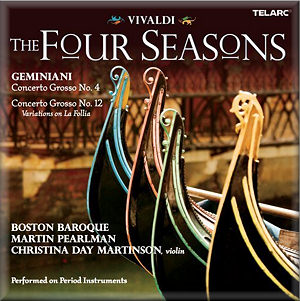
to the morose side sometimes favored. One fine detail worth
mentioning is the excellent cover design, sparing us the usual
birds and trees. It is a photo of the elegantly carved bows
of Venetian gondolas, thus suggesting Vivaldi, who lived and
worked in Venice. But the curvature of the boats is also reminiscent
of the fern-curls at the end of the peg boxes of violin-family
instruments. And, to cap it off, each of the four boats is
lightly trimmed in a seasonal color, yellow, green, red and
blue. Very piquant.
Mark
Sebastian Jordan


























 [59:26]
