Editorial Board
MusicWeb International
Founding Editor Rob Barnett Editor in Chief
John Quinn Contributing Editor Ralph Moore Webmaster
David Barker Postmaster
Jonathan Woolf MusicWeb Founder Len Mullenger
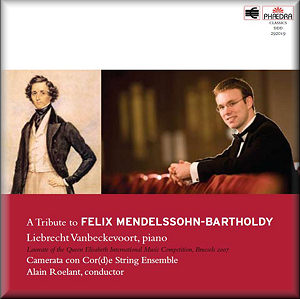
Felix MENDELSSOHN (1809-1847) A Tribute to Felix Mendelssohn-Bartholdy
From Songs without Words for solo piano:
Op. 19/1 in E major (c.1829/32) [3:05]
Op. 19/4 in A major (c.1829/32) [2:10]
Op. 38/6 in A flat major Duetto (1836) [2:46]
Op. 62/1 in G major (1844) [2:00]
Op. 62/6 in A major Spring Song (1842) [2:02]
Op. 67/2 in F sharp minor (1845) [2:00]
Op. 67/4 in C major Spinning Song (1845) [1:46]
Op. 85/1 in F major (c.1840s) [2:19]
Op. 102/5 in A major Kinderstück (1845) [1:01]
Rondo Capriccioso in E Major for solo piano,Op.
14 (c. 1828, revised later) [6:12] Variations Sérieuses in D minor for solo piano, Op. 54 (1841) [11:34]
Concerto in A minor for Piano and String Orchestra, S.3 (1822) [33:32] Liebrecht Vanbeckevoort (piano)
Camerata Con Cor(d)e String Orchestra/Alain Roelant
rec. 29-31 July 2008, Academiezaal, Saint-Trond, Belgium. DDD PHAEDRA
CLASSICS 292019 [70:27]
This 2009 release from the Phaedra label marks
the 200th anniversary of Mendelssohn’s birth. It
is good to have another version in the catalogue of the
rarely recorded Concerto in A minor for Piano
and String Orchestra from the thirteen year
old Mendelssohn.
A new name to me, the Belgian-born pianist Liebrecht Vanbeckevoort,
is a laureate of the Queen Elisabeth International Music
Competition of Belgium 2007. He studied with Professor
Jan Michiels at the Royal Conservatory of Brussels and
later with Professor Ton Demmers at the Brabants Conservatorium,
Holland. In 2008 Vanbeckevoort attended the New England
Conservatory, Boston in the class of Russell Sherman.
Mendelssohn composed his eight volumes of Songs without Words (Lieder
ohne Worte) at various points in his life from 1830
to 1845. There are 36 of these short lyrical piano pieces
designed to be within the compass of pianists of various
abilities. The first volume of six was tentatively issued
in 1832 by Novello of London but they would not underwrite
the costs of printing. After a year only 48 copies had
been sold, a fact that contrasts with the consequent
and enduring popularity of the pieces. Two of the volumes
Op. 85 and Op. 102 were published posthumously. It seems
that five of the piano pieces were allocated titles authorised
by Mendelssohn himself. I tried to find the exact composition
dates but for some of the Songs without Words they
are only approximate.
For me the finest recording is a selection of 15 of the pieces
played with refinement and poetry by Murray Perahia. The disc
was recorded in 1997 at New Jersey, USA and 1998 in London
on Sony Classical SK 66511 (c/w Bach/Busoni Choral
Preludes and Schubert/Liszt Song Transcriptions).
I used Perahia’s Sony recording to make a comparison with
those four matching pieces that Vanbeckevoort has chosen
to record here.
The opening piece, Op. 19/1 in E major marked Andante con
moto is
played with an invigorating freshness and lightness of
touch. Perahia plays with authority and additional assurance.
He is able to mould every note into his overall vision
of the piece. With considerable purity each note is clearly
defined with a luminous tone. Compared to Vanbeckevoort,
Perahia’s dynamics are frequently broad but not wildly
so. Marked Moderato in the A major piece, Op. 19/4
Vanbeckevoort delivers a stately and serious interpretation,
discovering an undercurrent of passion.
I enjoyed the buoyancy of the A flat major Duetto,Op.
38/6 which is an uplifting Andante con moto containing
a central section of considerable excitement. Here Perahia
selects a rather measured pace affording himself ample
time for expression compared to Vanbeckevoort’s slightly
brisker tempo. The G major score, Op. 62/1 an Andante
espressivo is interpreted by Vanbeckevoort with an
impressive dramatic breadth. I was struck by the instant
memorability of the lullaby-like A major, Op. 62/6 a lively
and characterful Allegretto grazioso known as the Spring
Song.
In the F sharp minor piece, Op. 67/2 marked Allegro leggiero Vanbeckevoort
is delicate and witty displaying a mischievous quality.
In the famous Spinning Song a C major Presto,Op.
67/4 he is joyously brisk and sparkling and displays splendid
control. Perahia in the Spinning Song adopts a similar
speed, playing with his usual brilliance. Vanbeckevoort
in the F major piece, Op. 85/1, an Andante espressivo conveys
a swaying rhythm suggesting an aqueous character. With
the A major Kinderstück, Op. 102/5 marked Allegro
vivace he comes across as brisk and bustling.
There is some difference of opinion over the composition
date of Mendelssohn’s Rondo Capriccioso in E Major,Op.
14. Mendelssohn may have
completed it as early as 1824 or even in 1828, with a later
revision. I note there is an autograph version dated 1830
which was possibly used as a gift for the Munich pianist Delphine
von Schauroth, a baroness’s daughter. The Rondo Capriccioso is
formed in two contrasting sections played continuously.
In the first part an Andante in E major Vanbeckevoort
finds a lyrical tenderness that he develops into a fiery
fervour. At 2:04 the second section an E minor Presto is
given a convincing interpretation. One can easily picture
a dreamlike nocturnal magic, evocative of fairy creatures
at play in a moonlit woodland glade à la A Midsummer
Night’s Dream.
The Variations Sérieuses in D minor, Op. 54 is considered a
great masterpiece of Romantic piano music. Following an
invitation from Pietro Mechetti, the Viennese publisher,
Mendelssohn wrote this work as his contribution to an “Album-Beethoven”.
This collection of works by several composers was conceived
in the hope of raising money for a commemorative Beethoven
statue in Bonn. Mendelssohn completed the score in 1841
with publication in Vienna following the next year. Biographer
Prof. Glenn Stanley, in his ‘The music for keyboard’ Chapter
9 from ‘The Cambridge Companion to Mendelssohn’ (ed.
Peter Mercer-Taylor, Cambridge University Press, 2004,
p. 160) has described this set of piano variations as “a
Bachian Homage to Beethoven.” It seems that Mendelssohn deleted one of the original
eighteen variations leaving us with a rich and affecting
theme followed by the seventeen variations. In
this substantial single movement score numerous
and widely varying emotions are evoked and Vanbeckevoort
gives an interpretation of promising assurance. The playing
encompasses graceful delicacy, sparkling vitality, brooding
mystery and stormy tempestuousness.
In the alternative recordings of both the Rondo Capriccioso and
the Variations Sérieuses I greatly admire Perahia’s
expertly controlled and assured versions on Sony Classical
SNYC 37838 (c/w Mendelssohn: Sonata for Piano, Prelude
and Fugue).
The final work is the little known Concerto in A minor for Piano
and String Orchestra. Although the autograph score
is not dated it was, according to Mendelssohn’s nephew
Sebastian Hensel, composed in 1822 when Mendelssohn would
have been around 13 years old. Evidently
it was performed at one of the Sonntagsmusiken (Sunday
musicales) held at the Mendelssohn
residence in Berlin. This house would have been at Neue
Promenade as the Mendelssohn family did not move to the
large mansion in the Leipziger Straße until late
1825. The three movement score is the longest of Mendelssohn’s
three piano concertos and was possibly modelled on Hummel’s
1816 Piano Concerto No. 2, Op. 85 in the same
key.
In the substantial opening Allegro Vanbeckevoort communicates elegance,
combined with ample spirit and vivacity. His confident interpretation of
the central movement Adagio is one of considerable sensitivity and
grace. The final movement marked Allegro ma non troppo is performed
with joviality and ebullience with evident vitality. At 6:46-8:23 a short
reflective central passage provides a stark contrast before the work embarks
on a headlong sprint to the finishing line. Vanbeckevoort is skilfully accompanied.
Liebrecht Vanbeckevoort’s first solo CD is a fine achievement. His
splendid playing promises much for a future that looks
exceedingly rosy. This Phaedra disc is worth buying for
the rarely heard Piano Concerto in A minor alone.
With regard to the solo piano scores onthe disc
it is impossible not to look further than the magnificent
Sony Classics releases from Murray Perahia.
The well balanced sound quality from this Phaedra disc is slightly
lacking in clarity when compared to the above-mentioned
disc of the Songs without Words by Murray Perahia
on Sony Classics. The essay in the booklet is written to
a decent standard although I was left wanting more information
on the actual scores.
Michael
Cookson
Please support our advertisers below by clicking on the logos for further information.

























 Liebrecht Vanbeckevoort (piano)
