Last year I reviewed
a BBC Legends release of Ein deutsches Requiem in which
the LPO was conducted by Klaus Tennstedt. Now the same label gives
us another performance, from six years earlier, in which the same
orchestra is directed by another great conductor, Carlo Maria
Giulini.
Giulini led two
performances of the work at the 1978 Edinburgh Festival, which
was to be the last one directed by Peter Diamand. Though Giulini
was a noted interpreter of Brahms he came late to Ein deutsches
Requiem as Mike Ashman relates in an interesting booklet
note. He quotes at some length from an interview the conductor
gave not long before the Edinburgh performances in which he
said that a great obstacle for him had been the fugues that
feature in several parts of the work. As Giulini put it – rather
well, I think: “The music is going along and it’s beautiful
in a style that’s lyrical or espressivo or dramatic. Then suddenly
it stops and – “altogether please” – now the fugue will start.”
I know what he means. I’ve always enjoyed singing the fugues,
which are challenging and, I think, exciting, but listening
can be another thing. Here, in the hands of a master, I don’t
find listening to the fugues a problem at all.
One thing that must
be mentioned up-front is the recorded sound. On my equipment
the choir in particular sounds somewhat recessed and thus their
singing lacks some clarity. By comparison, the Tennstedt version,
recorded in the Royal Albert Hall, balances choir and orchestra
much better, even though the performers are set in a larger,
more resonant acoustic. I’m prepared to believe, however, that
what we hear on this Giulini recording is a reasonably accurate
aural representation of what the audience heard in the Usher
Hall.
In my review of his recording I expressed
reservations about some of Tennstedt’s speeds, and about his
pacing of the opening movement in particular. I’m much happier
with Giulini’s tempi and his speed for the first movement is
very well judged indeed. The music flows nicely in a traversal
that’s almost exactly two minutes shorter than Tennstedt’s.
Giulini begins the
second movement at a measured tread. Later on the fugue is sturdy
but not turgid and the tranquillo section towards the
end of the movement (from 13:09) is beautifully managed. Giulini
makes an unmarked slowing in the last few bars, which even if
it’s not marked in the score sounds convincing. The fourth
movement, ‘Wie lieblich sind deine Wohnungen’, is just held
back a little too much for my taste but it’s nicely performed.
I was a bit disappointed by the long fugue at the end of the
sixth movement, on the words ”Herr, du bist würdig”. This could
really have done with a bit more intensity all round, especially
from the choir.
I have mixed feelings
about the choir. I don’t think the rather recessed balance does
them full justice but even so there are times, such as the one
I’ve just given, when I think they lack incisiveness. Also there
are a few occasions when the pitching, especially of the sopranos
at the top of their register, sounds a little democratic. The
choir doesn’t sound fully warmed up in the opening pages. Later,
in the third movement, they sound muddy and unfocused in the
wonderful, radiant passage “Ich hoffe auf dich”, where the sopranos
top A is especially distressing. Overall they give a decent
account of the work but the London Philharmonic Choir (Tennstedt)
is on better form, I think.
The soloists have
relatively little to do in this work but what they have is important.
Ileana Cotrubas gives much pleasure in the fifth movement, though
I don’t think she quite matches the sincerity of Lucia Popp
(Tennstedt). Fisher-Dieskau is on imperious form but what impressed
me most of all about his singing is the subtlety he brings to
his solos. He’s thoughtful, prayerful even, in parts of the
third movement, producing some exquisite soft high notes and
I was also surprised – pleasantly – by the delicacy that he
brings to the start of the sixth movement. This is an intelligent,
thoughtful reading by a great artist.
And that last sentence
applies to Giulini also. In my experience he was peerless in
kitting together the spiritual and operatic dimensions of Verdi’s
Requiem. Though it has its fiery moments Ein deutsches Requiem
doesn’t offer comparable opportunities to the conductor. It’s
a more reflective, more consoling work and perhaps Giulini came
to it at just the right time in his life - he was sixty four
at the time of this performance. He secures some very fine playing
from the LPO and consistently he shapes the music with great
care and understanding. The dramatic pages are given full value,
one example being the vivace section in movement VI at
“Denn es wird die Posaune” (3:43), which is appropriately fiery.
However, even more representative of Giulini’s art is the passage
in the final movement, “Ja, der Geist spricht” (2:39 – 6:54),
one of the loveliest in the whole work. Giulini shapes these
radiant pages lovingly and with great eloquence but without
ever sacrificing momentum and here the choir gives him their
very best.
Despite a few reservations
this is a performance of stature. It’s a devoted, sincere and
lyrical reading, one which is typical of Carlo Maria Giulini
in its nobility and integrity.
John Quinn
























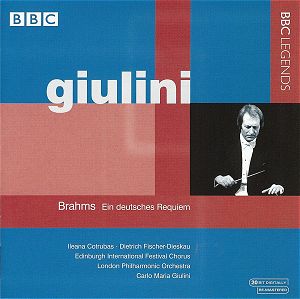

 Ileana Cotrubas
(soprano); Dietrich Fischer-Dieskau (baritone)
Ileana Cotrubas
(soprano); Dietrich Fischer-Dieskau (baritone) 
