Véronique Gens started out as a baroque specialist during the
second half of the 1980s, working especially with William Christie
and his Les Arts Florissants. She soon widened her scope and has
been particularly successful as a Mozart singer. Among other things
she was a superb Donna Elvira in the Aix-en-Provence production
of Don Giovanni about a decade ago. She is also much in
demand as an interpreter of French songs and her Naxos recordings
of Canteloube’s Chants d’Auvergne have been highly praised.
The present disc
is a sequel to Trágediennes, issued in 2006, which
basically covers the same period and some of the same composers.
Rameau and Gluck are represented there too but also Lully,
Royer, Leclair, Mondonville and Campra. With this second issue
she also moves into the 19th century (Arriaga and
Berlioz) – and with equal success. The musical quality is
high, also in the arias by lesser-known composers like Piccinni
and Sacchini. I enthusiastically reviewed Naxos’s complete
recording of Sacchini’s Œdipe à Colone a couple of
years ago (see review),
even making it a Recording of the Month. I made the
comment that ‘for my money this is an opera to set beside
Gluck, Haydn and Mozart as a superb example of late 18th
century music theatre’. This verdict could apply to all the
music here.
The Alceste
aria, for example, is among the finest operatic numbers from
the 18th century – and in saying this I take the
works of Handel and Mozart fully into account. Cherubini is
another master, who still hovers somewhere in the outskirts
of the general listeners’ knowledge. Médée is without
doubt musically on a par with Gluck, Handel and Mozart even
though the dramatic pulse sometimes slackens and the drama
becomes more oratorio-like. In Néris’s aria from act II there
is a lot of repetition of text that can become tiring, but
in a lived-in reading, like the one here, it feels psychologically
convincing. Arriaga, ‘the Spanish Mozart’ who died before
he was twenty, is another remarkable composer. His three string
quartets and single symphony are played not infrequently,
the aria from the cantata Herminie shows him to have
been more than an embryonic opera composer.
Concerning Sacchini
the arias from Dardanus and Renaud only confirm
that Œdipe à Colone was far from a one-off – he stands
out as one of the great non-persons among 18th
century opera composers. Piccinni is a name that appears frequently
in the opera history books as one of the most popular Italian
composers between Pergolesi and Cimarosa and Grétry. He wrote
about fifty operas and was no doubt the leading composer of
opéra comique during the latter half of the 18th
century. Both of them have occasionally been recorded, at
least the odd aria. Sutherland recorded an aria from La
buona figliuola miratata and Christiane Eda-Pierre made
a whole LP some thirty years ago with arias by Grétry and
Philidor. Tragédiennes 2 is definitely an utterly invaluable
disc in putting some of these composers firmly on the musical
map.
It would be of
only passing interest, were the performances run-of-the-mill.
But they aren’t! I would on the contrary go as far as to say
that this is one of the most satisfying vocal discs, in all
categories, for a long, long time. Véronique Gens seems never
to have put a foot wrong these days. This doesn’t in any way
mean that she is cautious or playing safe. Quite the contrary.
She immerses herself in the predicaments and feelings of the
different characters with the intensity and bravery of a performance
artist. She milks the music and texts of their inherent dramatic
and expressive potential using the skills and insight of a
great improviser –John Coltrane or Charlie Parker. In the
midst of this spontaneity she is in full control of her interpretative
means. What finally makes the disc so utterly compelling is
the singing as singing: the musical phrasing, the purity of
tone and the intrinsic beauty of the voice.
It comes as something
of a surprise to find that she concludes the recital with
Cassandra’s great aria from the first act of Les Troyens.
She has sung, and recorded, the song-cycle Les nuits d’été,
and very successfully at that, but the role of Cassandra literally
cries out for a high-dramatic voice, an Isolde or Brünnhilde.
Véronique Gens shows that intensity is not only a matter of
volume, it is an inner quality, manifest through conviction
and projection. Berit Lindholm on Colin Davis’s legendary
Philips recording and Deborah Voigt on Charles Dutoit’s comparable
later Decca set - both have magnificent grand voices but Véronique
Gens brings out the message of the text with even more conviction.
Add to this the
playing of Les Talens Lyriques, which is absolutely superb.
Here is an orchestra playing on period instrument with not
a trace of hesitant intonation, scrawny tone or sprawling
ensemble that characterises lesser groups in the period performance
stakes. Rhythms are springy and the full-bodied sound accords
their readings a punch that is quite amazing – and this doesn’t
exclude lightness and sensibility. If in doubt about their
greatness, do listen to the two orchestral excerpts from Orphée
et Eurydice: the transparency and elegance of the well-known
Ballet des ombres heureuses (Dance of the Blessed Spirits)
followed by the dramatic and almost orgiastic Air de Furies
(Dance of the Furies) played with tremendous rhythmic drive.
These and the other purely orchestral pieces are in this recital
no mere resting points but contribute to keeping the temperature
near boiling-point. Even the slow Sarabande and the
two Menuets from Les Paladins, normally rather
vapid decorations, are invested with life through subtle ebb
and flow.
The recorded sound
is fully worthy of the performances and there are excellent
notes in three languages by Jean Duron. Unfortunately the
track-list in the booklet has become cryptic through some
technical mishap, where the titles of the works have been
replaced by sundry symbols – but the back-cover of the jewel-box
is correct.
I don’t expect
to review many – if any – better discs this year and I can
promise that it will be one of my selected Recordings of
the Year in December.
Göran Forsling
























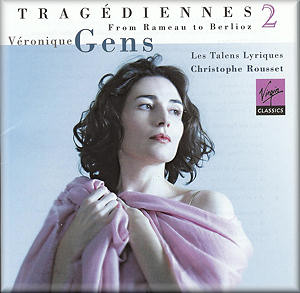

 Véronique
Gens (soprano), Les Talens Lyriques/Christophe Rousset
Véronique
Gens (soprano), Les Talens Lyriques/Christophe Rousset 
