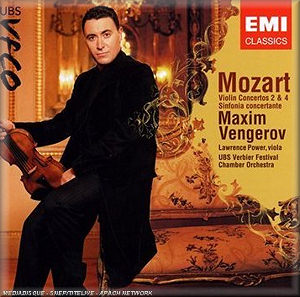
Back when the CD catalogue endlessly duplicated the standard repertoire,
the common complaint about modern ‘cookie-cutter’ performances
was probably justified. On the other hand, there's a fine line
between being distinctive and being "different," in
a distracting way - if you're noticing what's "different,"
you're no longer focused on the music - and Maxim Vengerov
doesn't always avoid crossing it in this program.
The booklet note - not quoting the soloist directly, but strongly suggesting
that this is his view - notes that, in Mozart's time, "an
increase in the number and variety of orchestral instruments
deployed had begun to inspire a wider dynamic range and a new
tendency towards expressive crescendos and diminuendos."
Well, maybe - certainly that view will serve as a useful corrective
to early-music mavens who impose a limited dynamic and expressive
scheme on this music. But I don't hear anything unusually loud
or soft here - just a tendency towards pumped-up accents, as
early as the third chord of the Sinfonia concertante.
They're not aggressive or unmusical - indeed, their cushioned
buoyancy could serve as a model for how to integrate accents
within the phrase, and not just in this repertoire. But they
do sound overdone - out of scale with everything else, to no
immediately clear structural or expressive purpose.
At the opposite end of the spectrum, the strings favor soft-edged,
restrained attacks - playing that is piano in style,
not just in sheer decibels. But the effect tends to be mushy
in lyrical passages, finicky and under-projected in the more
articulated ones. If you like this sort of orchestral playing,
you'd do better to hunt down David Oistrakh's old EMI accounts:
he leads the Berlin Philharmonic, a more polished ensemble than
the ad hoc Verbier group, and one which, grâce à Karajan,
took more naturally to such a style.
The Sinfonia concertante, which ought to be magical, particularly
suffers from all this musical bobbing and weaving. The fourteen-minutes-and-change
of the opening Allegro maestoso seems endless, because
there's not enough of a through line; the Andante simply
elapses. Only the Presto finale comes to life, exploiting
the timbral differences between Vengerov's full-bodied, silky
playing and Lawrence Power's darker, grainier tone. The horns
are unduly reticent throughout the piece. The Fourth Concerto
is a bit better than this - its central Andante cantabile
is graceful, if not quite elegant - but here it's the oboes'
turn to be bashful.
Only the Second Concerto - recorded first, perhaps before the concern
with details got out of control - comes off as one might have
hoped. I'd still prefer crisper attacks in the outer movements,
but at least the phrasing, stripped of dynamic chicanery, sounds
natural and musical; the Andante sings with real poise.
Here and there, Vengerov's tone on the G string seems rather
outsized, à la Perlman, but he plays handsomely and phrases
impeccably.
Recommendations are difficult in the solo concertos - the cultivated
Grumiaux accounts (Philips), remain a safe and satisfying choice,
although the recorded sound has aged noticeably. In the Sinfonia
concertante, the father-son duo of David and Igor Oistrakh
(Decca) offers a top-notch rendition, though it might be hard
to find on CD - I have a "super-LP" issue.
Stephen
Francis Vasta