Editorial Board
MusicWeb International
Founding Editor Rob Barnett Editor in Chief
John Quinn Contributing Editor Ralph Moore Webmaster
David Barker Postmaster
Jonathan Woolf MusicWeb Founder Len Mullenger
Sergei
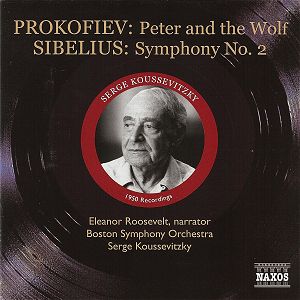
PROKOFIEV (1891-1953) Peter and the Wolf, op.67 (1936) [25:27] Jean SIBELIUS (1865-1957)
Symphony No. 2 in D major, op.43 (1902) [41:30] Edvard GRIEG (1843-1907) The Last Spring (Elegiac Melody, op.34,
no.2) (1881) [5:44] Eleanor
Roosevelt (narrator) (Prokofiev)
Boston Symphony Orchestra/Serge Koussevitzky
rec. Theatre-Concert Hall, Tanglewood (Prokofiev) and
Symphony Hall, Boston (Sibelius and Grieg); 11 August
1950 (Prokofiev), 29 November 1950 (Sibelius and Grieg) NAXOS HISTORICAL
8.111290 [72:42]
In the midst of the economic depression
of the 1930s US President Franklin Delano Roosevelt (1882-1945)
was famous for broadcasting comforting “fireside chats” to
a worried nation. But, on the basis of this recording,
it is fair to say that his widow Eleanor was probably
quite incapable of anything resembling a “fireside chat”. Instead
she addresses the “dear children” listening to Prokofiev’s
piece as if they are a rather hard of hearing audience
at a public meeting.
As one brought up on the somewhat similar
presentational style of the BBC Home Service’s Listen
with Mother (“Are you sitting comfortably? Then I’ll
begin…”), I have to say that Mrs Roosevelt’s delivery
didn’t worry me too much at all. But it’s something
that would probably sound very odd indeed to today’s
touchy-feely younger generation.
Even then, though, it need not have been
done that dry way, as demonstrated by an even older recording
from 1941 with Basil Rathbone narrating and Leopold Stokowski
conducting the All-American Orchestra (on Avid AMSC 601). Rathbone’s
delivery is both dramatic and sensitive to the meaning
of the words, as well as delivered with the benefit of
an actor’s professional training. As such, it has not
dated nearly as much as the recording under consideration
here and it engages the listener far more effectively. I
can only presume that Mrs Roosevelt was chosen to narrate
- or, in this instance, declaim! - Prokofiev’s tale not
for her presentational skills but rather because of her
celebrity as the country’s previous First Lady. Probable
confirmation of that hypothesis is the fact that RCA
chose not to release her recording outside the USA at
all.
Koussevitzky’s contribution is notably
weighty and authoritative, an impression reinforced by
the reverberant acoustic. Did he perhaps feel that Eleanor
Roosevelt’s status deserved nothing less than his Boston
Orchestra in its plushest mode? Certainly, Stokowski,
recorded in a dryer acoustic, is sharper and edgier – though
not necessarily preferable. There is, I think, easily
room for both approaches, even in such a superficially
straightforward piece as this.
Koussevitzky was one of Sibelius’s greatest
champions between the two world wars and his recording
of the second symphony will be, I suspect, of greatest
interest to most listeners. It was set down during the
76 year old maestro’s final recording session and, unlike
some conductors, Koussevitzky definitely stands down
on a high. It must have been very tempting to consider
utilising this great Romantic warhorse to go out with
a bang but, as Colin Anderson’s useful booklet notes
suggest, this is instead an expertly graded and controlled
performance that, while certainly exciting, holds in
check any inclination to play to the gallery. Long
admired as an interpreter of Sibelius’s later symphonies – his
live BBC Symphony Orchestra recording of the seventh
(on Naxos Historical 8.110168) is still very highly rated – Koussevitzky
demonstrates on this occasion an equal affinity with
the composer’s earlier sound-world with its strong flavour
of Tchaikovsky.
An earlier recording of the second symphony
from the same forces, made in 1935, is also available
as a Naxos Historical release (8.110170) but there is
little to choose between the two musical interpretations. Moreover,
given that the earlier recording was inexplicably made
using equipment that was actually obsolete at the time,
the far superior sound of the 1950 version is likely
to decide the issue for most listeners.
After setting down the Sibelius symphony
there was, it seems, time left for one more (short) recording – and
this time Koussevitzky did indulge himself. Appropriately
enough, he directs a rich, mellow and clearly valedictory
interpretation of Grieg’s Elegiac Melody no.2 it
pulls out all the emotional stops. With a timing of
5:54 it is, indeed, more than a full minute longer than
an earlier Koussevitzky recording from 1940 that had
clocked in at 4:42 (also to be found on Naxos Historical
8.110168). On this very special and no doubt highly
emotional occasion, the Boston Symphony’s famous strings – memorably
once described as “one of the hedonistic delights of
Western civilization” – play their considerable hearts
out for their departing maestro who was, sadly, to die
within less than a year.
Once again, Mark Obert-Thorn has made a
superb job of rehabilitating the sound from a wide variety
of sources - at this transitional period, many recordings
were being issued simultaneously on 78 rpm, LP and 45
rpm formats.
As I have already indicated, Colin Anderson’s
booklet notes are once again a wise guide to the music,
although his assertion that those final 1950 recordings
took place on 29 September conflicts with the 29 November
date given twice elsewhere in the documentation. He
is also a somewhat shaky guide to US politics, repeating
the schoolboy howler that Franklin Delano Roosevelt,
the country’s 32nd President, was the son of
26th President Theodore Roosevelt – whereas
he was actually no more than a fifth cousin. That slip
would certainly have earned a stern reproof from First
Lady Eleanor and ought to be corrected in any future
printings.
Rob Maynard
Please support our advertisers below by clicking on the logos for further information.
























 Eleanor
Roosevelt (narrator) (Prokofiev)
Eleanor
Roosevelt (narrator) (Prokofiev) 
