It goes without saying that anyone looking for recordings of Chopin’s
piano concertos is quite simply spoiled for choice.
In
preparation for this review, I looked on my own CD shelves to
remind myself of the pianists who, over the years, I thought
had something distinctive to say. They included Arthur Rubinstein
(recorded in 1931 and 1937), Krystian Zimerman (1979 and 1980),
the 12 years old (!) Evgeny Kissin (1984), Martino Tirimo (1984),
Idil Biret (1990) and Martha Argerich (1999). I also own a couple
of stand-alone accounts of the E minor concerto: Maurizio Pollini’s
1960 recording and Earl Wild’s from 1965.
So
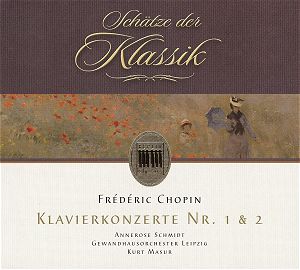
does the rather less well-known Annerose Schmidt’s disc deserve
a place on those rather well filled shelves? Let’s note first
of all that hers is a distinctively cooler than usual approach
- especially so in the first concerto – with performances characterised
by a slightly lighter touch on the keys and a reluctance to
linger unnecessarily over the notes. Schmidt’s comparatively
brisk - and very deft – finger-work thus does a great deal to
purge these warhorses of the anachronistic lush Romanticism
that many other pianists, understandably succumbing to Chopin’s
gorgeous melodies, have often applied in varying degrees to
the scores.
Take
the first concerto’s opening movement, for instance. Of the
accounts listed above, Biret and Tirimo are, at 21:24 and 21:13
respectively, the most long drawn out. Occupying the middle
ground are Zimerman (20:04), Wild (19:29), Argerich (19:03 –
a 1968 account with Abbado took 18:59) and Pollini (19:01).
At the front of the field by some way, only the very young Kissin,
at 18:22, comes in faster than Annerose Schmidt’s time of 18:35.
[Rubinstein’s 1937 account cannot be compared to the others
on timings because it suffered from cuts that were conventionally
applied to the score at that time.] That pattern is, in fact,
pretty consistent throughout Schmidt’s performances. In the
E minor’s second movement and the opening movement of the F
minor concerto, for example, only Kissin and Argerich’s 1999
versions are faster, and in the F minor’s finale it is only
Kissin’s.
That
“Chopin-lite” approach may not, of course, be to everyone’s
taste. Indeed, for many listeners those wonderful melodies just
call out for the application of maximum emotion with all the
stops fully pulled out. It’s the sort of music that you can
easily imagine listening to under the stars on a balmy California
summer’s evening at the Hollywood Bowl - a point well understood
in the movie capital itself where Chopin has unwittingly provided
a great deal of effective mood music over the years. Keep an
eye open on daytime TV for the 1940 swashbuckler The Son
of Monte Cristo, where the main musical theme is actually
one of the E minor concerto’s melodies.
One
is sometimes led to believe that Chopin’s rather conventional
and heavy orchestration do his two concertos little service.
But that is by no means always the case in performance where
many conductors, such as Paul Kletzki on the Pollini recording,
rise successfully to the challenge of making it sound more imaginative
and exciting than it appears on paper. Kurt Masur, who must
in his time have accompanied many soloists in these works, shows
particular sensitivity in adapting his style to fit in with
Annerose Schmidt’s conception. Thus the orchestra plays, at
times, with rather more delicacy and discretion than one is
sometimes accustomed to. That, in turn, allows several soloists
– the flautist in the E minor’s first movement, for example
- a little more space to make their contributions heard more
clearly. Both works are, by the way, well recorded in a comparatively
warm, natural and entirely appropriate acoustic.
The
disc comes in an attractively designed and sturdy cardboard/plastic
case that will take up less shelf room than a normal jewel case.
Unfortunately, there are no notes whatsoever on either the music
or the artists.
In
a very competitive market, this is not, it must be admitted,
a disc likely to supplant an existing favourite version. It
can, though, be commended in its own right as an interesting
and enjoyable account that offers a slightly different perspective
on these much-loved works.
By
the way, if you enjoy the Chopin concertos in their usually-heard
form with orchestral accompaniment, do remember the alternative
versions for piano and string quintet. According to a few of musicologists,
Chopin himself regarded them not just as second-rate substitutes
but as compositions of equal validity in their own right. Although
not widely accepted, that theory has precipitated a couple of
discs that are well worth hearing, if only as a supplement to
Pollini, Argerich, Kissin or perhaps even Ms. Schmidt. Pianist
Fumiko Shiraga, with the Yggdrasil Quartet and Jan-Inge Haukås
(double bass) made the world premiere recordings of both concertos
in that form in 1996 (on the BIS label, BIS-CD-847) while, two
years later, Jean-Marc Luisada recorded just the E minor no.1
with the Talich Quartet and Benjamin Berlioz (RCA Red Seal 74321
632112). Taking up yet more space on my crowded Chopin shelf,
the BIS version is, in particular, a real eye-opener.
Rob Maynard